 The Mid-Career Digital Shift
Mid-Career Futures
AI Adoption Starts With Quieting the Inner Critic
Read original on LinkedIn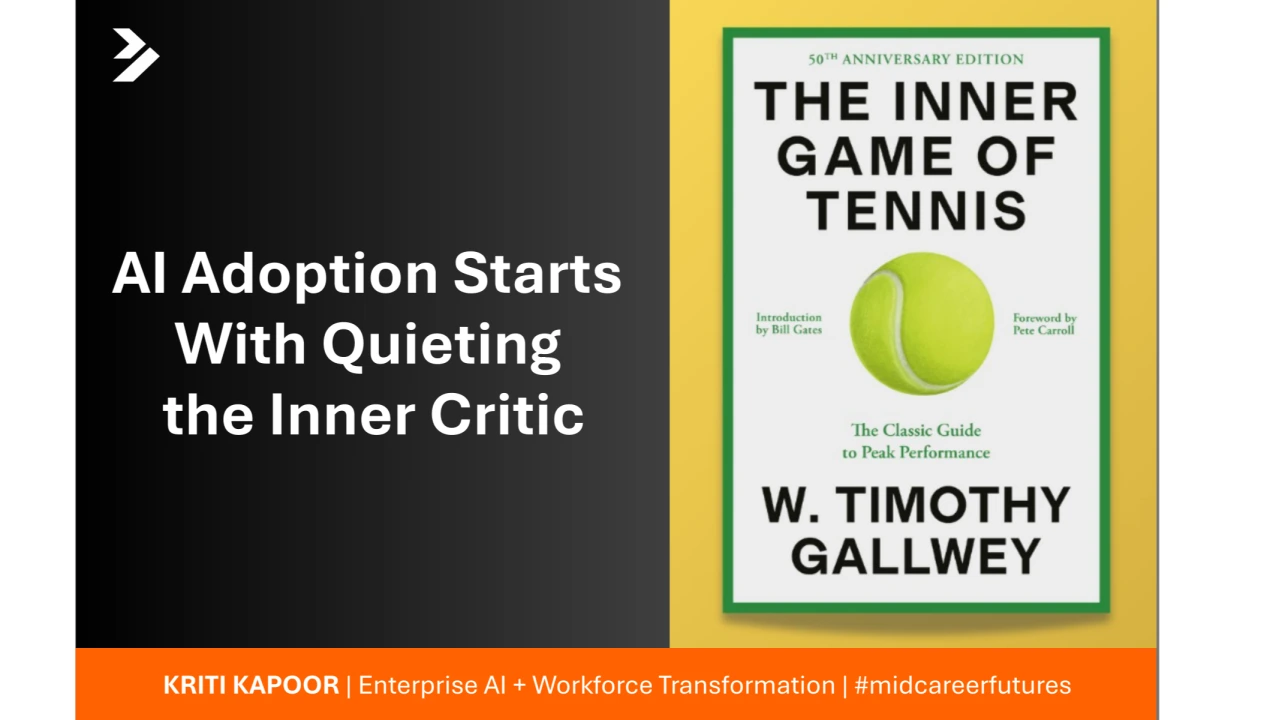
The Skills Gap Is Real. But It Goes Beyond the One Everyone is Measuring.
Every major report says the same thing. The WEF. McKinsey. LinkedIn. BCG. The barrier to AI transformation is a skills gap. Reskill or fall behind.
They're not wrong. But they're measuring a different gap.
You know you should be further along with AI.
You've read the articles. Sat through the workshops. Maybe even downloaded the tool. But when it comes to using it for something that actually matters — a real decision, a real deliverable, a real conversation with your team — something stops you.
It isn't the technology. You've learned harder things than this.
The deeper constraint is something none of those reports have a framework for. It isn't what you don't know. It's what you won't let yourself do with what you already know.
I had a conversation last year with a VP at a regional bank — twenty-two years in financial services, led through two digital transformations, the person her CEO called when implementation hit a wall. She told me: "I feel like I'm watching everyone else board a plane and I'm still reading the boarding instructions."
She didn't lack capability. She lacked permission — to not know, to experiment, to be seen learning something from scratch after two decades of being the one with answers.
I've had versions of that conversation hundreds of times. And every time, the obstacle isn't skill. It's something quieter and harder to name.
I know this because I felt it myself. On November 30, 2022 — the day ChatGPT launched — I was leading HP's Global Digital Practices team. My job, literally, was to help people work differently with digital tools.
And when I opened ChatGPT for the first time, my first thought wasn't curiosity. It was: I need to understand this properly before I say anything about it. The perfectionism hold. In the person whose job was digital transformation.
The Critic doesn't care about your job title.
The Inner Game equation explains what's going on
In 1974, Timothy Gallwey captured it precisely, in his book The Inner Game of Tennis:
Performance = Potential minus Interference
Gallwey noticed that the players who struggled weren't lacking ability. They were generating interference — a constant internal commentary that disrupted everything their body already knew how to do.
More instruction made it worse, not better. The problem wasn't the gap in skill. It was the noise drowning the skill they had.
The same equation might be running your career right now.
The two voices you're probably navigating
You already know this voice. It shows up in specific moments, with specific lines:
The 25-year-olds picked this up faster. I'll start properly when I have more time to understand it. This isn't really my area — it belongs with the tech team. I should have started two years ago.
Gallwey called this the Critic. The narrator. The system that monitors, judges, and intervenes — usually at exactly the wrong moment.
Against it sits the Performer: the part of you that actually performs. The pattern-recognizer built through decades of hard decisions, difficult conversations, and systems you had to figure out as you went. The system that learned every hard thing you've ever learned — not through perfection, but through movement and adjustment.
The Performer doesn't need more information. It needs the Critic to get out of the way.
Here is the thing tha few people say clearly enough: the professionals who are winning the AI transition aren't the ones who know the most. They're the ones whose Critic is quietest.
Why the Critic gets louder with seniority
Early in a career, not knowing things is expected. Uncertainty is structurally permitted. But at Director, VP, or Senior Manager level, not knowing something carries different weight. There is an identity built around being the person with answers. A reputation constructed over twenty-plus years. A team watching.
When AI arrives and the learning curve is real, the stakes of being seen as a beginner feel existential in a way they simply didn't at 28. The Critic gets louder precisely because there is more to protect.
That's the paradox that rarely gets talks about. The more you've built, the more the Critic has to work with.
This is why mid-career professionals are underrepresented in AI adoption data. Not because they are less capable, but because the identity investment is larger. The gap between who you have been and who you are being asked to become — beginner, experimenter, not-yet-knowing — feels wider when you have spent twenty years earning the right to be the expert.
The discomfort is real. But discomfort of not-yet-knowing is not evidence of inadequacy. It is evidence of learning. The pattern recognition and judgment that took decades to build will make you faster at this than you think. They just need permission to operate without the Critic calling it a demotion.
The four signals creating interference
Each pattern has a personal cost. And because you lead people, each one has a ripple you may not be seeing.
BCG's research across 10,600+ employees found that only 1 in 4 frontline workers receive strong leadership support for AI adoption. Three out of four are looking to someone at your level for a signal about whether this is real, whether it's safe to try. The signal they're getting, in most organizations, is the Critic running the room without anyone naming it.
- The comparison loop. Younger colleagues picked this up faster. I should be further along. Comparing your week three to someone else's year two is the Critic generating evidence for a conclusion it already reached. What your team sees: a leader whose body language says AI is for others, not for people like us.
- The perfectionism hold. I'll start when I understand it properly. Nobody understands it properly — including the people building it. What your team sees: hesitation at the top. Permission to wait.
- The identity protect. This isn't really my area. After twenty years of expertise, being a beginner feels like a demotion. So the new skill gets reclassified as someone else's domain. What your team sees: AI handed to a task force. The signal that leadership isn't in this.
- The retrospective regret. I should have started two years ago. Two years ago is gone. What your team sees: a senior leader stuck in self-recrimination instead of the visible experimentation that would give them permission to begin.
Three Moves That Actually Work
Gallwey's key finding was this: people improved fastest not when they received better instructions, but when they stopped instructing themselves.
The Performer is faster and more capable than the Critic. It just needs breathing room.
Most AI skill acquisition happens through doing and peer conversation, not formal training (McKinsey, 2025). Yet most organizations measure learning by completion rates on programs that drive less than 10% of actual capability change. We are loading up the Critic while the Performer waits.
Swap the judgment for a question. The Critic delivers verdicts: I'm behind. I'm not technical enough. It's too late. Verdicts close doors. Questions open them: I haven't built a consistent practice yet. What would 20 minutes with a real work problem look like? The shift feels small. The effect is not.
Move before you're ready. Open the tool. Use it on something that actually matters to you this week — a document, a decision, a problem you've been circling. Don't take a course about it first. Experimentation is how the Performer learns. Preparation is how the Critic stays in charge.
Name what you already bring. You know which organizational resistance is political and which is structural. You can read a room when a new system threatens someone's identity. You have watched transformations fail and know exactly where and why. That isn't background context. It is the rarest capability in any AI transformation. The question is whether you've given yourself permission to lead with it.
I spent months treating AI as someone else's expertise — until I realized I was doing exactly what I'd spent years helping others stop doing. Waiting to belong in the room instead of walking into it. The moment I started bringing my own experience into the AI conversation instead of leaving it at the door, everything shifted. Not because I suddenly knew more. Because I stopped pretending I knew less.
The Skills Gap That Needs Closing
63% of employers cite skills gaps as the primary barrier to transformation (WEF, 2025). In my experience, those gaps are rarely technical. They are the ability to lead through ambiguity, redesign how work actually gets done, and give people around you enough safety to try something new.
You have been building those capabilities for decades.
Performance = Potential − Interference.
For most mid-career professionals I work with, potential is not the constraint.
So this week, try three things.
- Name the interference pattern you recognized most in this article.
- Do one thing with AI on a real work problem — before you feel ready.
- And do it where someone on your team can see you.
The Critic has had enough airtime. Now, it's the Performer's turn.
Which pattern do you recognize most right now?
Comment below or DM me directly, I'd love to hear from you.

Kriti Kapoor
Digital Innovation & Workforce Transformation
Author, The Mid-Career Digital Shift