 The Mid-Career Digital Shift
Mid-Career Futures
From Risk to Relevance: Navigating your career in a VUCA world
Read original on LinkedIn
https://www.kritikapoor.ai/digital-shift | #midcareerfutures
Two significant business transformations are colliding as we speak, and most experienced professionals are standing right at the intersection.
The first is digital transformation, the long migration of value from physical scale to systems that learn. The second is workforce transformation, the slower and harder shift in what people must know to stay valuable. AI is pouring fuel on both. What once took a generation now takes a quarter.
This is the ground I set out in the opening chapter of The Mid-Career Digital Shift: the global economy, the digital economy, and the shrinking longevity of companies and whole industries. The figures frame the stakes. The digital economy is on track to reach $16.5 trillion by 2028, roughly 17% of global GDP, growing close to three times faster than the wider economy. Five technology companies now carry a combined market value of $19.7 trillion, larger than any national economy except two. More than a billion people reach for an AI tool every month. ChatGPT found 100 million users in 60 days. The telephone took 75 years.
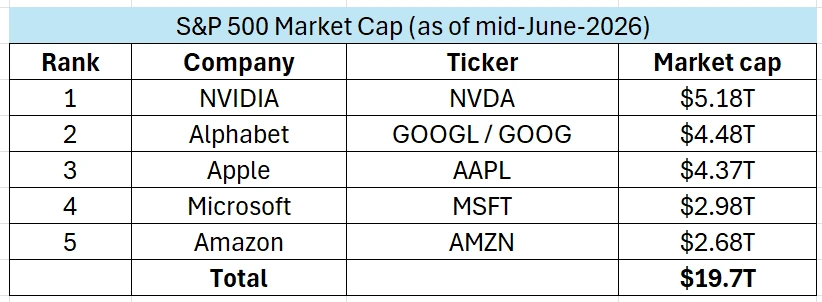
Source: https://companiesmarketcap.com/ and https://www.financecharts.com/screener/biggest
Here is the figure that should hold your attention. In 1965, a company stayed on the S&P 500 for 33 years on average. Today it is under 20. Industries compress. Companies live shorter lives. And when the lifespan of a company can halve in a generation, the shelf life of any single set of skills can halve with it.
Career theorist A. G. Watts had a word for this. He called it a careerquake. The ground shifts faster than people can adapt, and the old map of how careers progress stops matching the terrain. We are all standing on that ground now. The rules at work changed. Quietly.
A careerquake does not announce itself. It arrives as a quiet repricing of what you already know. For experienced professionals, that repricing carries a specific kind of risk:
- experience the market no longer reads clearly
- being seen as expensive rather than strategic
- knowing a lot, yet not fluent in the new language of work
- waiting too long to reposition
Your ability stays constant through all of it. What changes is how the market prices that ability. So the question that matters at mid-career quietly changed too. From "how do keep up?" to "how do I move from risk to relevance?"
Four shifts. One purpose: navigate career risk → professional relevance.
Here is a mental model that will help, one that many of us are familiar with, VUCA.
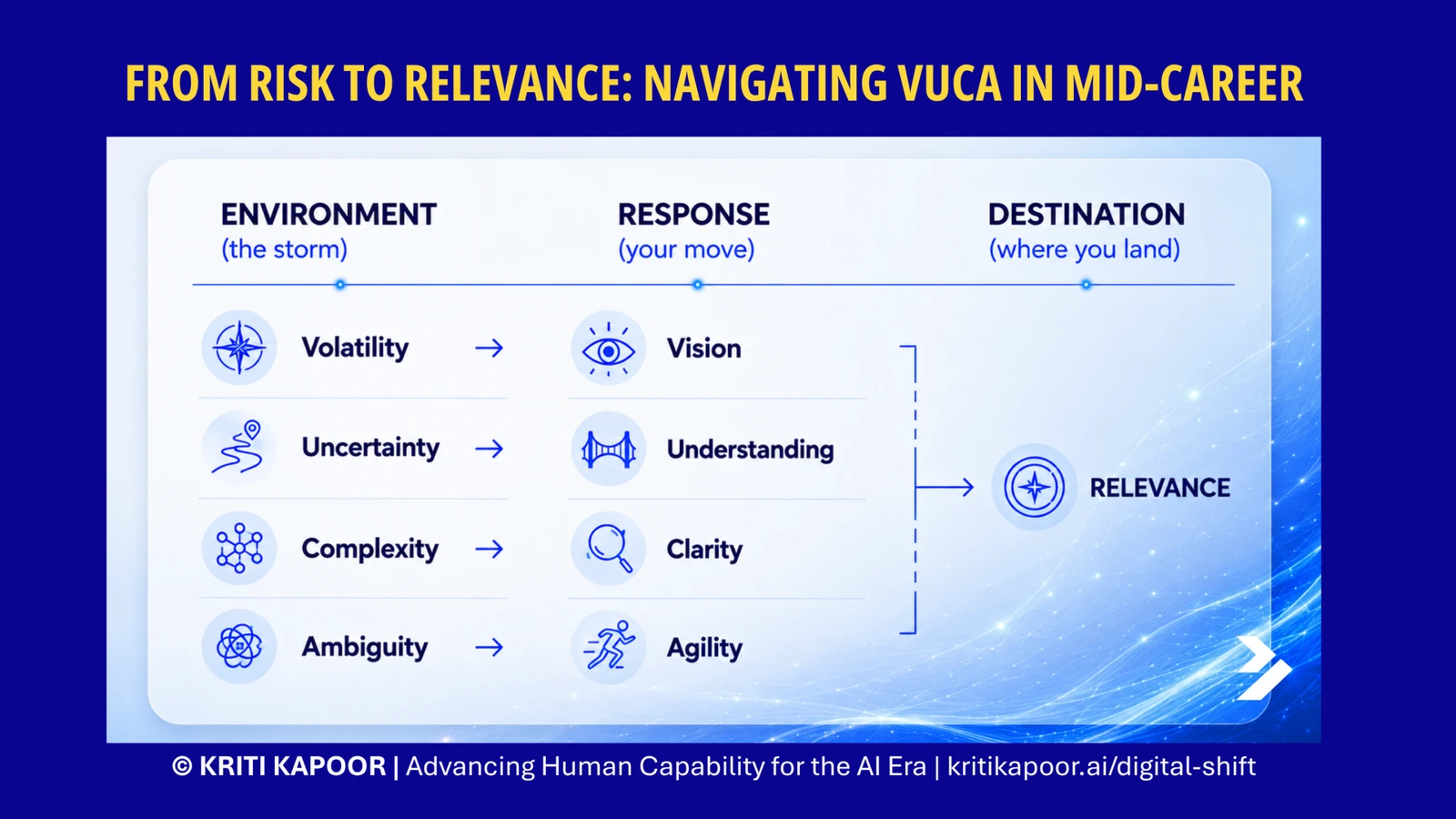
Think of VUCA as weather. Volatility, uncertainty, complexity, and ambiguity are the conditions you sail through. You cannot calm the sea. You can learn to read it. Each condition, left unanswered, pulls you toward risk. Answered with intent, each one carries you toward relevance.
Volatility → Vision
Volatility is the wind. It blows hard and from every direction, and it rewards motion that merely looks like progress. Drift is the risk, and in a fast market drift reads as decline. The professionals who hold their value in a storm are the ones who chose their course before the wind chose it for them. Nearly 40% of today's core job skills will change within five years. You cannot learn all of it. You can decide which version of your expertise is worth building toward.
Your Next Move: Name it this week. Pick the one capability you want to be known for in eighteen months. Write it down. Let it decide what you say yes to.
Uncertainty → Understanding
Uncertainty is the fog. Seniority hides a quiet trap inside it: the market assumes you are fluent in the new tools because you are experienced, when the exposure may never have been there. That assumption is the risk. Understanding is the discipline of mapping the water you are actually in, rather than the water you remember. What has shifted in your role, your industry, the way decisions get made? Where has AI already changed the work around you?
Your Next Move: List three ways AI has reshaped work in your function. A thin list simply shows you where to begin.
Complexity → Clarity
Complexity is the crosscurrent. It tempts you to pull in every direction at once, and busy-but-invisible is the risk that follows. The professionals who advance do less, with sharper intent. Clarity is subtraction. You do not need to master every tool. You need one clear win that builds credibility and momentum, applied to real work, visible to the people who matter.
Your Next Move: Choose the single capability that would most change how your team works. Start there. Let the rest wait.
Ambiguity → Agility
Ambiguity is the shifting horizon, the day with no fixed landmark. Waiting for certainty is the most expensive habit in a fast market, because reposition too late and the window has already closed. Agility is learning while the picture is still forming. Seventy percent fluency that ships a result in thirty days beats perfect fluency that arrives too late. Progress over perfection, every time.
Your Next Move: Take one task this week, improve it with one tool, measure what changed, and tell someone.
The harbour: relevance
Put the four shifts together and they point one way. They carry you from risk to relevance.
The evidence sits with the experienced professional here. McKinsey finds that more than 70% of the skills used in today's jobs appear in both automatable and non-automatable work, and the interpersonal capabilities you have spent decades building carry the lowest automation exposure. Here, experience counts for more. A careerquake leaves your expertise intact. It only tests whether you can translate it into new value.
That translation is the whole game. Organisations with strong translators between business and technology achieve roughly seven times higher transformation success and nearly twice the earnings growth. That translator is you. This is the move from risk to relevance: experience the market can read clearly again.
Relevance is the harbour you steer toward. The weather never stops. Your reading of it gets better.
The navigation system
I wrote The Mid-Career Digital Shift to turn that navigation into something you can repeat, not just admire. It runs on two frameworks that work together.
The ADAPT Method is the rhythm. Five steps, run in roughly thirty-day cycles: Acknowledge where you are, Determine your one priority, Activate new capability inside your real workload, Partner with AI to scale it, and Translate the result into visibility. Acknowledge and Determine are your Understanding and Clarity shifts in motion. Activate and Partner are Agility in practice. Translate is how relevance becomes visible, because work nobody sees rarely advances a career.
The Digital Practices Framework is the map. It names which capabilities to build across three dimensions: Navigate (strategic intelligence and foresight, your Vision shift), Operate (execution excellence), and Lead (adaptive influence). Nine practices, each one building on strengths you already hold.
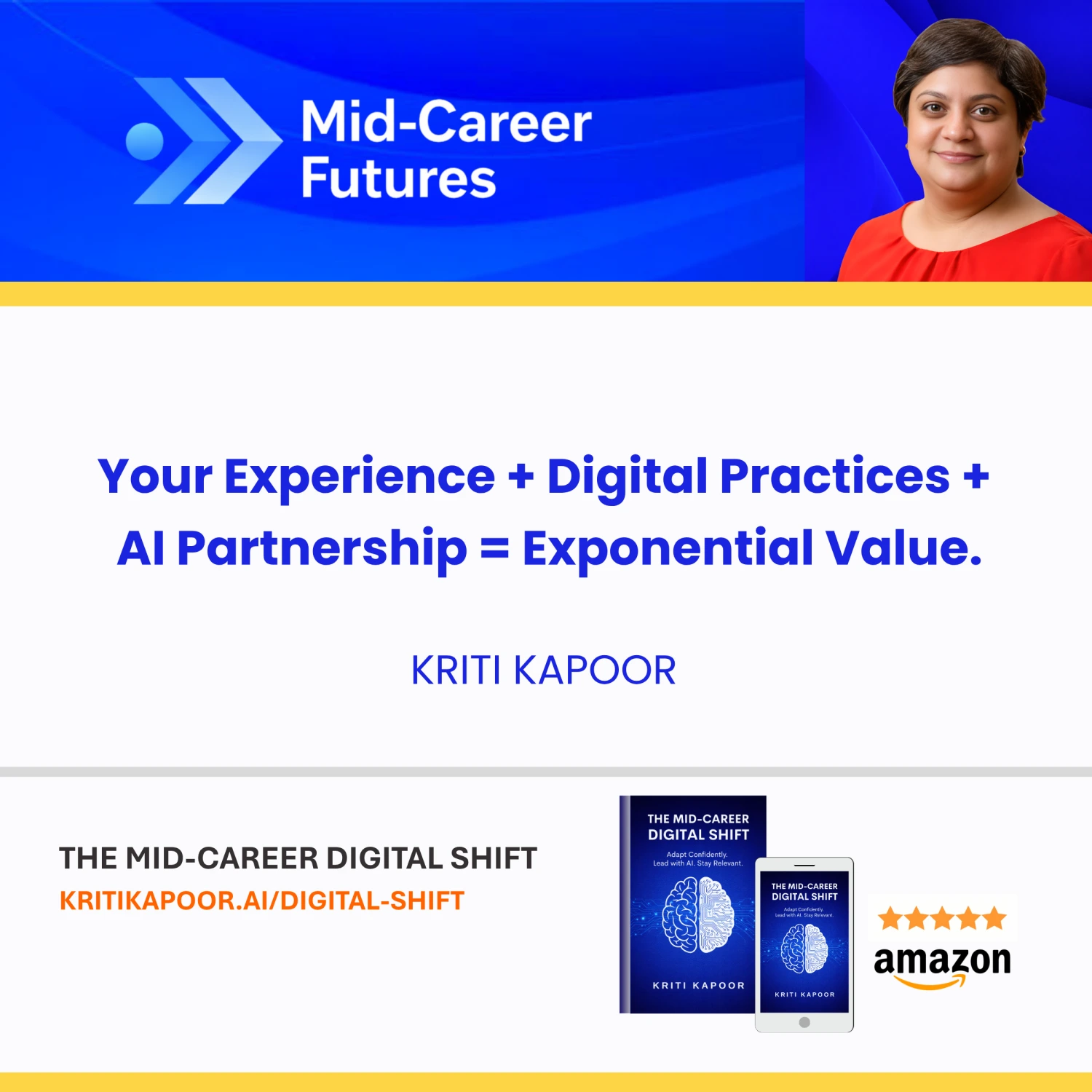
Together they hold to a single formula the book returns to throughout:
https://www.kritikapoor.ai/digital-shift
Start with one thirty-day cycle. Build one capability. Measure one outcome. Then decide whether you are ready to build momentum that compounds.
You are not behind. The rules changed quietly and quickly. Now you hold the compass, and the four shifts that turn career risk into professional relevance.
Kriti Kapoor
Digital Innovation & Workforce Transformation
Author, The Mid-Career Digital Shift