
Adaptive Intelligence
Human-AI Agency: A Defining Capability for Creating Lasting Value in the AI Era
Read original on LinkedIn
November 2026
Singapore's workforce research reinforces the case for combining domain expertise, digital fluency and human-AI partnership to create lasting value.
On 30 November 2022, I was leading HP's Digital Practices team and building the case for scaling citizen-led development when I received a simple message on my phone: “Try ChatGPT.”
It marked a fundamental shift in how knowledge work could be performed, how professionals could create value, and how enterprises would need to develop their workforce.
For well over three years, I have been exploring the implications of this shift. It was this exploration, combined with decades of enterprise transformation experience, that led me to write The Mid-Career Digital Shift: Adapt Confidently. Lead with AI. Stay Relevant, published earlier this year.
Reading Singapore's Skills & Workforce Development Agency (SWDA) report, Human Capabilities in the Age of AI, I was particularly encouraged by the convergence of its findings with the principles and practical frameworks covered in the book.
The research provides a Singapore-specific evidence base for an increasingly important conversation: How do we advance human capability as AI capability accelerates?
1. AI capability is becoming a mainstream professional requirement
SWDA's analysis of more than 300,000 job postings annually, covering over 1,600 job roles in Singapore, reveals several important shifts:
Approximately three in five job roles show demand for AI skills.
More than 90% of job roles mention AI-related applications and tools.
60% of job postings mentioning AI skills are for non-technology roles.
Explicit demand for AI skills is higher among middle and senior roles than junior roles.
Education leads sector-level demand for AI skills, ahead of Infocomm Technology and Electronics.
The research also points towards a growing emphasis on responsible AI adoption. Job postings mentioning ethical and responsible generative AI adoption increased 26-fold between 2022 and 2025.
AI capability is becoming relevant across professional disciplines, from finance and marketing to operations, education and workforce development.
This is precisely why I developed the Digital Practices Framework™ around broader digital business fluency. Professionals need to understand how technology connects with business strategy, customer needs, operational performance and organisational change.
Learning to use AI is one part of a much larger capability shift.
2. Experience provides a foundation for AI-enabled value creation
One of the most compelling findings in the report is how the dominant skill profiles of job roles evolve across career stages.
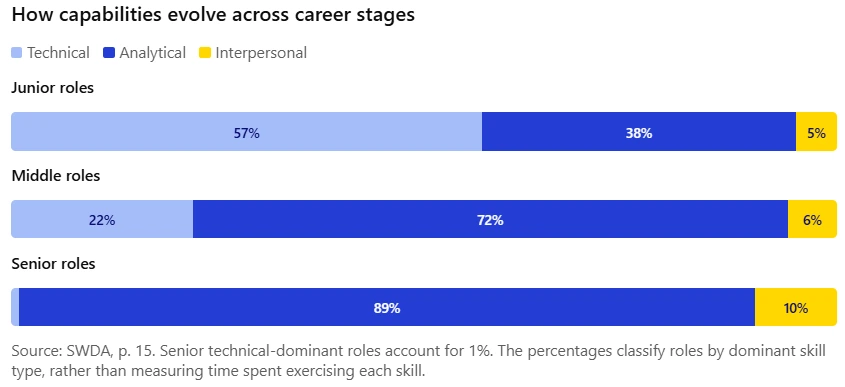
As professionals progress through their careers, greater emphasis is placed on interpretation, synthesis, judgement, decision-making and organisational influence.
These capabilities develop through years of navigating complexity, making decisions, solving problems and working with people.
They are also central to directing AI effectively.
In The Mid-Career Digital Shift, I describe this as the Experience Multiplier:
Your Experience + Digital Practices + AI Partnership = Exponential Value
Experienced professionals bring context, pattern recognition, institutional knowledge, relationships and judgement. When combined with contemporary digital capabilities, these strengths can become powerful sources of competitive advantage.
The opportunity for mid-career professionals is to translate their accumulated expertise into new forms of value.
3. We must protect the learning that happens through work
Perhaps one of the most consequential questions raised by the SWDA report is what happens to human capability development when AI takes over the tasks through which people traditionally learn.
A junior developer builds technical judgement by writing, testing and debugging code. A financial analyst develops commercial judgement by examining assumptions and constructing financial models. A marketing professional develops customer understanding through research, experimentation and feedback.
If AI increasingly performs these activities, how will the next generation develop the expertise needed to evaluate its outputs?
The report identifies two distinct learning patterns across career pathways:
Progressive mastery: Learning becomes steepest during the transition from middle to senior roles.
Front-loaded learning: The steepest learning occurs early in a professional's career, establishing the foundation for future progression.
Together, these patterns account for approximately 92% of the career pathways examined.
This has significant implications for workforce transformation. Organisations must redesign learning alongside the redesign of work.
We need to preserve opportunities for deliberate practice, critical thinking, experimentation, mentoring and reflection. Productivity gains from AI can create additional capacity for these activities, provided organisations make that an intentional choice.
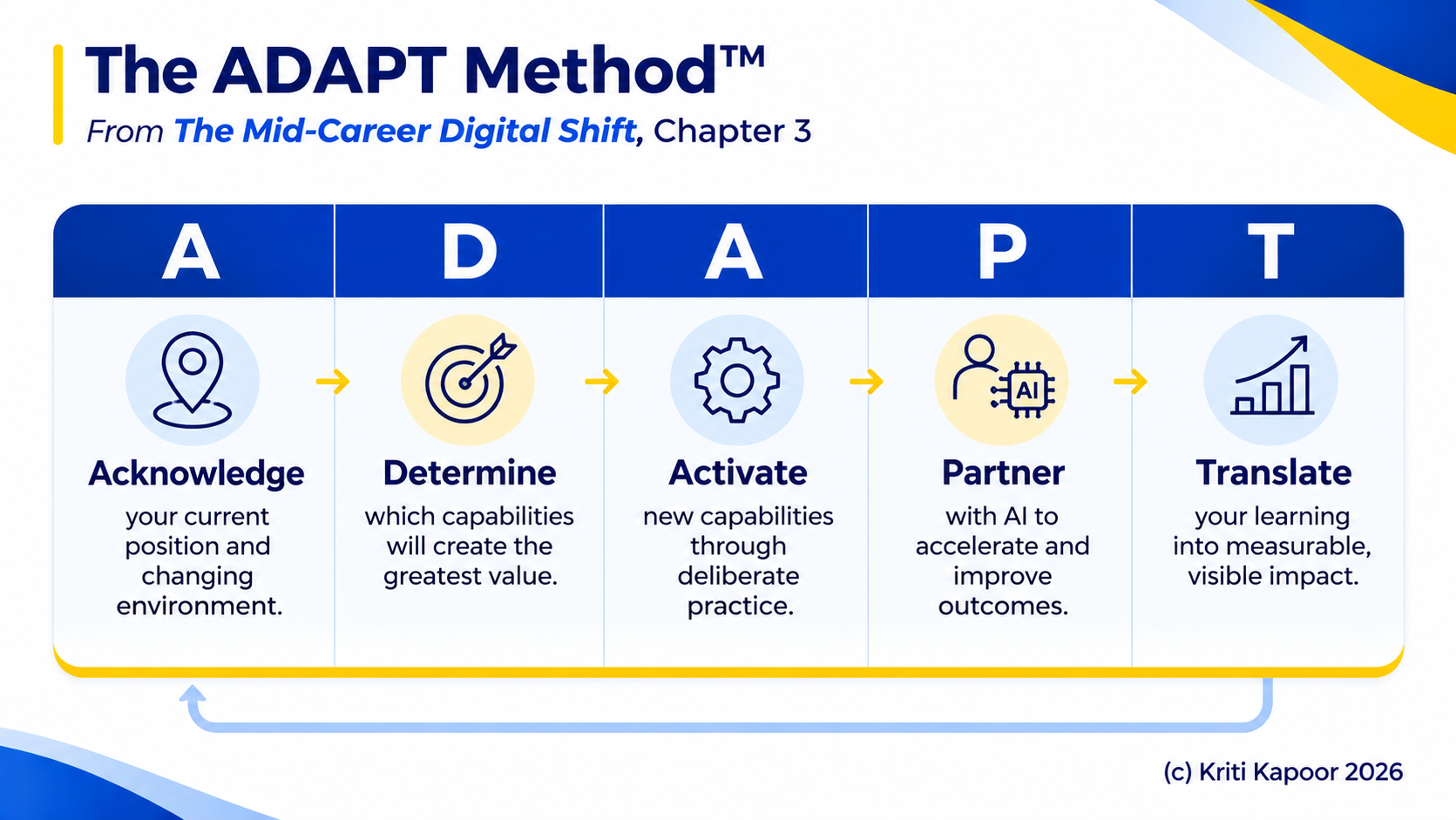
In my book, I introduce 30-day ADAPT cycles to help professionals build capability through continuous application and reflection. Learning becomes part of everyday work, rather than an occasional training intervention.
As we automate work, we must also redesign how humans develop mastery.
4. Human-AI Agency: A critical capability for the future of work
The most significant development in the report, in my view, is SWDA's proposal to introduce Human-AI Agency as Singapore's 17th Critical Core Skill.
Developed in collaboration with the Institute for Adult Learning, with inputs from the Ministry of Digital Development and Information, this proposed capability focuses on human judgement, autonomy and responsibility when working with AI.
It comprises three dimensions:
Direct AI: Define purposeful outcomes and determine where AI can contribute.
Reflect on AI-enabled work: Question assumptions, verify outputs and exercise judgement.
Shape AI practices: Work with others to develop effective and responsible ways of integrating AI into everyday work.
This resonates strongly with Chapter 8 of my book, Partner with AI to Multiply Your Impact, where I explore how professionals can move towards intentional human-AI collaboration.
The Work-to-Impact Journey introduced in that chapter examines how we redesign work, identify opportunities for AI augmentation, establish human oversight and connect these changes to measurable business outcomes.
As AI agents become increasingly capable of executing complex workflows, these capabilities will become even more consequential.
Professionals will need to determine what to delegate, what to retain, how to evaluate performance and where to intervene.
Human accountability remains central.
5. Moving from research insights to practical capability building
The SWDA report examines workforce capability through three complementary areas: AI skills, domain skills and Critical Core Skills.
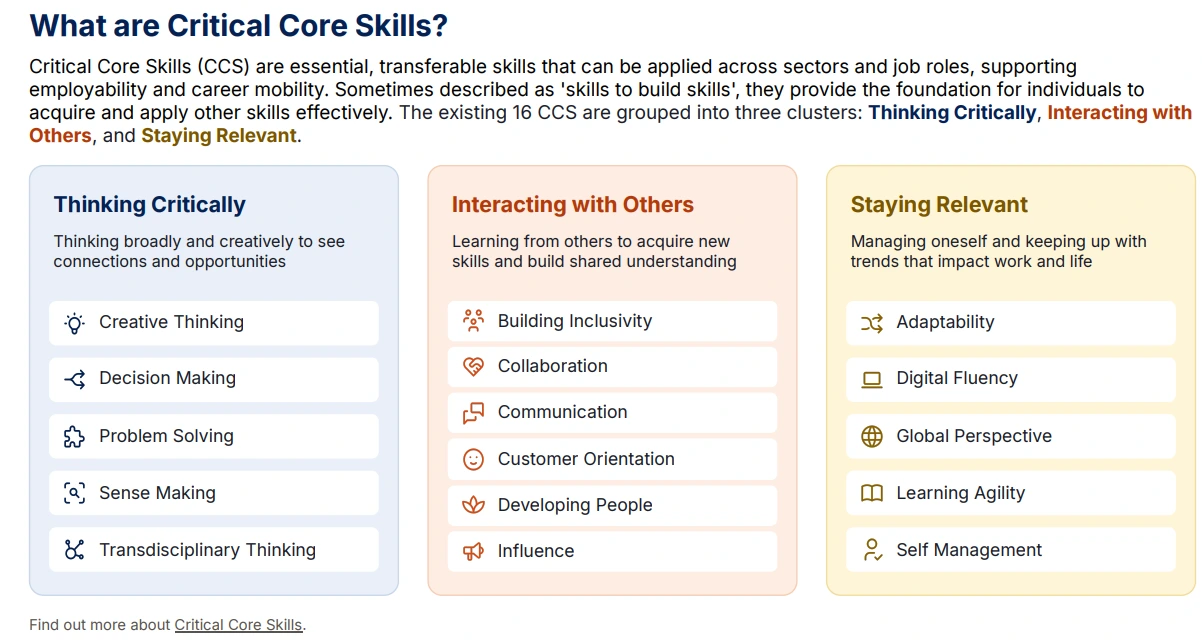
The Mid-Career Digital Shift complements this research with a practical approach to developing and applying capabilities across these areas. The Digital Practices Framework™ identifies nine practices across three dimensions of transformation:
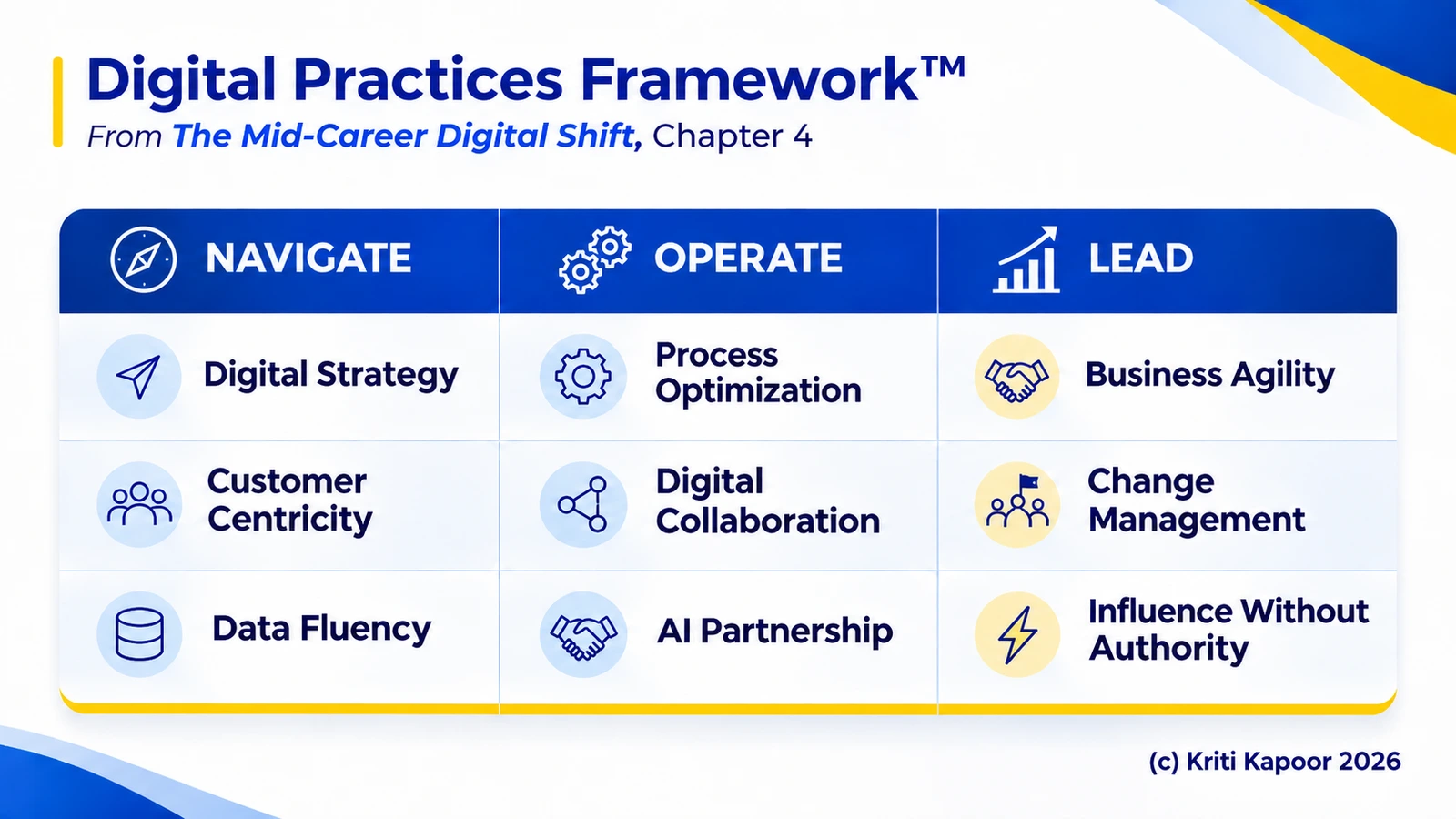
These practices connect strategic intelligence, execution excellence and adaptive leadership.
The ADAPT Method™ provides a repeatable rhythm for putting them into practice:
Together, these frameworks help professionals answer two practical questions:
What capabilities should I develop?
How do I develop them while continuing to deliver in my existing role?
That second question is particularly important for experienced professionals who are simultaneously delivering business outcomes, guiding others through transformation and navigating their own learning journeys.
6. The enterprise imperative: Turning workforce potential into AI value
During my time leading digital capability building at HP, our automation community grew from 250 to more than 5,000 practitioners.
One of my most enduring lessons from that experience was that technology adoption accelerates when people are equipped with the skills, confidence, shared practices and support systems to solve meaningful business problems.
The same principle applies to AI at an even greater scale.
Enterprise leaders now have an opportunity to rethink workforce development around five priorities:
Develop AI fluency within business functions and professional disciplines.
Protect and deepen domain expertise as tasks become automated.
Embed human judgement and accountability into AI-enabled workflows.
Create communities of practice that accelerate peer learning and knowledge sharing.
Measure capability development alongside productivity gains and business outcomes.
This requires a coordinated effort across business leadership, technology, HR, learning and development, and transformation functions.
Workforce capability must become an integral part of enterprise AI strategy.
The road ahead
Technology is advancing at machine speed. We are learning, adapting and reinventing ourselves at human speed. Bridging that gap is one of the most important workforce and leadership challenges of our time. - Kriti Kapoor
Singapore's research is a welcome contribution to this conversation, particularly its emphasis on domain expertise, career-stage learning and Human-AI Agency.
When I began exploring these questions more than three years ago, and subsequently published The Mid-Career Digital Shift several months ago, my purpose was to help experienced professionals navigate this transition with greater clarity, confidence and intention.
The convergence of these ideas with Singapore's workforce research reinforces my conviction that human capability deserves a more central place in the AI transformation agenda.
We have an opportunity to build a future of work where technology expands what people can achieve, experience continues to compound in value, and continuous learning becomes a shared responsibility.
The future of AI-enabled work depends on how deliberately we develop the people who will shape it.
Further reading
Human Capabilities in the Age of AI | Skills & Workforce Development Agency, Singapore, 2026.
The Mid-Career Digital Shift: Adapt Confidently. Lead with AI. Stay Relevant. | Kriti Kapoor, 2026. Learn more at https://kritikapoor.ai/digital-shift.

Kriti Kapoor
Digital Innovation & Workforce Transformation
Author, The Mid-Career Digital Shift