 The Mid-Career Digital Shift
Mid-Career Futures
Singapore just placed AI at the centre of its economic strategy for the next decade.
Read original on LinkedIn
Image Artwork by Kriti Kapoor + ChatGPT, Inspired by moderncampus.com
Last week, Singapore elevated AI from policy priority to economic infrastructure.
S$154.69 billion. Six strategic focus areas. AI embedded across all of them.
"We cannot wait for conditions to turn more favourable, nor can we fall back on strategies designed for a previous era." - Prime Minister Lawrence Wong, Singapore
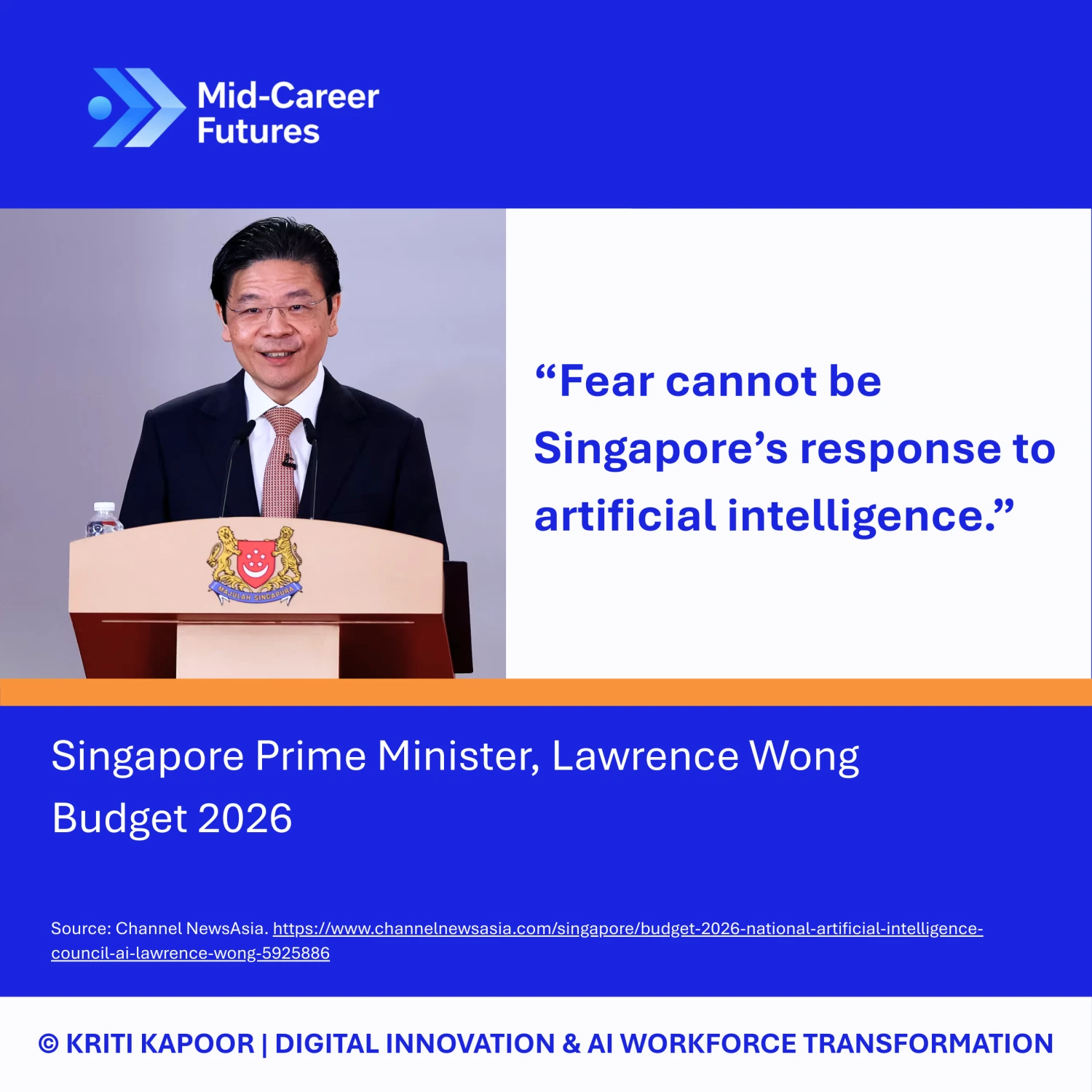
Here's what was announced on 12 February 2026, what it means for anyone leading teams or navigating their career, and what it demands right now.
What changed
1. The PM is chairing Singapore's AI agenda personally.
A National AI Council, led by PM Wong, with DPM Gan Kim Yong, Minister Josephine Teo, and Minister Tan See Leng. Four national AI Missions targeting the sectors where AI will reshape how Singapore competes: advanced manufacturing, connectivity and logistics, finance, and healthcare.
This is sector-level transformation with head-of-state accountability. When leadership accountability moves to that level, execution accelerates.
2. Enterprise support got specific.
A new "Champions of AI" programme offering tailored, company-by-company transformation support. Not a generic grant application. A designed intervention.
400% tax deductions on AI expenditures, capped at SGD 50,000 per year for YA 2027 and 2028. An expanded Productivity Solutions Grant covering more AI-enabled solutions for SMEs. And regulatory sandboxes so companies can test AI innovations without navigating the full compliance stack first.
The message to businesses: we've removed the financial excuse. Now lean in.
3. The workforce architecture is being rebuilt.
Six months of free premium AI tools for Singaporeans who complete selected AI training. PM Wong made the point directly: most advanced AI tools sit behind paid subscriptions, which means people learn the theory but never practise with real tools. This fixes that.
SkillsFuture's website will be redesigned around clearer AI learning pathways. The TechSkills Accelerator is expanding beyond tech into accountancy and legal, with more sectors coming. And SkillsFuture Singapore and Workforce Singapore will merge into a single agency under the Ministries of Education and Manpower. One place for skills training, career guidance, and job matching.
AI capability is now tied directly to training, transition, and job placement. That integration didn't exist before last week's announcement.
Underneath all of this: S$37 billion committed through RIE2030, and S$1 billion announced in January specifically for AI R&D from 2025 to 2030.
Singapore has moved from enabling AI adoption to orchestrating national-scale execution.
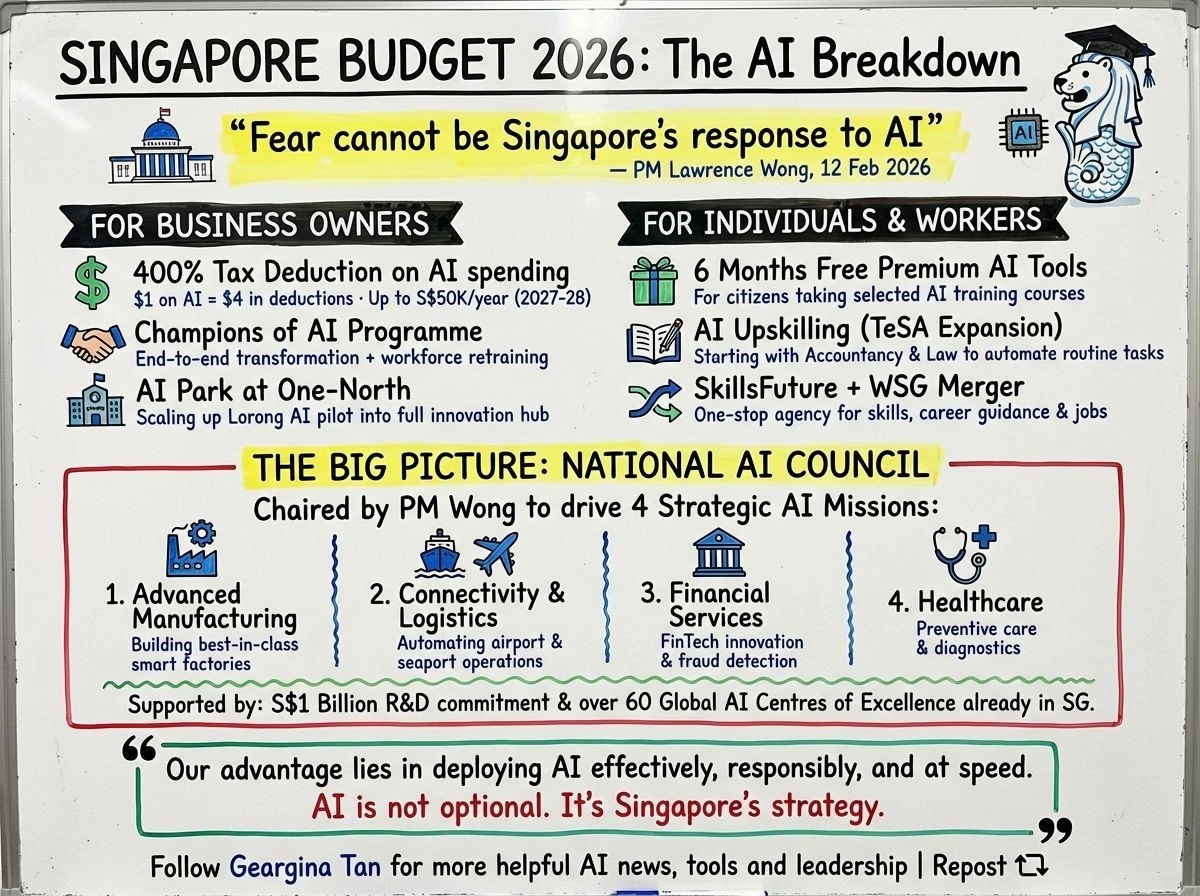
Singapore Budget 2026 - AI Breakdown | Visual Summary and TLDR by Georgina Tan
Current State of AI in Singapore
Singapore's National AI Strategy launched in 2019, was updated in 2023, and Budget 2026 is the third major acceleration. The supply side for AI infrastructure, investment, and individual skills is genuinely growing.
Over 60 companies, including Google and Microsoft, have already established AI Centres of Excellence in Singapore. Google Cloud, Microsoft, and AWS are each running enterprise accelerators for 300 companies through the Enterprise Compute Initiative.
There are 1500+ AI courses available via SkillsFuture. BCG RISE has upskilled over 2,000 mid-career professionals. NUS, NTU, SMU, INSEAD, and SUSS all offer executive AI programmes. PM Wong named DBS and Grab as companies already moving decisively on end-to-end AI transformation.
The tools, the training, and the funding are all in place. So why are most organisations still stuck?
The real tension is not adoption. It is organisational readiness.
The data makes this concrete. 79% of Singapore employees already use GenAI at work (EY, 2024). Yet 63% have received zero employer-led training on using it responsibly (YouGov, 2024). 88% of Singapore workers feel urgency to become AI experts, yet 63% have spent fewer than five hours total learning AI (Slack Workforce Index, 2024).
People are using AI. They're just doing it informally, outside company systems, without governance or shared fluency across teams. When they leave, the productivity leaves with them.
PM Wong named this directly: "End-to-end transformation is demanding. It requires organising data, rebuilding systems, redesigning processes and jobs, and retraining workers. Even major global companies are grappling with this."
And there's a structural urgency that makes this more than an efficiency conversation. Singapore is on track to become a "super-aged" society this year, with 21% of the population aged 65 and above. The total fertility rate sits at a historic low of 0.97. A shrinking workforce means productivity growth through AI is not a strategic choice. It is a mathematical necessity.
DPM Gan Kim Yong was honest about the other side: with AI and automation, there will be higher value-adding industries. But higher value-add per worker also means employers may not need as many workers. At the Economic Strategy Review mid-term update in January, his response was clear: "We will double down on our efforts to support them in their upgrading journey, so that they will be AI-ready, job-ready, and future-ready."
AI creates value. AI also changes who creates it, and how. The question is whether that transition is managed or chaotic.
The capability gap is both organisational and individual. Budget 2026 just made it the most funded, most supported, and most consequential gap in Singapore.
What this demands
The investment architecture is in place: tax incentives, enterprise programmes, free tools, regulatory sandboxes, a PM-chaired council. National direction is clear.
The next phase of AI leadership comes down to three execution choices:
- Capability → building shared AI fluency
- Operating model → redesigning workflows and decisions
- Speed → translating learning into measurable outcomes
If you lead teams or functions: If you lead teams or functions: the question has evolved. It is no longer "How do I get my people trained on AI?" It is: How do I build AI fluency into how my teams actually work, make decisions, and deliver results? That means redesigning workflows, redefining roles, and embedding AI into decision systems. Measure business outcomes, not course completions.
If you are mid-career: this budget is for you. Expanded SkillsFuture, free premium tools, new TechSkills pathways into non-tech professions, a merged agency that connects training to jobs. The infrastructure is being built around your transition. But the professionals who will thrive are not the ones who take AI courses alone. They are the ones who make their entire team more capable. That is a leadership skill. And it is the one Singapore needs most right now.
If you run a business: the Champions of AI programme and 400% tax deduction are designed to remove barriers. The question is no longer whether to invest. It is how fast you can redesign operations around AI, because every month of delay is competitive ground lost.
PM Wong said Singapore's advantage "does not lie in building the largest frontier models. It lies in deploying AI effectively, responsibly, and at speed."
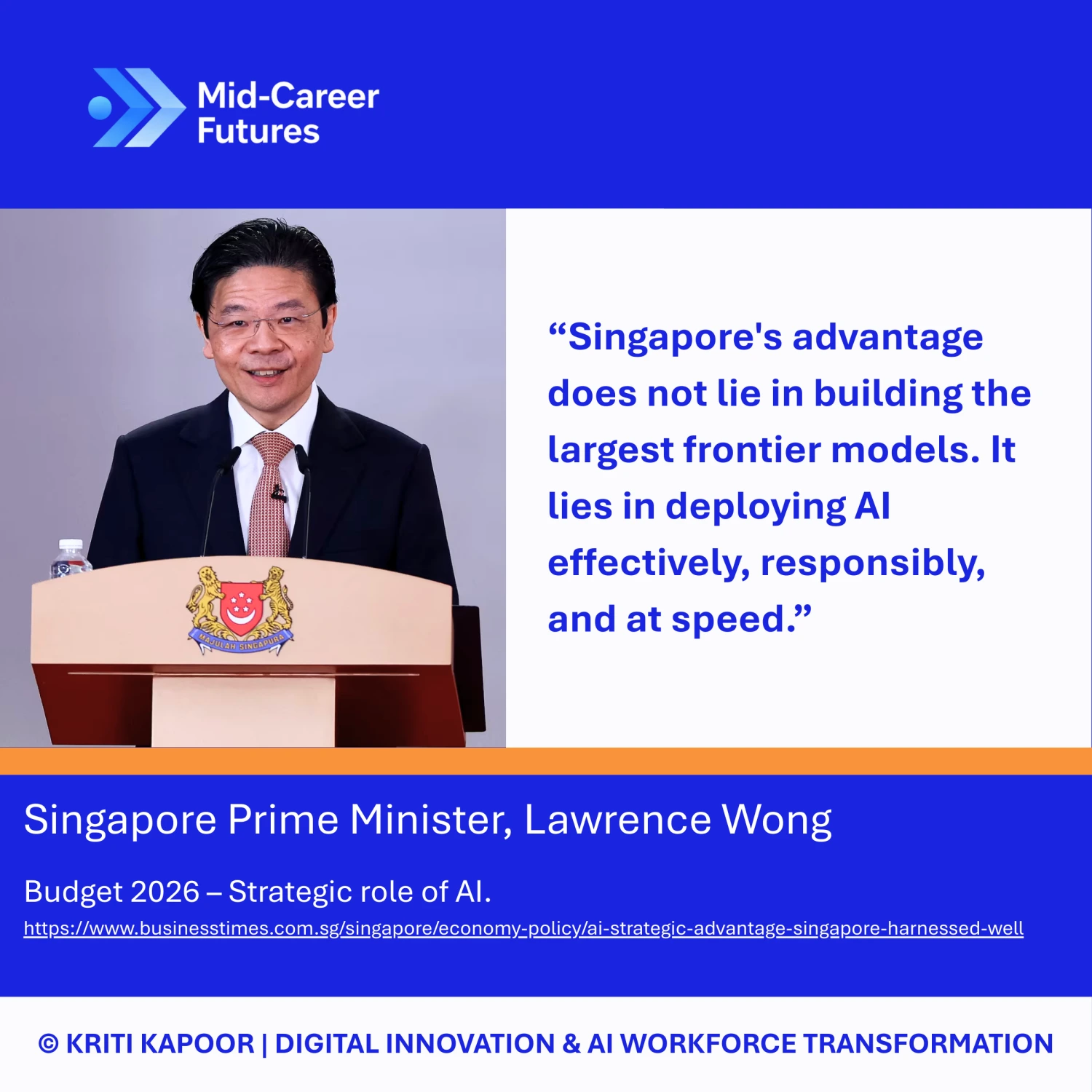
Execution speed now determines competitive advantage and business relevance.
The organisations that win in this phase will not be those experimenting with AI. They will be those redesigning decision systems around it.
Where is your organisation today: experimenting with AI, scaling adoption, or redesigning how work actually happens?
More Details: Coverage of the PM Wong’s speech https://www.straitstimes.com/live-singapore-budget-2026-pm-wong, visual summary/TLDR by Georgina Tan https://lnkd.in/gBdpTT4r and Budget 2026 statement in full https://www.singaporebudget.gov.sg/budget-speech/budget-statement
SOURCES
Budget 2026 Announcements
Ministry of Finance Singapore. (2026, February 12). Singapore Budget 2026 statement. https://www.mof.gov.sg/singaporebudget/budget-2026
Prime Minister's Office Singapore. (2026, February 12). PM Wong: National AI Council, Champions of AI programme, sector AI missions.
Channel News Asia. (2026, February 12). Singapore Budget 2026: National AI Council, 400% tax deduction on AI spend, free premium AI tools. https://www.channelnewsasia.com/
CNBC. (2026, February 12). Singapore launches AI support measures, tax breaks in 2026 Budget. https://www.cnbc.com/2026/02/12/singapore-2026-budget-ai-measures-ai-support-workers-companies.html
The Online Citizen. (2026, February 12). Budget 2026: PM Wong to chair National AI Council for manufacturing, finance and healthcare push. https://theonlinecitizen.com/2026/02/12/budget-2026-pm-wong-to-chair-national-ai-council-for-manufacturing-finance-and-healthcare-push
Mothership. (2026, February 12). PM Wong's Budget 2026 in summary: AI, supporting workers, vouchers & helping businesses. https://mothership.sg/2026/02/2026-budget-summary/
Human Resources Online. (2026, February 12). Singapore Budget 2026: Key highlights for HR leaders, employers, and employees. https://www.humanresourcesonline.net/singapore-budget-2026-key-highlights-for-hr-leaders-employers-and-employees
NTUC. (2026, February 12). Singapore Budget 2026: New and enhanced work initiatives and schemes to support workers. https://www.ntuc.org.sg/uportal/news/Singapore-Budget-2026-New-and-enhanced-work-initiatives-and-schemes-to-support-workers/
Xinhua. (2026, February 12). Singapore's 2026 budget unveils AI-focused measures. https://english.news.cn/asiapacific/20260212/c224b1ac05854928b49601b019f7d0d7/c.html
Tech Edition. (2026, February 12). Budget 2026 positions AI as a strategic advantage for Singapore. https://www.techedt.com/budget-2026-positions-ai-as-a-strategic-advantage-for-singapore
TechNode Global. (2026, February 12). Singapore to set up National AI Council — Budget 2026. https://technode.global/2026/02/12/singapore-to-set-up-national-ai-council-budget-2026/
Workforce & AI Adoption Data
EY Singapore. (2024, October 30). Employers in Singapore drive higher GenAI adoption: 79% of employees using GenAI at work, up from 24% in 2023. EY 2024 Work Reimagined Survey. https://www.ey.com/en_sg/newsroom/2024/10/employers-in-singapore-drive-higher-genai-adoption-and-continue-to-value-flexible-work-arrangements
Slack. (2024, Fall). Workforce Index Fall 2024: 88% of Singapore workers feel urgency to become AI experts; 63% spent fewer than 5 hours learning AI. Survey of 1,008 desk workers in Singapore. https://slack.com/intl/en-sg/blog/news/the-fall-2024-workforce-index
YouGov. (2024). Survey of 1,000 Singaporean employees: 63% lack employer-led ethical GenAI training. As cited in Vertical Institute. (2025, March 18). Yahoo Finance. https://finance.yahoo.com/news/ai-replaced-why-singaporean-professionals-062400168.html
Skills & Training Ecosystem
MySkillsFuture Singapore. (2026). AI course listings: 1,617 AI-related courses available. https://www.myskillsfuture.gov.sg/
BCG. (n.d.). BCG RISE: Upskilled more than 2,000 mid-career Singaporean professionals through SkillsFuture. https://www.bcg.com/beyond-consulting/bcg-rise
Enterprise AI Accelerators (Enterprise Compute Initiative — Budget 2025, launched mid-2025)
Google Cloud & DISG. (2025, June). AI Cloud Takeoff: 300 companies, up to SGD 500,000 in incentives. https://www.edb.gov.sg/en/business-insights/insights/artificial-intelligence-in-singapore-for-businesses-a-round-up-from-july-to-september-2025.html
Microsoft & DISG. (2025, August). Agentic AI Accelerator: 300 companies, up to SGD 250,000 credits + SGD 700,000 for select firms.
AWS & DISG. (2025, June 26). AI Springboard: 300 enterprises, up to SGD 600,000 in cloud credits and training. https://press.aboutamazon.com/sg/aws/2025/7/aws-and-disg-launch-ai-springboard-in-celebration-of-sg60-to-support-300-singapore-based-enterprises-build-ai-centers-of-excellence
Economic & Demographic Context
Bloomberg. (2026, February 12). Singapore Budget 2026: PM Wong unveils AI tax breaks, testing sandboxes. https://www.bloomberg.com/news/live-blog/2026-02-12/singapore-budget-2026
The Edge Malaysia. (2026, February 12). Singapore PM Wong crafts budget for 'more dangerous' world. https://theedgemalaysia.com/node/792772
Ministry of Finance Singapore. (2025). Income inequality fell to record low in 2025; total fertility rate 0.97 in 2024. As cited in The Edge Malaysia.
Ministry of Manpower Singapore. (2026, January). SkillsFuture Singapore and Workforce Singapore to merge into a single statutory board. https://www.mom.gov.sg/newsroom/press-releases/2026/0107-skillsfuture-singapore-and-workforce-singapore-to-merge

Kriti Kapoor
Digital Innovation & Workforce Transformation
Author, The Mid-Career Digital Shift