 The Mid-Career Digital Shift
Mid-Career Futures
The Mid-Career Operating System for the AI Era: Six Moves that Matter
Read original on LinkedIn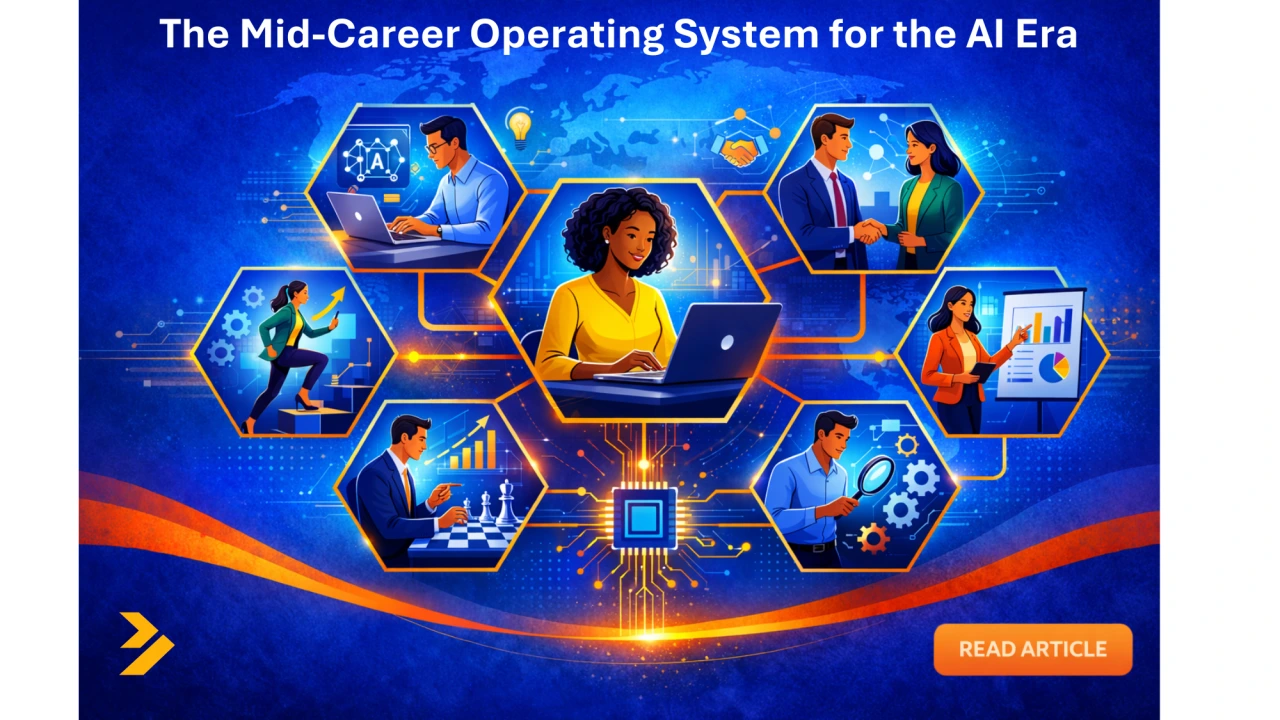
Image Artwork by Kriti Kapoor + Canva + ChatGPT
You are navigating AI transformation on top of everything else. Full workload. Legacy systems. Leadership expectations. A new acronym every week.
It can feel infinite. Any Rubik's Cube, no matter how scrambled, is at most 20 moves from solved. 43 quintillion combinations. Maximum distance from chaos to order: 20 moves. In a recent IMO podcast conversation with Michelle Obama, comedian Josh Johnson put it plainly: children focus on the next move. Adults fixate on the overwhelming number of possibilities.
That distinction feels relevant right now.
Mid-career professionals are navigating AI on top of full workloads, legacy systems, and leadership responsibilities. The complexity is real. Tools. Vendors. Governance. Agentic AI. A new acronym every week.
The path through it is shorter than it looks.
In the #MidCareerFutures 2026 Lunar New Year special edition, "The Horse Runs. So Does the Clock," I wrote about AI acceleration. WEF Davos 2026 underscored that this is a skills transition moment, with 39% of core skills projected to change by 2030. In a following edition, we explored why this matters. This article focuses on how to move inside it.
If you are mid-career, you are absorbing that shift while still delivering results today.
You do not need more noise. You need a clearer operating system.
Here are six moves that matter.
1. Your Catalog Is Your Leverage
Build a body of work.
In comedy, Josh builds volume instead of obsessing over one perfect special. He calls it "practice for the practice." Repetition sharpens judgment.
The same applies to careers. Your leverage is your catalog:
- The AI pilot that failed but taught you workflow reality
- The automation use case you documented
- The governance friction you resolved
- The system redesign others mistook for tool selection
Most organizations struggle to scale AI pilots into production. Only 25% have moved even 40% of their pilots to production at scale (Deloitte, 2026). The experimentation-to-value gap remains wide.
If you have operated inside that gap, you hold capability that matters.
The move: Make one initiative visible this week. Document what was built, what changed, what metric moved, and what you learned. Frame it as capability, not just responsibility.
2. The Role You Need Is Yours to Create
Solve the problem before it has a title.
Creative careers are self-authored. Organizational careers increasingly are too.
AI is reshaping workflows faster than org charts can respond. Middle management postings dropped over 40% in two years as companies flattened structures (Deloitte). That creates whitespace between functions.
Emerging roles are forming in real time:
- Human–AI workflow designer
- AI operations integrator
- Responsible AI governance lead
- Transformation architect
The professionals advancing fastest are solving the capability gap before formal appointment.
The move: Identify one friction point your organization has not formally owned. Draft the workflow, the accountability model, and the measurable outcome. Start the conversation before the title exists.
3. Know When You're Full
Momentum without limits becomes burnout.
Josh compares success to a meal. Keep eating just because it tastes good, and you will make yourself sick. Success is knowing when you are "full." He describes careers as parabolas. Expecting constant rise breeds dissatisfaction.
AI acceleration makes this more urgent. Four in ten professionals believe in AI's business value while simultaneously fearing what it means for their own relevance (HBR, 2026). Researchers call it the Belief–Anxiety Paradox. Employees with higher AI anxiety used AI more, yet reported more than double the internal resistance. Fear drove usage up and wellbeing down.
That pattern is playing out across entire organizations.
Mid-career professionals are carrying a triple load: delivering current performance, bridging legacy and emerging systems, and continuous reskilling. That pace demands deliberate boundaries.
The move: Define three outcomes that would make this quarter sufficient. Use them as a filter for new initiatives. Protect your energy for work that compounds.
4. Real Systems Bring True Success
Close the loop.
Beyond personal achievement, Josh is building sustainable community systems. He partners with local organizations in every city he tours, working toward a closed loop where a farm feeds a pantry that sells items to fund the farm. His line: "Real success is real systems."
Tools alone do not create value. Systems do.
The failure pattern is consistent:
AI output generated → No workflow integration → No decision changed → No metric improved
Top-performing organizations invest significantly more in process redesign and adoption than in technology alone (McKinsey, 2026). The system determines the return.
The move: Map one AI output to the workflow it should influence. Ask: Where does this output flow next? What decision changes because of it? Who owns the downstream impact? Connect it to a measurable business result.Context before optimization.
Writing for The Daily Show shifted Josh from hoping his specific joke made the cut to understanding how his work fit the larger segment. He learned to contextualize before he optimized.
A solution only works if it fits the broader narrative of the organization. High-performing teams adopt AI at 78%, compared to 54% for others (Deloitte, 2026). The difference is cross-functional translation: converting what the data team built into language operations can use, connecting the finance team's risk concerns to the product team's roadmap decisions.
Translation bridges:
- Data to operations
- Risk to product
- Finance to innovation
- Strategy to frontline execution
Mid-career professionals often hold this advantage. You understand trade-offs across domains.
The move: Take one initiative from your function and rewrite it in business outcome language for a leader outside your team. Share it. Invite critique.
6. Micro Moves
First direction, then speed.
Back to the Rubik's Cube. 43 quintillion combinations. 20 moves to solved. McKinsey reports that roughly three-quarters of knowledge workers are already using AI ahead of formal organizational enablement. The micro moves are happening.
What separates the intentional from the accidental is direction.
The move: Pick one this week.
- 30 minutes: Run one recurring task through an AI drafting assistant
- One meeting: Sit in on a governance discussion outside your domain
- One conversation: Exchange experiment insights with a peer
Each move is small. Together, they create trajectory. And they compound.
The Bottom Line
You are in your highest leverage window.
Over 70% of the skills employers seek today apply to both automatable and non-automatable work (McKinsey, 2025). Your skills endure. How you deploy them evolves.
AI transformation is a work design and capability challenge. The Great Skills Reset rewards pattern recognition, systems thinking, translation capability, and strategic agency.
These are mid-career strengths.
Complexity favors experience.
Six moves. Directional. Compounding. Within reach.
Which move will you apply this week?
Sources
- Eatough, E., Ferrazzi, K., Smith, W., & Waters, S. (2026, Feb 17). Harvard Business Review. https://hbr.org/2026/02/why-ai-adoption-stalls-according-to-industry-data
- Deloitte AI Institute. (2026). State of AI in the enterprise. https://www.deloitte.com/us/en/what-we-do/capabilities/applied-artificial-intelligence/content/state-of-ai-in-the-enterprise.html
- Deloitte. (2026). Human capabilities and high-performing teams. https://www.deloitte.com/us/en/insights/topics/talent/building-high-performing-teams.html
- Deloitte. (2025). The future of work and AI. https://www.deloitte.com/us/en/services/consulting/about/future-of-work-ai.html
- World Economic Forum. (2025). Future of jobs report 2025. https://www.weforum.org/publications/the-future-of-jobs-report-2025/
- McKinsey Global Institute. (2025). Agents, robots, and us. https://www.mckinsey.com/mgi/our-research/agents-robots-and-us-skill-partnerships-in-the-age-of-ai
- McKinsey & Company. (2026). Investing in frontline workers' AI skills. https://www.mckinsey.com/capabilities/operations/our-insights/a-us-productivity-unlock-investing-in-frontline-workers-ai-skills

Kriti Kapoor
Digital Innovation & Workforce Transformation
Author, The Mid-Career Digital Shift