 The Mid-Career Digital Shift
Mid-Career Futures
Choosing Your Next Career Move, A Practical Guide
Read original on LinkedIn
A practical approach to weigh four directions and test one before you commit.
During the pandemic (and yes, feels like a lifetime ago!), I spent a year job searching and had more than 250 conversations before landing a role at HP to help advance the use of automation across the workforce. Much of the work happened between applications as I figured out whom to follow up with and which opportunities to pursue.
Here are some lessons learnt.
Before opening another job alert, ask what you want your next move to change. That answer gives you a way to decide which conversations to start and which opportunities deserve your time.
1. Start with the work you want to do
Picture an ordinary work day in your next role. How much of it would you like to spend teaching, solving customer problems, leading a team, or doing hands-on work? Then list your must-haves, such as an income floor, predictable hours, organization culture, preferred work environment, remote, hybrid or a particular location. Use them to narrow the search options.
Next, name two outcomes you helped deliver. What problem did you solve, what did you do, and what changed? Building a training programme, for example, shows how you designed learning, got managers on board, and helped teams apply new skills. Ask who else needs those outcomes. That gives you a place to look beyond familiar titles.
2. Compare four possible directions
- Grow in your field. A finance manager at a consumer goods company who enjoys shaping business decisions could move into a regional finance director role. They’d go from owning the forecast for one market to helping several country teams decide where to invest, which product lines to expand, and how to respond when margins fall. Leading one regional planning cycle would give them a feel for the broader scope.
- Make an adjacent move. A procurement manager at a hospital who enjoys supplier negotiations and improving service could move into vendor operations at a health insurer. They’d use familiar skills to manage contracts and review service performance while learning how insurers handle claims and member enquiries. Walking through a supplier performance review with someone in the role would show which skills carry over and what they’d need to learn.
- Work independently. A commercial director at an industrial equipment company could turn years of working with distributors into a focused advisory offer. A manufacturer entering a new market might pay for a short project to assess potential distributors, compare their reach and service capabilities, and recommend a shortlist. A paid pilot would let the director test demand and see how they feel about the work that comes with independence, from finding clients to setting fees.
- Change direction. A retail operations director who has spent years opening stores and managing large teams might want to work more directly with people making career decisions. They could explore career counselling, where a typical day might involve one-to-one sessions with adults weighing a return to work, a retraining programme, or a new occupation. Before committing, they could shadow a practitioner and check what qualifications, supervised practice, and income to expect during the transition.
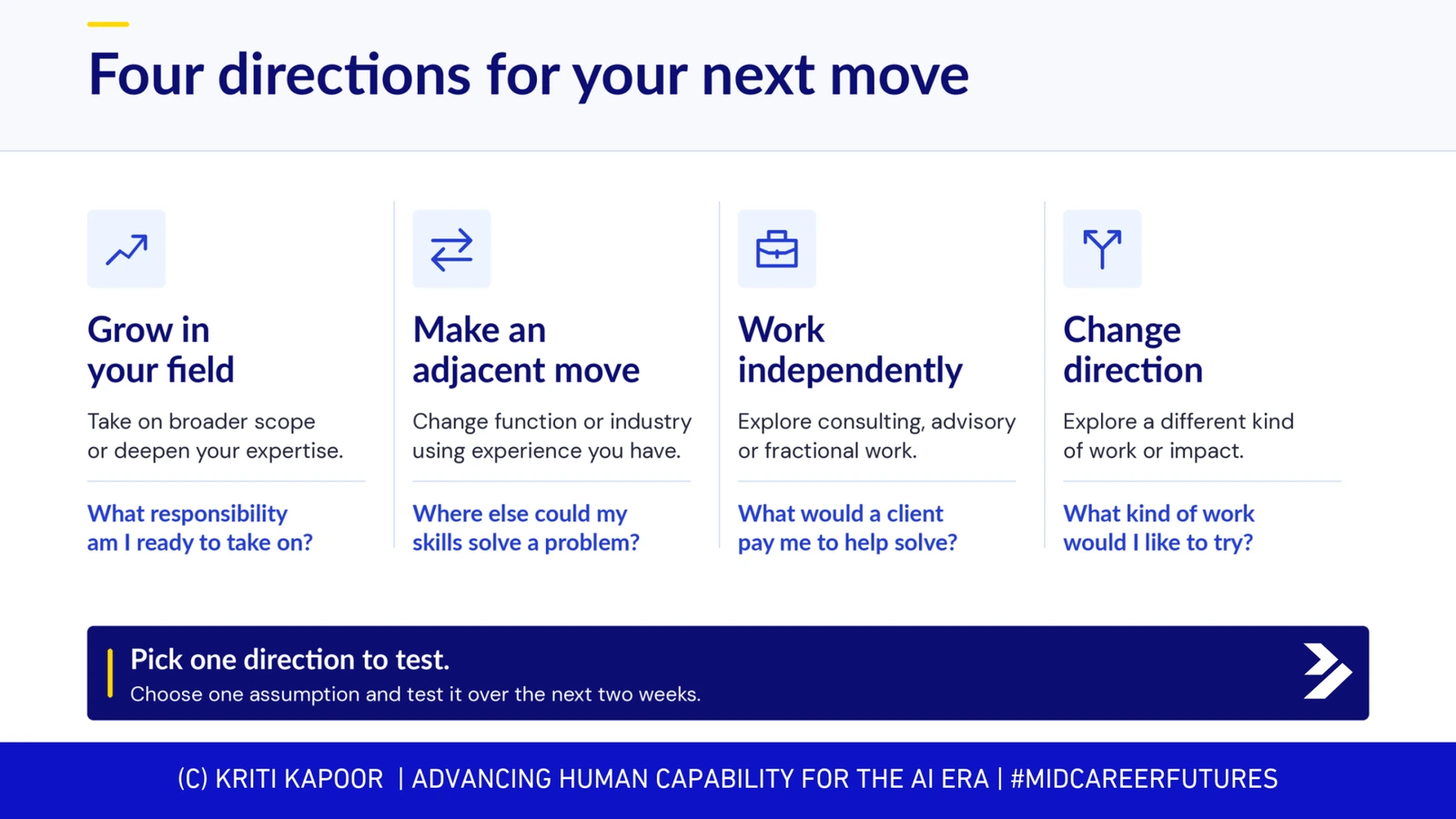
Compare four possible directions #midcareerfutures
3. Choose one direction to test
Pick one direction to focus on for the next two weeks. Check it against your must-haves. If something clearly conflicts, decide whether that requirement can flex. If something is unknown, make it the focus of your test. You can keep a second direction open with one small experiment if you have the time.
For example, if you’re exploring customer education, read five job descriptions and speak with two people who do or hire for that work. Ask how much of the job involves designing learning, delivering it, or managing a platform. If you’re exploring independent work, talk to potential buyers about the problem, how they handle it today, and whether they have a budget to solve it.
Set a date to review what you learned. If the daily work fits and you can show relevant results, build a target list and tailor your outreach. If you discover a gap that matters, choose a small project or targeted learning that helps you close it. If the direction falls short on a must-have, revisit the other options.
4. Write down your search focus
For the next two weeks, I’m focusing on [type of work] because [what I want and what I can bring]. I’ll test [one assumption] by [specific action], then review what I learn on [date].
As more career paths open up and the job market feels less predictable, we can spend a lot of energy weighing every possibility.
Getting clear about the work we want and what we need from it makes the search less exhausting. It helps us give promising opportunities a closer look, let others pass, and adjust our direction as we learn.

Kriti Kapoor
Digital Innovation & Workforce Transformation
Author, The Mid-Career Digital Shift