 The Mid-Career Digital Shift
Mid-Career Futures
When Your Career Playbook Stops Working: Five Lessons for Navigating Uncertainty
Read original on LinkedIn
Microsoft's voluntary exit offer to 60,000 employees is a powerful reminder that even established careers are subject to change. What can mid-career professionals learn from executive coaches and leadership thinkers about navigating what comes next?
On 26 October 2026, Microsoft announced a voluntary exit offer for approximately 60,000 employees, more than a quarter of its global workforce. Eligible employees across selected teams in the United States, United Kingdom, Canada, and India can leave with financial support and career planning resources. Chief People Officer Amy Coleman positioned the programme as a way to give employees greater flexibility while helping participating organisations adapt to changing workforce needs.
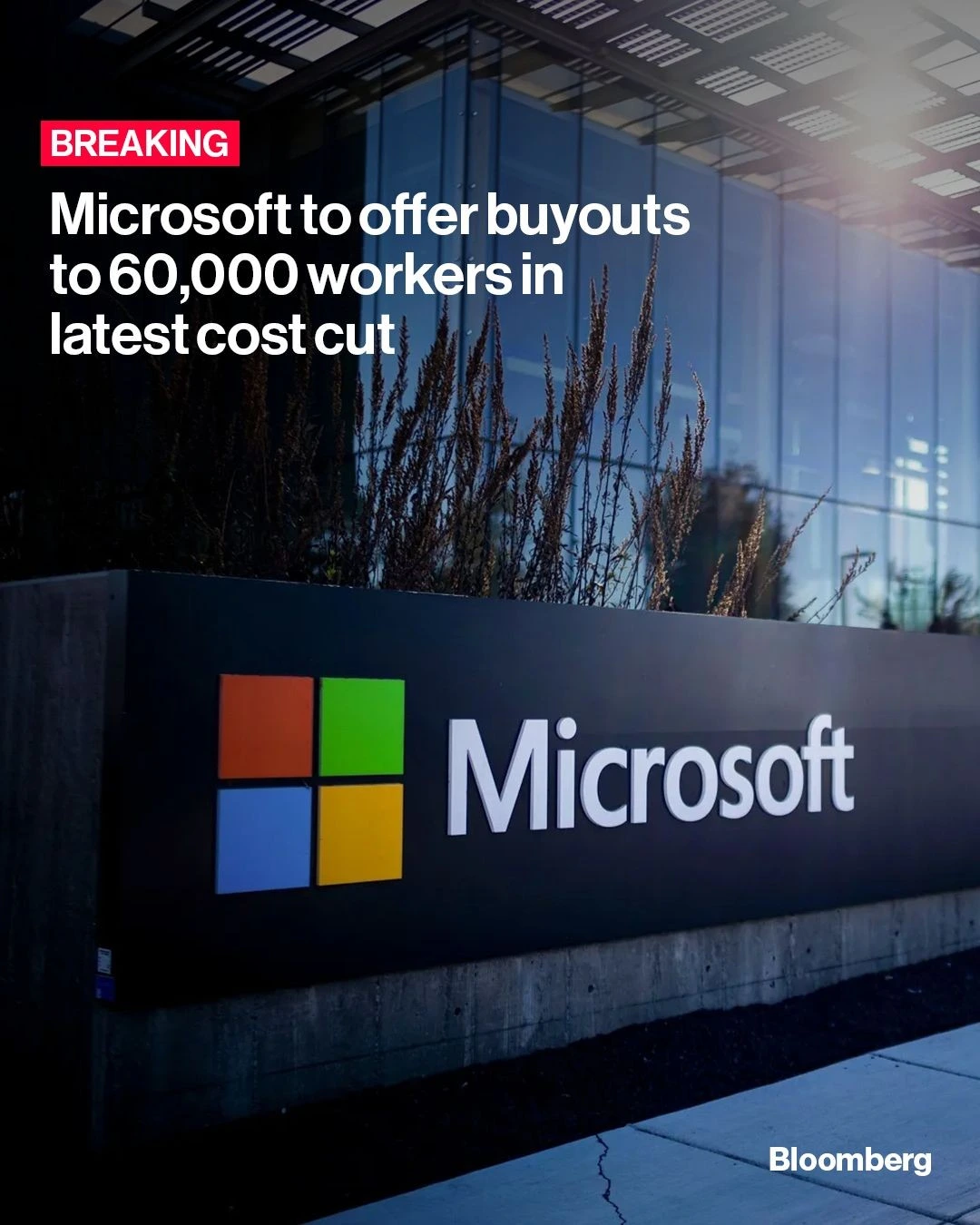
https://www.bloomberg.com/news/newsletters/2026-10-29/microsoft-s-employee-buyout-could-be-a-model-for-layoffs-in-the-ai-age
The announcement comes as Microsoft invests heavily in AI infrastructure and capabilities while rethinking its operations and managing costs. AI alone does not explain the programme. It does show a broader reality: even organisations leading technological transformation are rethinking how they structure their workforce and create value.
For experienced professionals, developments like these can feel unsettling. You may have spent 15, 20, or even 30 years building expertise, delivering results, and establishing your professional reputation. You have navigated complexity before, yet an unexpected restructuring or career interruption can leave you questioning decisions you once made confidently.
For experienced professionals, news like this can feel unsettling. You may have spent 15, 20, or even 30 years building expertise, delivering results, and earning your reputation. You have navigated complexity before. Yet an unexpected restructuring can leave you questioning decisions you once made with confidence.
At mid-career, the stakes feel higher. Financial commitments, family responsibilities, and professional identity become intertwined with career choices. Starting over feels daunting, particularly when the market itself is shifting.
The World Economic Forum's Future of Jobs Report 2025 says employers expect 39% of workers' existing skill sets to change or become outdated by 2030. Yet analytical thinking, resilience, flexibility, and leadership remain among the most valued capabilities.
As technology accelerates change, the ability to navigate uncertainty becomes a professional asset in its own right.
So, what can we learn from the decision-making principles taught by the world’s leading executive coaches and leadership thinkers? The work of Marshall Goldsmith, Annie Duke, Herminia Ibarra, Michael Watkins, Ronald Heifetz, and Amy Edmondson offers five useful lessons.
1. Reclaim Your AGENCY: Focus on What You Can Influence
Uncertainty pulls our attention towards what we cannot control. We worry about restructuring decisions, economic conditions, changing hiring expectations, or whether we made the right career choices. These worries are understandable. Revisiting them again and again rarely changes our circumstances.
Executive coach Marshall Goldsmith has spent decades helping senior leaders take greater responsibility for their behaviour and effectiveness. His most practical lesson: redirect attention to what you can personally influence.
Picture a 48-year-old transformation leader whose position has been eliminated after two decades at the company. They have delivered significant business results and led complex initiatives. Months into the job search, opportunities are not materialising. It would be easy to conclude that the market no longer values their experience.
Look closer. Their expertise may need new positioning. Employers may be prioritising AI-enabled transformation while their professional narrative emphasises earlier digital initiatives. The strongest opportunities may be emerging through executive relationships rather than conventional applications.
Each possibility can be investigated and improved. The leader can reconnect with decision-makers, sharpen their value proposition, and show how their experience answers current business priorities.
The question shifts from "Why is this happening to me?" to "What can I influence that would improve my chances of a better outcome?"
That is the essence of agency. We acknowledge the circumstances we cannot control and direct our energy towards actions that make a real difference.
2. Strengthen Your JUDGEMENT: Make Decisions Without Perfect Information
At mid-career, decisions feel consequential. Should you accept a new role, negotiate a voluntary exit, relocate for an opportunity, or pursue independent consulting? We want to make the right choice, so we research, compare, and rehearse what could go wrong. Extra analysis often deepens indecision instead of sharpening judgement.
Decision strategist Annie Duke separates the quality of a decision from the quality of its outcome. A thoughtful decision can produce a disappointing result because circumstances unfold differently than expected. A poorly considered decision can occasionally succeed through good fortune.
This matters because we judge past choices through hindsight. If a relocation fails to deliver the expected opportunities, we call the move a mistake. If a promising role ends unexpectedly, our confidence in our own capabilities takes a hit. The outcome alone does not tell us whether the decision was reasonable given what we knew at the time.
Return to our transformation leader, who is weighing three paths: another senior corporate role, executive education, or independent advisory work. Each offers a different mix of income, stability, autonomy, and growth. Instead of hunting for the perfect answer, they can score each path against explicit criteria: financial requirements, market demand, personal priorities, and reversibility.
The same discipline applies to a voluntary exit offer. An attractive package buys flexibility. The decision still has to account for future income, benefits, equity, healthcare, taxes, contractual conditions, and realistic employment prospects.
Good decisions start with clear priorities, sound evidence, and an honest view of the risks you can absorb. A reliable process builds confidence. It tells you when to gather more information, when to seek advice, and when to commit.
3. EXPERIMENT Your Way Into the Next Chapter
We often hear that reinvention starts with knowing exactly what we want, then building a plan. For experienced professionals, this creates enormous pressure to pick the perfect next role before moving at all.
Prof. Herminia Ibarra's research offers another route. In Working Identity, she shows that professional reinvention usually develops through experimentation, new relationships, and exposure to unfamiliar possibilities. We learn about our future selves partly by trying different ways of working.
Each of the leader's three paths draws on existing strengths. Each needs a different professional proposition and route to market. Instead of spending months choosing, they can test demand for each. Conversations with hiring executives can reveal emerging opportunities. A workshop can validate interest in AI capability building. A consulting pilot can show whether organisations will pay for workforce transformation expertise.
These experiments produce evidence that reflection alone cannot. They also ease the pressure of one enormous career decision. Every test teaches something before the next commitment.
For mid-career professionals, this approach pairs accumulated wisdom with renewed curiosity. Years of solving business problems train us to recognise patterns, read organisational complexity, and spot opportunities others miss.
Experience shows us what creates value. Experimentation shows us where that value is needed next.
4. Build MOMENTUM: Make Large Transitions Manageable
When career uncertainty collides with financial pressure, family responsibilities, or personal challenges, unresolved decisions pile up. We spend hours thinking about what must change and still struggle to find a starting point.
Leadership transition expert Michael Watkins, author of The First 90 Days, offers a practical answer. His work centres on accelerating learning, setting priorities, building relationships, and securing early wins.
The same principles apply to professional reinvention. You do not need to solve the next decade of your career to make meaningful progress over the next 90 days.
Our leader could spend month one clarifying their proposition and engaging decision-makers. Month two could focus on testing opportunities and demonstrating capability. By month three, the goal is to see which directions generate credible interest and deserve further investment.
The distinction that matters is activity versus progress. Another hundred untargeted applications create a sense of busyness without improving results. A promising referral, a paid engagement, or a direct conversation with a hiring executive moves you further.
Progress also needs realistic expectations. Transitions are rarely linear, and external decisions often take longer than anyone expects. A structured plan cannot guarantee success in 90 days. It does help you spend your time, attention, and energy more deliberately.
When the future feels overwhelming, shorten the planning horizon and make the next milestone specific.
5. ADAPT Without Losing Your Professional Identity
Perhaps the most demanding part of mid-career change is recognising when the approaches that made us successful need to evolve.
Leadership scholar Ronald Heifetz distinguishes technical problems from adaptive challenges. Existing expertise can solve technical problems. Adaptive challenges ask us to question assumptions, build new capabilities, and sometimes let go of familiar ways of working.
AI offers a timely illustration. Learning to use an AI application is largely a technical challenge. Redesigning an organisation when AI can perform substantial portions of existing work is an adaptive challenge. It forces leaders to rethink workflows, responsibilities, decision rights, and workforce capabilities.
Individual careers follow the same pattern. Updating a CV is a technical task. Repositioning yourself after two decades in an established leadership role means reassessing how you define and communicate your professional value.
For our leader, a successful career in digital initiatives and workforce programmes remains relevant. Organisations now look for leaders who can turn AI investments into measurable business outcomes. The opportunity sits at the intersection: established expertise in organisational transformation, applied to AI-enabled operations and workforce redesign.
Prof. Amy Edmondson's research on intelligent failure adds another dimension. When you explore unfamiliar opportunities, some thoughtful experiments will fall short. Ask what the outcome reveals, separate avoidable mistakes from useful learning, and adjust.
Setbacks also carry real loss: security, status, relationships, and belonging. Naming that loss is part of adapting with self-awareness.
Your professional identity grows more resilient when it rests on the value you create rather than the title you hold.
⏩ CLEAR: A Practical Operating System for Uncertainty
I have brought these five lessons together into the CLEAR method, a practical approach for navigating uncertainty with clarity, confidence, and purpose.
- Clarify Reality: Separate facts from assumptions and fears. Understand what has changed, what remains uncertain, and which information matters most.
- Locate Your Agency: Sort what you can control, what you can influence, and what you need to accept or prepare for.
- Evaluate Options: Assess alternatives against your priorities, constraints, opportunities, and risks. Identify which possibilities you can test before making major commitments.
- Act Deliberately: Take a purposeful next step that creates momentum, generates evidence, or opens new doors.
- Review and Recalibrate: Learn from outcomes, challenge assumptions, and adjust as circumstances evolve.
Consider a mid-career professional holding a voluntary exit offer. Fear and urgency push towards a quick answer. CLEAR slows the moment down. They map the financial implications, assess career options, test opportunities through targeted conversations, and decide on evidence and personal priorities.
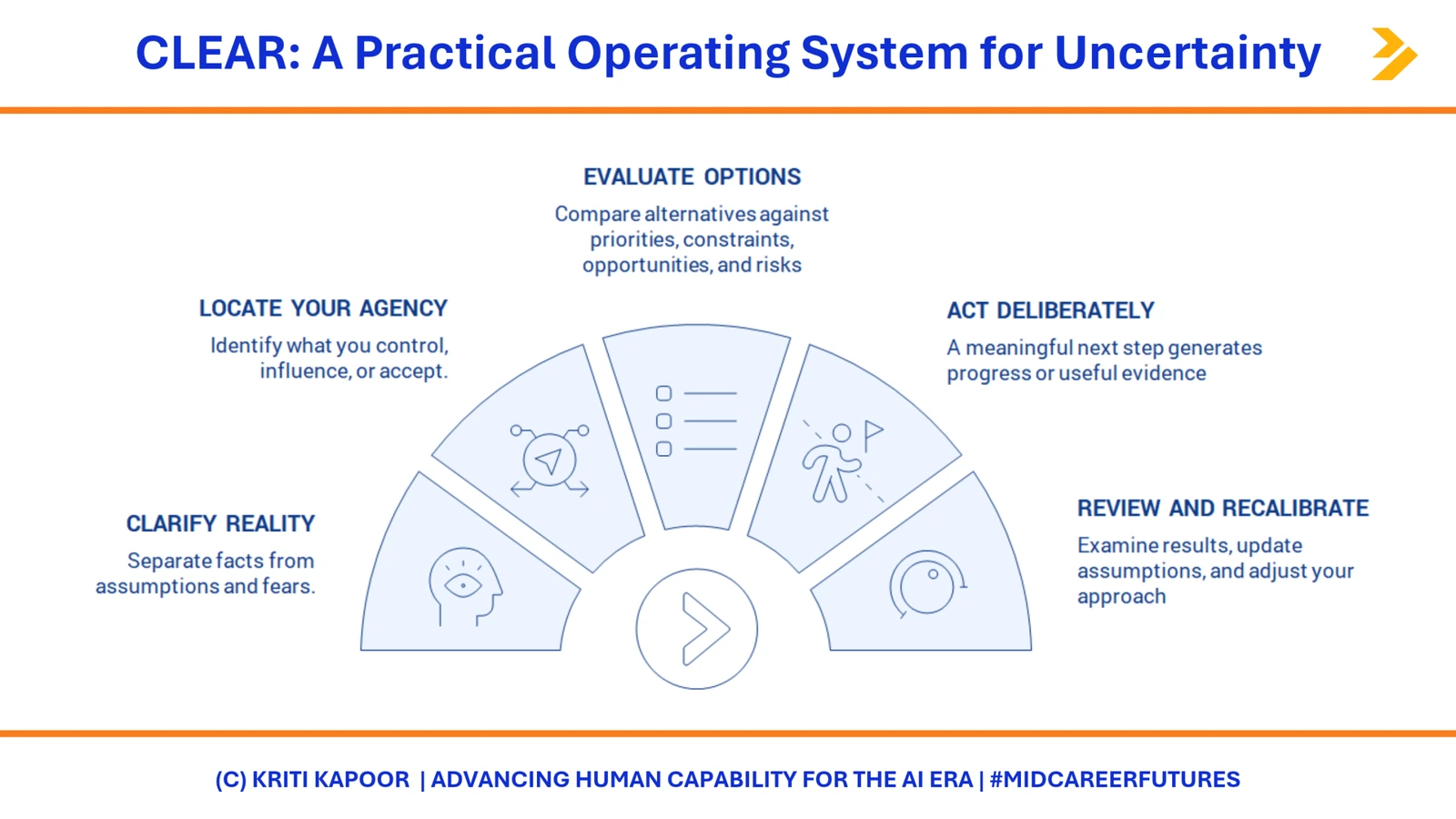
CLEAR method for Navigating Uncertainty
Where This Leaves Us
Microsoft's announcement is a reminder that change reaches successful organisations and established careers alike. The judgement you have built over decades remains your most valuable asset. The challenge is to apply it in new ways, stay open to possibilities, and build the capacity to adapt as circumstances evolve.
Confidence grows from trusting your ability to assess reality, make sound decisions, recover from setbacks, and keep moving forward. Certainty about the next chapter is a bonus.
We may not be able to predict our next chapter. We can become far more capable of shaping it.
Your Next Move
Set aside 20 minutes each week to examine one uncertainty that matters. Ask yourself what you have learned, which part of the situation you can influence, and what meaningful action would improve your position over the next seven days.
Then decide what you will continue, change, or stop doing.
Over time, this builds a visible record of decisions, actions, and learning. It also rebuilds something valuable: trust in your own ability to handle difficult circumstances.
A Question Worth Reflecting On
What is one important uncertainty in your professional life that you could turn into a concrete decision, conversation, or experiment this week?
If this article and framework resonated, I would love to hear which insight stood out and how you might apply it. Drop me a comment or message, and please share this with someone who may find it useful.
Source: Bloomberg, "Microsoft's Employee Buyout Could Be a Model for Layoffs in the AI Age"
Sources and Further Reading
Workforce developments and research
- Microsoft. (2026). Introducing a Voluntary Exit Offer.
- Reuters. (2026).Microsoft offers buyouts to around 60,000 employees to contain costs.
- World Economic Forum. (2025). The Future of Jobs Report 2025.
- Microsoft. (2025). 2025 Work Trend Index.
Leadership and career reinvention
- Goldsmith, M., & Reiter, M. (2015). Triggers.
- Duke, A. (2018). Thinking in Bets.
- Ibarra, H. (2023). Working Identity.
- Watkins, M. D. (2013). The First 90 Days.
- Heifetz, R. A., Grashow, A., & Linsky, M. (2009). The Practice of Adaptive Leadership.
- Edmondson, A. C. (2023). Right Kind of Wrong.

Kriti Kapoor
Digital Innovation & Workforce Transformation
Author, The Mid-Career Digital Shift