 The Mid-Career Digital Shift
Mid-Career Futures
Big AI and Small AI: Choosing Intelligence That Fits the Work
Read original on LinkedIn
As covered in an earlier article on Big AI vs. Small AI a few months ago, most conversations about AI strategy still sound like technology debates. Big models versus small models. Cloud versus edge. Power versus efficiency. In case you missed it, let's recap, and look at this distinction in the context of the Healthcare outcomes.
That debate misses the point.
The first question leaders need to ask is simpler: What are we trying to achieve, and where can AI help us get there faster?
This shift changes everything. AI is not just another IT system or a long governance program waiting for perfect data. AI is capability. It enables teams to do things they could not do yesterday.
Big AI and Small AI are two practical paths to that capability. They solve different problems, carry different risks, and create value in different ways.
Big AI: General Intelligence at Scale
What defines Big AI
- Trained on extensive, diverse information
- Built with billions or trillions of parameters
- Able to work across writing, analysis, coding, and translation
- Typically delivered through cloud infrastructure
Where Big AI creates value
- Open-ended and ambiguous work
- Knowledge-intensive and cross-functional collaboration
- Creative, analytical, and strategic tasks
Common applications
- Copilots for clinicians and researchers
- Summarizing complex records and guidelines
- Designing patient communication
- Strategy and scenario planning
Tradeoffs to manage
- Higher operating costs
- Limited explainability at the single decision level
- Privacy and bias governance
- Energy and sustainability impacts
Leadership lens: Big AI expands human thinking. Its value comes from reducing cognitive friction and connecting knowledge, not from replacing expertise.
Small AI: Precision, Speed, and Control
What defines Small AI
- Focused on a specific task
- Trained on domain-relevant datasets
- Lightweight with fast response
- Runs on devices, sensors, or local systems
Where Small AI creates value
- Repetitive and time-critical work
- Operational and rules-driven tasks
- Environments sensitive to latency or connectivity
Typical applications
- Laboratory and imaging quality checks
- Fraud and anomaly detection
- Medical device monitoring
- Triage workflows
Tradeoffs
- Limited flexibility
- Multiple models for multiple problems
- Less contextual reasoning
Leadership lens: Small AI can deliver greater reliability and testability when models are narrowly defined and well monitored.
Healthcare Shows Why Both Big AI and Small AI Matter
Imaging and diagnostics Task-specific models inside scanners can flag potential findings in seconds, giving clinicians a focused starting point. These systems must be validated locally and monitored over time to ensure consistent performance.
Point-of-care devices Some wearables and bedside systems use machine learning to surface early warning signals, with performance dependent on local workflows and populations. Human oversight and clear escalation paths remain essential.
Clinical research Narrow models help classify slides or identify eligible trial participants. Because the task is well defined, evidence and governance boundaries are clearer.
Where Big AI enters Big AI can read the patient record, summarize guidelines, and draft notes, connecting scattered information so clinicians spend more time with people and less with screens.
The practical pattern becomes
- Small AI handles fast, high-volume signals
- Big AI synthesizes context and knowledge
- Humans make the final decision
This is architectural resilience, not automation for its own sake.
Guardrail: AI performance is context-dependent. Models that work well in one setting can drift in another. Safe adoption requires validation, monitoring, and clear accountability.
The Real Starting Point
Too many teams begin with a tool instead of a need. The better path is practical.
Start with one simple, low-risk use case. Document what you learn. Refine the solution. Demonstrate value before scaling.
You do not need perfect data to begin, but you do need data that is fit for purpose and governed for privacy and safety.
When AI is treated as capability rather than infrastructure, progress accelerates. Nurses reduce paperwork. Researchers analyze more data in days. Patients receive quicker answers.
Four Questions That Guide Choices
- Is the task narrow or open-ended?
- Do you need instant response on a device?
- How sensitive is the data?
- What level of explainability is required?
If the work is precise and time-critical, start with Small AI. If it requires judgment across domains, Big AI is the right layer.
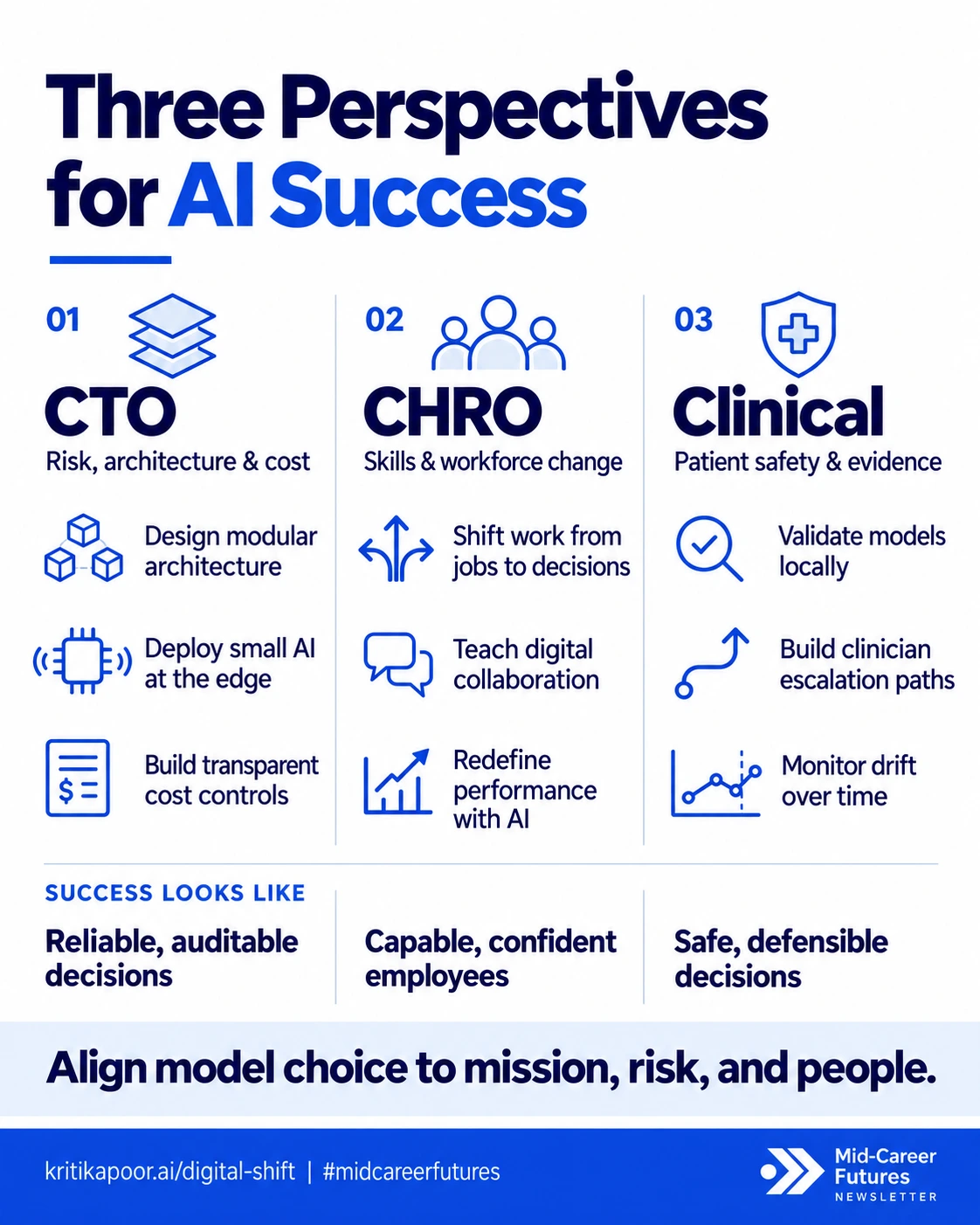
Three Perspectives for Action - CTO, HRO, Clinical Lens
1. Chief Technology Officer Lens: Risk, Architecture, and Cost
For technology leaders, the decision is not model size. It is operational fitness and sustainable design.
- Match Big AI to high-value knowledge work where latency is acceptable
- Deploy Small AI at the edge where speed and data locality matter
- Design modular architecture so models can evolve as evidence and regulation change
- Build transparent cost controls for inference and monitoring
- Treat explainability and security as core engineering requirements
CTO measure of success: reliable systems, auditable decisions, and an architecture that accelerates innovation without creating technical debt.
2. CHRO Lens: Skills and Workforce Change
AI adoption succeeds through people, not platforms.
- Shift from job descriptions to decision maps
- Teach digital collaboration skills before advanced data science
- Redefine performance to reward judgment with AI
- Build change muscle through small wins and peer champions
- Protect trust with transparent communication
CHRO measure of success: employees who feel more capable, not more replaceable, and leaders who can coach work done with machines.
3. Clinical Lens: Patient Safety and Evidence
In care settings, usefulness is secondary to safety.
- Validate models locally before clinical reliance
- Monitor for drift across populations and devices
- Design clear escalation paths to human clinicians
- Prioritize explainability that supports clinical reasoning
- Measure outcomes that matter to patients
Clinical measure of success: better decisions with less burden and evidence clinicians can defend.
How Leaders Build Lasting Value
- Evolve business and operating models to create new value and resiliency
- Map work by decision type instead of job title
- Align AI with risk and accountability instead of trends
- Design learning loops where people, Big AI, and Small AI improve together
This treats AI as a partner in care and operations rather than a replacement.
The Opportunity Ahead
Organizations that align AI capability to mission and strategy will shape the future of their industries. The winners will be those who understand their work deeply and choose intelligence that fits.
2 questions to leave you with:
- What are we trying to achieve, and where can AI help us get there faster?
- What is the biggest opportunity for AI in your industry right now?

Kriti Kapoor
Digital Innovation & Workforce Transformation
Author, The Mid-Career Digital Shift