 The Mid-Career Digital Shift
Mid-Career Futures
The Relevance Race: How the Next 12–24 Months Could Redefine Your Career
Read original on LinkedIn
(c) Kriti Kapoor #midcareerfutures
The rules at work have changed, quietly and quickly. The shift arrived through a thousand tiny moments. A colleague delegated a first draft to an agent. A report that used to take a week was built in an afternoon. A meeting passed without anyone mentioning the tool because using it was already assumed.
You may feel a quiet unease about becoming obsolete or being passed over by someone younger or faster with the tools. You are not imagining the scale of the shift. Nearly every mid-career professional I speak with names a similar concern. It deserves a more useful response than “keep up or fall behind.”
To stay relevant, you need to understand what is changing, recognise where your experience still creates an advantage, and take practical action while new ways of working are still forming.
What’s changing
A new divide is forming. Some people use AI to make existing work faster. Others use it to rethink the value they create and the outcomes they can own.
Picture two people with near-identical experience starting today. One uses AI occasionally, mostly to speed up familiar tasks. The other learns to work with it, redesigns parts of the job, takes on responsibilities that were previously out of reach, and builds visible proof of the value created.
Six months in, the difference may barely show. A few years in, it could be substantial. The real risk is that someone with similar experience moves first and keeps learning. The advantage compounds through repeated practice.
Why it matters
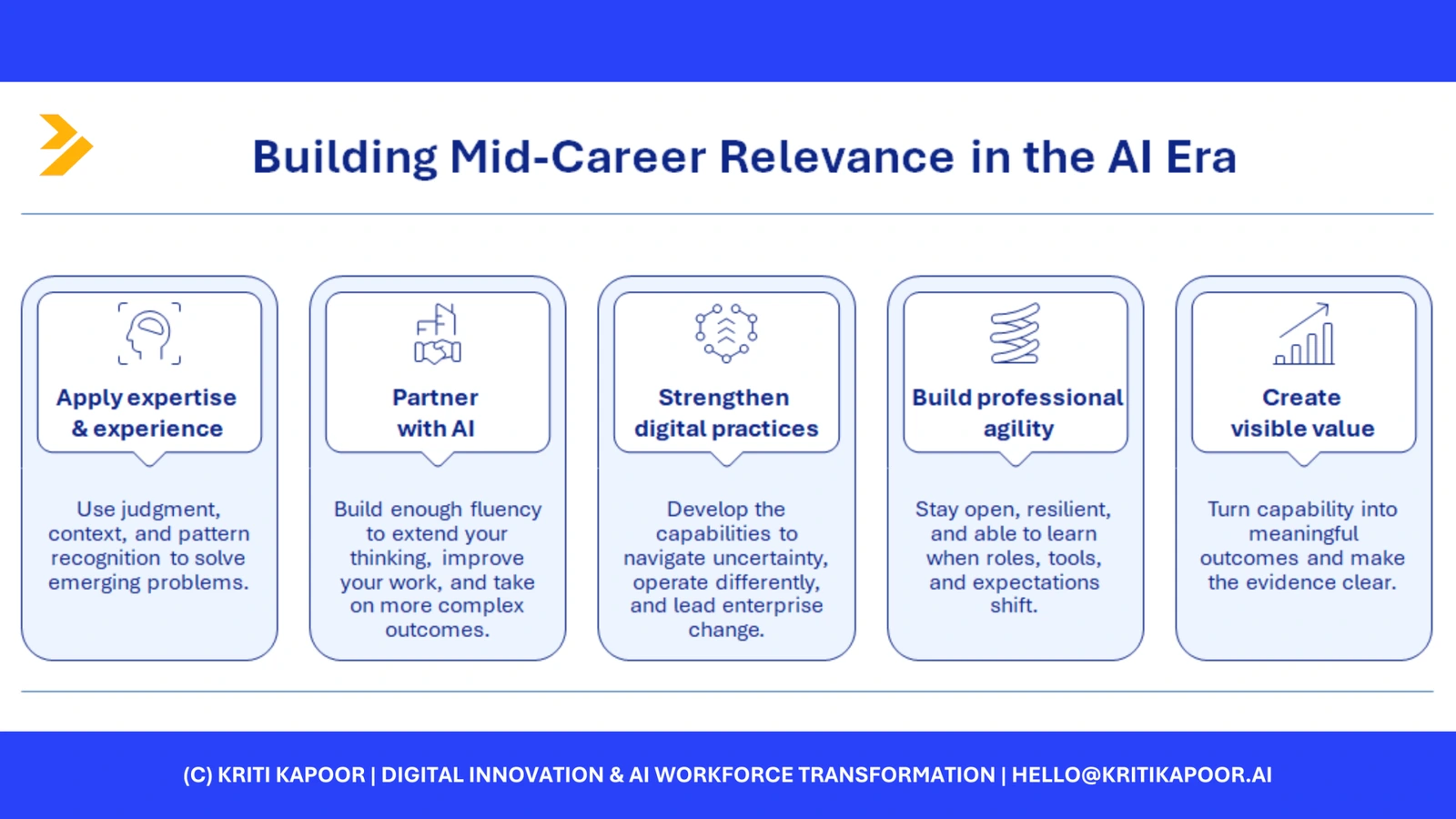
Career relevance over the next few years will be built through five connected capabilities. Together, they form the bridge between the experience you already have and the value organisations increasingly need:
- Apply your experience: Use judgment, context, and pattern recognition to solve emerging problems.
- Partner with AI: Build enough fluency to extend your thinking, improve your work, and take on more complex outcomes.
- Strengthen durable digital business practices: Develop the capabilities to navigate uncertainty, operate differently, and lead enterprise change.
- Build professional agility: Stay open, resilient, and able to learn when roles, tools, and expectations shift.
- Create visible value: Turn capability into meaningful outcomes and make the evidence clear.
Each capability reinforces the others. Experience becomes more valuable when you apply it to current problems. AI fluency becomes more useful when it is guided by judgment. Adaptability gains credibility when it produces evidence of value.
Microsoft’s 2026 Work Trend Index makes the point concrete. Among 20,000 AI users surveyed across 10 countries, 66% said AI enabled them to spend more time on high-value work, while 58% said they were producing work they could not have produced a year earlier. As AI takes on more work, respondents identified quality control of AI output (50%) and critical thinking (46%) as the two human skills becoming most important.
That finding matters for experienced professionals. AI can generate options quickly. Critical thinking helps you frame the problem, test assumptions, assess trade-offs, and decide which options deserve attention.
Tool dexterity is only one part of the picture. Mid-career professionals bring judgment earned through experience: an understanding of customers, organisations, risk, relationships, and how change works in practice. As AI makes answers easier to generate, this judgment becomes more valuable. Producing fifty possibilities is increasingly easy. Knowing which three deserve attention remains a human responsibility.
Experience still matters. Its value now depends on how you apply it.
Positioning matters too. “AI expert” is already becoming a crowded label. Your more defensible position sits at the intersection of your sector and domain expertise, whether that is HR, finance, supply chain, marketing, or sustainability, and your ability to apply AI, redesign work, build capability, support adoption, and create business value.
That is Bridge Value: the ability to connect strategy with execution, established systems with emerging tools, and people with technology. You translate across these worlds and help the organisation move from possibility to practical value.
You are carrying your experience forward and applying it to a new class of problems.
What to do about it
The five capabilities describe what career relevance requires. The seven moves below show how to build it, starting with the assets you need and progressing towards regular renewal.
1. Build the five forms of capital that support your career
- AI capital: Fluency with models, agents, and automated workflows.
- Judgment capital: The ability to frame ambiguous problems, question outputs, and surface hidden assumptions.
- Transformation capital: Skill in redesigning roles, teams, and operating models around human and AI collaboration.
- Evidence capital: Visible proof, such as a workflow you automated, an agent you built, a decision you improved, or hours you returned to a team.
- Relationship capital: Deeper ties to people solving problems that matter, because networks have become powerful learning engines.
These forms of capital turn the five capabilities above into assets you can develop and demonstrate. Aim for fluency and useful progress. Start where you are and use what you have.
2. Identify how you currently work with AI
- Level 1, AI User: “I can use AI.”
- Level 2, AI-Augmented Professional: “AI materially improves my work.”
- Level 3, AI Work Designer: “I redesign workflows around people and AI.”
- Level 4, AI-Era Leader: “I redesign teams, capability, and governance around human and machine intelligence.”
Level 1 is becoming common. Level 2 is likely to become a baseline expectation. Levels 3 and 4 are where experienced professionals can create disproportionate value. They draw on judgment, systems thinking, business context, and the credibility to lead people through change.
The purpose of these levels is not to collect another label. It is to help you see your next move. If you are an AI User, improve one recurring workflow. If you are already AI-augmented, redesign how the work gets done. If you lead others, create the conditions for your team to learn, experiment, and apply sound judgment.
3. Build durable skills to navigate, operate, and lead change
Once you know your current level, strengthen the practices that help you apply AI in a wider business context. AI tools will keep changing. Durable skills help you keep creating value as tools, business models, and expectations shift around you.
In my book, The Mid-Career Digital Shift, I organise this capability through the Digital Practices Framework™, with nine practices across three connected dimensions:
- Navigate: Read the environment and decide where to focus. The practices are Digital Strategy, Customer Centricity, and Data Fluency.
- Operate: Turn intent into better ways of working. The practices are Process Optimization, Digital Collaboration, and AI Partnership.
- Lead: Bring people with you and make change stick. The practices are Business Agility, Change Management, and Influence Without Authority.
Navigate sets direction. Operate turns intent into action. Lead brings people with you. Together, the nine practices help you make sense of disruption, translate strategy into action, and lead enterprise change with people at the centre.
You do not need equal depth in every practice. Identify the two or three that matter most in your context. Strengthen them through real work and connect them to an outcome the business values.
4. Strengthen your inner engineering
Skills and tools will take you only so far. You also need the inner capacity to keep moving when the path is unclear.
I call this inner engineering: building the professional agility and resilience to respond thoughtfully, recover from setbacks, learn in motion, and update your identity as work changes.
It includes the ability to:
- regulate yourself before reacting to uncertainty;
- separate a difficult outcome from your sense of worth;
- stay curious when an old strength or role is losing relevance;
- ask for help, feedback, and perspective early;
- test small moves before you have perfect certainty;
- recover, reflect, and re-enter after disappointment; and
- protect the routines, relationships, and energy that make sustained learning possible.
Resilience is the capacity to adapt without abandoning yourself. Professional agility helps you change direction, learn a new way of working, and carry your deeper strengths forward.
This matters because reinvention often creates an identity gap. You may be highly experienced in the work that shaped your reputation and still feel like a beginner in the work now emerging. Both can be true. Your task is to remain grounded while becoming more flexible.
5. Turn tacit knowledge into leverage
Your inner capacity helps you remain open to change. The next step is to convert what you already know into something others can use.
Much of your knowledge was never written down. It is tacit: how you assess risk, structure a decision, diagnose why a project is quietly failing, or know which question to ask first.
AI can help you turn that knowledge into something reusable, such as a decision guide, diagnostic, workflow, coaching tool, or learning asset. Codify it. Systematise it. Use AI to help you apply it faster and more consistently.
That is how accumulated experience becomes reusable leverage.
6. Ask the redesign question
Once you can see and codify your expertise, use it to redesign work. Many organisations begin with: “How can we make this task 20 per cent faster?”
A more useful question is: “If we designed this work today, knowing AI existed, how would we build it?”
That question sorts work into three broad categories. Some tasks can be automated. Some can be augmented through human and AI collaboration. Others should be redesigned entirely.
That third category holds the greatest strategic opportunity. It is where experienced professionals can contribute context, judgment, and change leadership.
7. Run a relevance check every six months
Ask yourself:
- What parts of my current work can AI now perform reasonably well?
- What can I accomplish with AI today that I could not a year ago?
- Which parts of my expertise are becoming more valuable?
- Which skills are becoming commoditised?
- Where am I still working manually when I could delegate to AI?
- What outcomes can I now own that once required a larger team?
- Which Navigate, Operate, and Lead practices do I need to strengthen next?
- How well am I responding to uncertainty, setbacks, and identity shifts?
- What evidence shows that my capabilities are creating value?
Career relevance is a continuing practice. This review creates a regular rhythm for choosing what to learn, what to release, and where to apply your experience next.
Where this leaves you
I would like to offer some reassurance. You are not behind. As mentioned at the start, the rules at work changed quietly and quickly, and most people are only beginning to feel the effects.
That creates an opening to redefine what your experience is worth. The next 12 to 24 months offer a useful window to learn while norms are still forming, redesign work before habits harden, and turn accumulated experience into value for what comes next.
Build on two fronts in parallel.
On the outside, deepen your AI fluency. Strengthen the durable skills to navigate, operate, and lead change. Redesign work and create evidence of value. On the inside, build the agility and resilience to learn, recover, adapt, and keep moving through uncertainty.
Solve more consequential problems. Keep your depth. Add AI leverage. Strengthen judgment. Redesign the work. Prove the value. Keep learning. Choose progress over perfection.

Kriti Kapoor
Digital Innovation & Workforce Transformation
Author, The Mid-Career Digital Shift