 The Mid-Career Digital Shift
Mid-Career Futures
Five Red Pill Moves Mid-Career Professionals Must Make in This Defining Moment
Read original on LinkedIn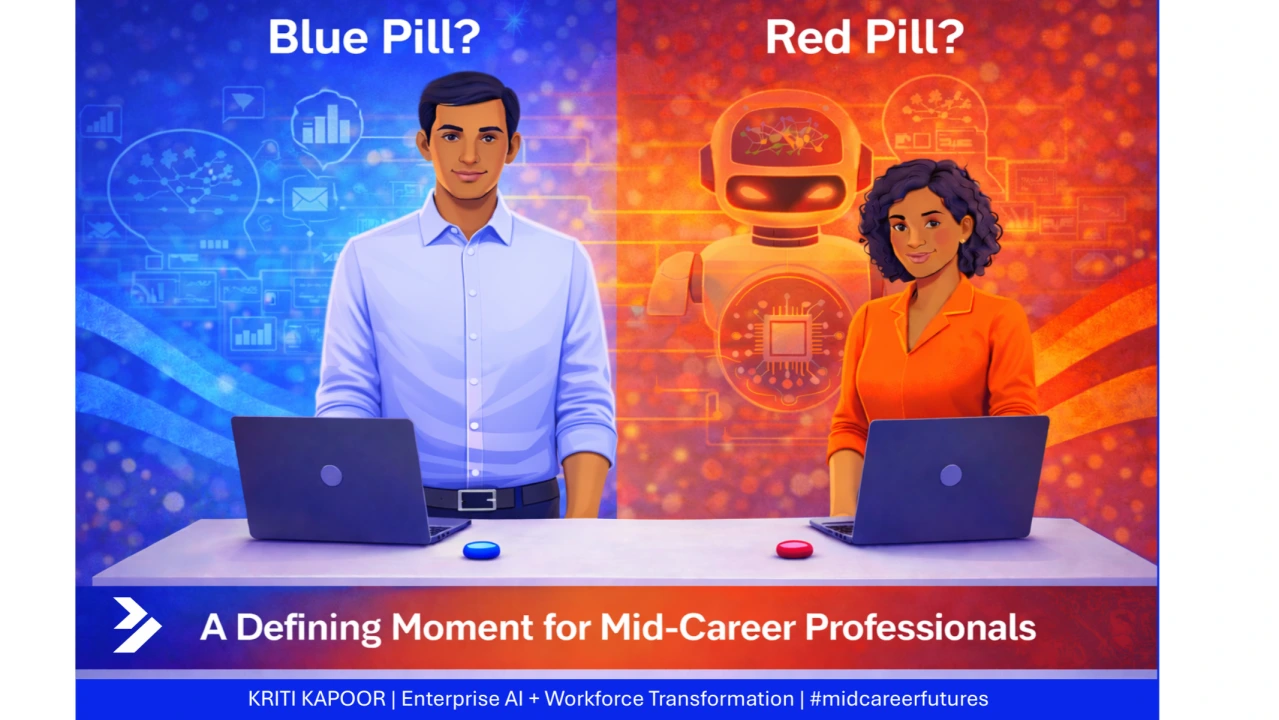
Image collaborator ChatGPT (OpenAI)
Adam Bloom recently named the moment every enterprise leader faces: the choice between optimizing the past or rewriting the future. The blue pill or the red pill.
He's right. And he wrote it for the CEO.
That same moment is hitting mid-career professionals harder, faster, and more personally than any C-suite executive.
The CEO chooses whether to re-architect the organization. You're choosing whether to re-architect yourself.
And most people are still holding both pills, waiting for someone to tell them which one is safe.
Neither one is safe. One just has a future.
Your Red Pill Moment Doesn't Look Like a Board Meeting
It looks like Tuesday afternoon.
It's the moment a junior colleague delivers in hours what used to take your team a week. Nobody broke a rule. Nobody got replaced. The math just changed.
It's the performance review where your manager struggles to articulate what you do that AI can't. Not because they don't value you. Because the language for your value hasn't caught up to the shift.
It's the quiet realization that your 15 years of expertise, the pattern recognition, the institutional memory, the ability to translate strategy into execution, is either your greatest asset or your biggest liability. Depending on one thing.
Whether you can deploy it at the new interface.
The Two Pills for Mid-Career Professionals
Bloom frames the enterprise choice as legacy systems versus AI-native thinking. Here's what that looks like when it's your career, not your company.
🔵 The Blue Pill: Optimize the Past
Stay in your lane. Double down on functional expertise. Wait for the organization to tell you what's next. Measure your worth by effort, tenure, and what you've always delivered. Hope the restructure doesn't reach your floor.
It feels responsible. It looks like stability. It's slow erosion disguised as patience.
🔴 The Red Pill: Reorient for What's Here
Accept that your value has shifted from "I can do this" to "I know what good looks like." Develop fluency at the AI interface, not mastery, fluency. Position yourself as the bridge between strategy and execution in an AI-accelerated world. Stop waiting for permission.
It feels uncomfortable. It looks like starting over. It's actually the opposite: it's leveraging everything you've built, but differently.
What Bloom Gets Right (That Applies Directly to You)
Bloom says AI doesn't replace humans. It replaces hesitation.
For CEOs, hesitation looks like pilot purgatory and governance theater.
For mid-career professionals, hesitation looks like this:
- "I'll learn AI when my company rolls out training." By then, someone who didn't wait will have your next role.
- "I'm too senior to start experimenting." Experimentation is the new seniority. The people directing AI systems with domain expertise are becoming the most valuable in the room.
- "My industry is different." Every industry leader said this. The ones who believed it are now case studies in what Bloom calls "comfortable irrelevance."
- "I don't have time." You don't have time not to. In my upcoming book, I highlight the Triple Effort Reality, we are faced with -- managing your current role, bridging legacy and emerging systems, and pursuing continuous learning, isn't going away. The question is whether you navigate it deliberately or get navigated by it.
The Divide Bloom Named Isn't Technology. It's You.
Bloom writes: "The real divide isn't technology or budget. It's leadership courage."
For experienced professionals, the real divide is simpler and harder.
It's the willingness to let go of how you proved your value yesterday, so you can prove it differently tomorrow.
That means accepting that effort is no longer the signal. That functional expertise alone isn't the moat it was. That coordination, judgment, and the ability to translate between humans and intelligent systems is where your next decade of career power lives.
It means becoming what I call a "bridge builder": the person who connects strategy to execution, legacy to emerging, people to technology. Not because it's trendy. Because it's the role AI literally cannot fill.
Five Red Pill Moves You Can Make This Week
You don't need a transformation roadmap. You need momentum.
- Run one experiment. Take a task you do well and do it with AI. Not to replace yourself. To see what changes when your domain expertise directs the tool instead of doing the work manually. Notice what gets better. Notice what still needs you.
- Rewrite your value statement. Open a blank doc. Write down what you do that AI can't. Not tasks. Judgment calls. Contextual decisions. Relationship-dependent outcomes. If the list is short, that's data, not a death sentence.
- Cross one functional boundary. Bloom says organizations are shifting from departments to outcome-centric teams. Start now. Have one conversation with someone in a different function about a shared outcome. Your ability to integrate across silos is about to become your most marketable skill.
- Learn to direct, not just use. There's a difference between using AI as a search engine and directing it with precision. Your 15 years of knowing what "good" looks like? That's the constraint set. Practice writing prompts that encode your expertise, not just your questions.
- Say it out loud. Tell one person, your manager, a peer, your network, that you're actively building AI fluency. Not because you're afraid. Because you see where the value is moving and you're choosing to move with it.
The Quiet Part, Out Loud
Bloom says CEOs will face existential change in the next 2-5 years.
Here's the quiet part: so will every Director, VP, and Senior Manager who built their career in the pre-AI operating model.
The difference? CEOs have boards pushing them toward the red pill. Mid-career professionals have to choose it themselves.
Nobody's going to tap you on the shoulder and say, "It's time to reorient." Your company's AI training program, if it exists, probably isn't designed for someone with your experience level. The generic "upskilling" narrative doesn't account for the fact that you already have skills. Deep ones. The kind that matter more than ever, if you can deploy them at the new interface.
This is the mid-career red pill moment. Not a crisis. A clarity point.
The Leaders Who Win the Next Decade
Bloom writes that the leaders who win won't be the loudest. They'll be the ones who quietly made the hard call early.
I'd add this: the professionals who win the next decade won't be the youngest or the most technical. They'll be the experienced ones who chose AI fluency over fear, career reorientation over reinvention, and action over permission.
The only question left: optimize the past, or reorient for what's here?
What does your red pill moment look like? I'd love to hear in the comments.
Small moves, consistently made, transform careers.
Post Inspired by Adam Bloom's "The Red Pill Moment: How Leaders Win — Changing Perception in the Age of AI."

Kriti Kapoor
Digital Innovation & Workforce Transformation
Author, The Mid-Career Digital Shift