 The Mid-Career Digital Shift
Mid-Career Futures
Time to Put Your Digital Backpack On. Here's What Goes In It.
Read original on LinkedIn
Image Source HBR - https://hbr.org/2026/02/ai-doesnt-reduce-work-it-intensifies-it
"AI Doesn't Reduce Work. It Intensifies It." — Harvard Business Review, February 2026.
That headline deserves attention.
You finish the deck in half the time. Then spend another hour checking, rewriting, and second-guessing it. Net time saved: unclear.
Here’s what rarely gets discussed in a leadership meeting: “I used AI on that deliverable, and I’m honestly not sure it saved time. I just felt like I was supposed to.”
If you've had that thought, stay here for a few minutes.
Eight months. One tech company. 200 employees. Two UC-Berkeley researchers watched what happened when AI adoption met real work. Productivity surged. So did cognitive fatigue, blurred boundaries, and unsustainable hours. More context switching. More review loops. More after-hours edits. Workers didn't work less. They worked more.
The professionals who struggled weren't resisting AI. They were using it reactively, without a clear operating model.
Busy and invisible effort is a tricky place to be in an AI-accelerated workplace.
If you're a Director, VP, or Senior Manager, you're already carrying what I started calling the Triple Effort Reality, because nothing else captured what I keep seeing at work and in workshops:
- → Deliver your official role
- → Bridge legacy practices and systems to new tools and ways of working
- → Continuously reskill
Now add AI adoption to that stack.
Are you directing the intensity, or absorbing it?
Two key signals are already telling you where the future of work is heading.
Signal One: AI Leverage Is Now a Performance Metric
AI use is shifting from optional to evaluated. Quietly, and in this performance cycle.
- Microsoft told employees in June 2025 that using AI is no longer optional. Managers now factor AI usage into performance reviews. CEO Satya Nadella personally cautioned senior leaders that those misaligned with the company's AI strategy should reconsider their future there.
- Amazon (Ring) went further. Every promotion application must include a written explanation of how the employee is actively using AI in their role. No explanation, no advancement.
- Accenture, Meta, and KPMG have made similar moves this cycle. Accenture tied senior promotions directly to AI tool adoption. Meta began tracking employee AI usage. KPMG is grading its entire workforce against AI goals in the 2026 review cycle.
Five leading companies. Same direction.
Your judgment remains valuable. Now it must be made legible through AI-enabled outcomes. This is about staying in the room where decisions get made.
Signal Two: Your Experience Is the Edge the Model Can't Replicate
Every LLM, the engine behind ChatGPT, Gemini, and Claude, predicts. It fills gaps based on patterns from billions of examples. Vague prompt, average output, every time. It has no idea what your leadership team cares about, what the political context is, or what narrative you need to land.
That gap is where your experience lives.
I learned this operationally. At Microsoft, I was transforming global support for Microsoft Answers: 1.5 million annual queries, a billion community search views, 24 languages. Data showed 80% of queries were routine. The critical 20% required human expertise. AI matched queries to experts with 94% accuracy, but humans handled context and nuance. Response time dropped from 72 hours to 2 hours. A cross-functional team orchestrated that globally.
The technology was essential. The judgment about where to apply it, and where to protect human decision-making, was what made it work.
That's Bridge Value. It lives in people who know their organisation inside out, and has three parts:
- Sensemaking: knowing what matters and what's noise, before the model ever sees the task.
- Context-loading: giving the model what it cannot know on its own: your customers, your politics, your constraints.
- Decision craft: knowing what must stay human: trade-offs, accountability, judgment calls that carry consequences.
The more context you bring, the sharper the output. Every time.
Which of these three practices do you underuse today?
PwC data confirms it: professionals who combine domain expertise with AI fluency are already seeing measurable compensation advantages. This is happening now, for people who moved deliberately and early.
Packing the backpack is that deliberate move.
What Goes in the Backpack
People need a path they can walk. That's what this is. Practical. Portable. Built for the intensity you're actually carrying.
The intensification problem has two parts: lack of operating principles and lack of prompting precision.
Operating principles first.
- Batching principle: Two AI windows per day. No always-on prompting. AI's conversational style makes it easy to slip prompts into every gap in your day. Over time those gaps stop feeling like recovery. Protect them.
- Validation principle: Anything that touches customers, money, or reputation gets a check before it leaves your desk. Run this: "List what you assumed, what you're uncertain about, and what data I should provide to make this decision-grade." One prompt. Significant risk reduction.
- Artifact principle: One AI leverage note per week. Two sentences: what you used AI for, what it produced, what it saved. This becomes your promotion evidence and your AI leverage narrative. Track it.
If you lead a team: individual discipline helps. Organisational design is what protects your people. Guardrails. Role clarity. Workload norms. Human oversight. Without these, AI compounds work instead of reducing it.
Then direct the GenAI models deliberately.
AI fluency is about thinking more precisely. As I was getting started, it took me longer than I expected to internalise this. I kept defaulting to speed. The real shift came when I focused on reasoning quality.
The model fills whatever gaps you leave open. The CoSTAR framework closes those gaps. It works for decision memos, stakeholder updates, board narratives, and performance reviews.
- C — Context. Set the scene, background information the model needs.
- O — Objective. What exactly should the AI achieve? Be specific.
- S — Steps. Break down the task. Force the model to reason through it.
- T — Tools. Any tools, data, or formats the AI should use.
- A — Actions. Expected output style or format.
- R — Reflection. Self-check or iteration loop before finalising.
In practice, here's what the difference looks like:
❌ Without CoSTAR: "Write a summary of our Q3 results for the leadership team."
→ Generic. Balanced. Requires significant rewriting.
✅ With CoSTAR: Context: Q3 results after a difficult H1, leadership team focused on cost reduction. Objective: Show measurable progress without overstating performance. Steps: Compare Q3 vs H1, lead with efficiency gains, flag one risk metric. Tools: Use the attached financial summary. Actions: Four bullets, data-led. Lead with efficiency, close with risk flag. Reflection: Identify one metric requiring a mitigation narrative. Check for overstatement.
→ The output requires editing. That's all. Editing.
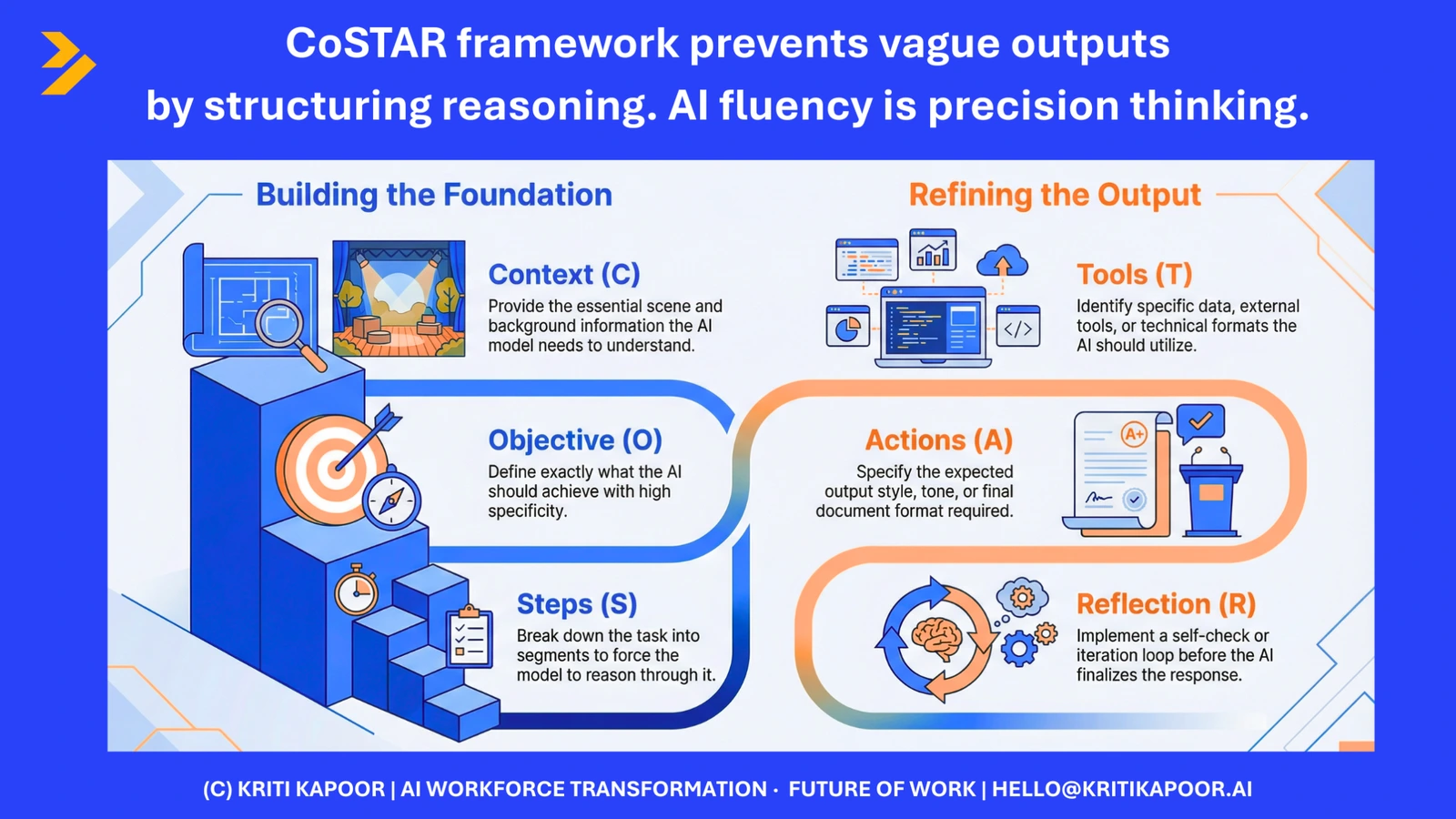
CoSTAR for Precision Thinking With AI LLMs - ChatGPT, Claude, Perplexity, Gemini, DeepSeek
⏩ Your Next Move:
Run CoSTAR once a week on a deliverable that matters. The data becomes your AI leverage narrative.
You are not behind. The performance criteria is shifting in real-time. And your digital backpack now includes:
- → Operating discipline
- → Prompt precision
- → Experience as a differentiator
Small moves, consistently made, transform careers.
Further Reading
- Harvard Business Review: https://hbr.org/2026/02/ai-doesnt-reduce-work-it-intensifies-it
- Beyond the Chatbot: The Four Roles Your Enterprise AI Team Needs https://www.linkedin.com/pulse/beyond-chatbot-designing-your-ai-team-kriti-kapoor-ycw5c
26.02.2026

Kriti Kapoor
Digital Innovation & Workforce Transformation
Author, The Mid-Career Digital Shift