 The Mid-Career Digital Shift
Mid-Career Futures
Beyond the Chatbot: Four Roles Your Enterprise AI Team Needs
Read original on LinkedIn
(C) Kriti Kapoor + Image collaborator ChatGPT (OpenAI)
A new Harvard Business Review study tracked AI adoption inside a 200-person technology company for eight months, across 40+ interviews spanning engineering, product, design, and operations.
The finding wasn't what most leaders expected.
Productivity surged. So did cognitive fatigue, boundary erosion, and workload creep. Workers expanded into tasks that weren't theirs, sent prompts during lunch breaks, and managed multiple AI threads simultaneously. Engineers found themselves reviewing and correcting AI-assisted work from colleagues across the organization, work that hadn't previously been part of their role. As one engineer put it: "You don't work less. You just work the same amount or even more."
Architecture determines outcomes. Always.
I've been working with AI since ChatGPT launched in November 2022. Early on, I ran a workshop for a leadership team that had invested in six AI subscriptions across their function.
Every person in the room was using at least two tools daily. Every person described feeling more scattered. The tools were capable. The stack had no design. One tool was doing everything, doing none of it particularly well. That session changed how I think about AI adoption entirely.
The question that matters: does each tool you are working with have a clear functional role?
Role Clarity Changes Everything
Think about the best team you've ever led or worked on.
Everyone knew their lane. The strategist focused on direction. The operator focused on execution. The analyst focused on structure. When roles were clear, performance compounded.
AI tools work exactly the same way.
A modern AI stack spans reasoning engines, memory systems, automation layers, and data pipelines. When you organize those tools by function, results become consistent. Learning accumulates. You stop resetting every time a new tool launches.
The researchers identified a self-reinforcing cycle that explains why unstructured adoption fails:
Acceleration → Higher expectations → Greater AI reliance → Broader scope → More total work
Each stage feels like progress. Collectively, they produce overload. The four-role framework below is designed to interrupt that cycle before it takes hold.
The Four Roles Your AI Team Needs
1. The Thinker
Expands your cognitive capacity
This is your strategic thinking partner. It explores scenarios, pressure-tests assumptions, refines language, and elevates decision quality before you act.
Tools: ChatGPT, Claude, Gemini, Perplexity
The Thinker sharpens judgment and elevates decision quality. When I'm preparing for a difficult stakeholder conversation or working through a positioning challenge, this is where I start.
2. The Organizer
Creates structured memory
Knowledge is only useful when you can find it, use it, and act on it.
The Organizer transforms messy inputs into decision-ready structure. Meeting transcripts become action items. Scattered notes become frameworks. Hours of reading become a one-page brief.
Tools: Notion AI, NotebookLM, Otter, Fireflies, Mem.ai
As information volume increases, the Organizer converts knowledge you have into knowledge you can actually deploy.
3. The Doer
Executes your repeatable workflows
Every week, you're doing work that doesn't need you.
Sending follow-up emails. Moving files. Triggering recurring tasks. Updating trackers. The Doer handles the operational layer so your attention stays where it creates the most value.
Tools: Zapier, Make, Microsoft Power Automate, Reclaim, Motion
The hours you recover here are restored capacity for the thinking only you can do.
4. The Connector
Integrates your systems
Isolated tools produce isolated insights.
The Connector turns your AI stack into a system. Calendars link to CRMs. Documents connect to databases. Data flows where it's needed, when it's needed.
Tools: LangChain, Flowise, API ecosystems, Slack integrations, Azure AI Studio
Without a Connector, you have capable tools operating independently. With one, you have leverage.
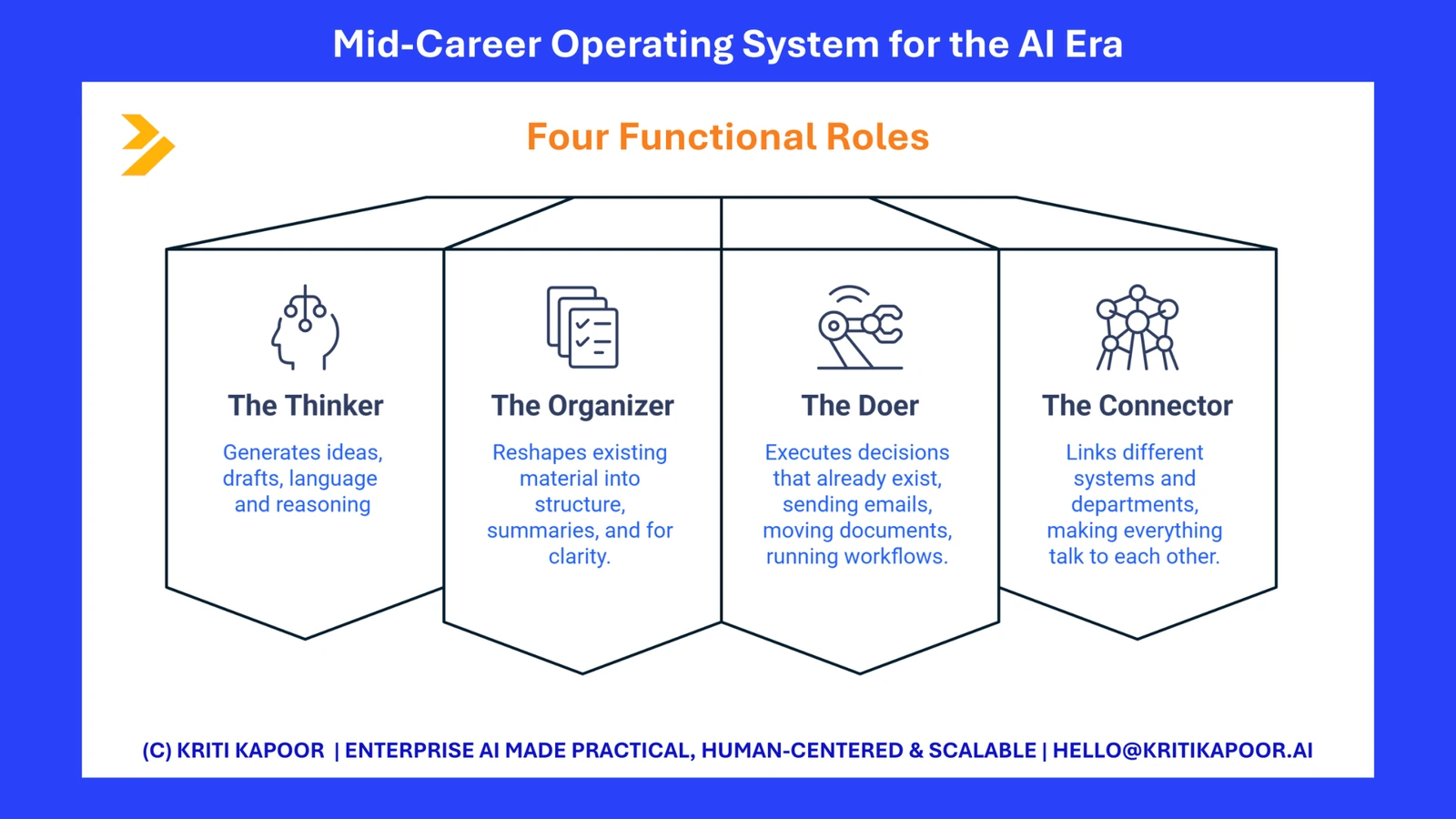
Four Functional Roles of AI | #MidCareerFutures #DigitalSkills #AILeadership
Building Your Stack with Intention
Start with the role that solves your most expensive problem. You don't need all four immediately.
The design principle worth carrying forward: one Thinker, one Organizer, one Doer, one Connector.
This structure reduces tool fatigue. It stops you from chasing every new launch. It gives your learning somewhere to land and compound.
Tools will change. Interfaces will improve. The role framework gives you continuity through all of it.
What This Means for Mid-Career Professionals
You're operating at the intersection of strategy and execution. Outcomes, alignment, and forward momentum are what you're measured on.
The Berkeley finding is worth sitting with: workers didn't feel less busy after AI adoption. They felt busier. AI made doing more feel possible, and without design, that possibility became pressure.
The professionals who avoid that trap are building architecture before the workload creep sets in. The harder leadership challenge is that silent intensity looks identical to genuine productivity, until it doesn't.
When your AI team is organized by role, you gain capability and control simultaneously. Decision quality improves. Communication sharpens. You move faster without burning more energy.
AI adoption is shifting from access to architecture. Every tool decision is a system decision.
Three Questions Before You Add Another Tool
⏩ Which role is carrying everything? If one tool is doing your thinking, organizing, executing, and connecting, it's doing none of them at full capacity.
⏩ Where is your biggest bottleneck? Thinking, organizing, executing, or connecting. The answer tells you where to invest first.
⏩ What would you do with the hours you'd recover? That answer defines the real return.
We are designing leverage now.
Small moves, consistently made, transform careers.
Which AI role has created the most measurable impact in your work? I'd love to hear from you.
SOURCES:
Ranganathan, A., & Ye, X. M. (2026, February 9). AI doesn't reduce work—it intensifies it. Harvard Business Review. https://hbr.org/2026/02/ai-doesnt-reduce-work-it-intensifies-it

Kriti Kapoor
Digital Innovation & Workforce Transformation
Author, The Mid-Career Digital Shift