 The Mid-Career Digital Shift
Mid-Career Futures
In the Age of Scaled Intelligence: Moving Up the Value Curve (Part 2/2)
Read original on LinkedIn
https://www.kritikapoor.ai/digital-shift | #midcareerfutures
In Part 1, we explored how AI is scaling intelligence and shifting value from execution toward direction.
The natural follow-up question is: What does this mean for mid-career professionals right now?
Because while the conversation around AI often focuses on technology, the real shift is happening at the level of role design, operating models and leadership expectations.
And this is where experience becomes a strategic advantage.
The Mid-Career Position Is Changing
Early-career professionals are learning quickly and adapting to new tools.
Senior leaders focus on long-term direction and enterprise strategy.
Mid-career professionals sit in a uniquely powerful position.
They translate.
Connect strategy with execution. Understand how decisions actually land inside teams. And see where complexity lives.
As intelligence becomes easier to access, that translation capability increases in value.
AI can generate outputs. However, It cannot easily navigate organizational reality.
The New Leadership Advantage: Integration and Orchestration
For years, career growth rewarded expertise.
Today, the emerging advantage is integration and orchestration.
The professionals gaining momentum are those who can:
- connect ideas across disciplines
- align people around change
- interpret signals from technology, markets, and teams
- make decisions when information is incomplete
This is not about knowing more.
It is about seeing patterns earlier and acting with clarity.
The Shift in Professional Identity
Many mid-career professionals built credibility through reliability and execution.
The next stage requires a different mindset.
The transition looks like this:
- from expert → integrator
- from operator → orchestrator
- from individual contributor → capability multiplier
This does not mean abandoning expertise.
It means using expertise to guide systems and people rather than carrying execution alone.
A Practical Framework for the Age of Scaled Intelligence
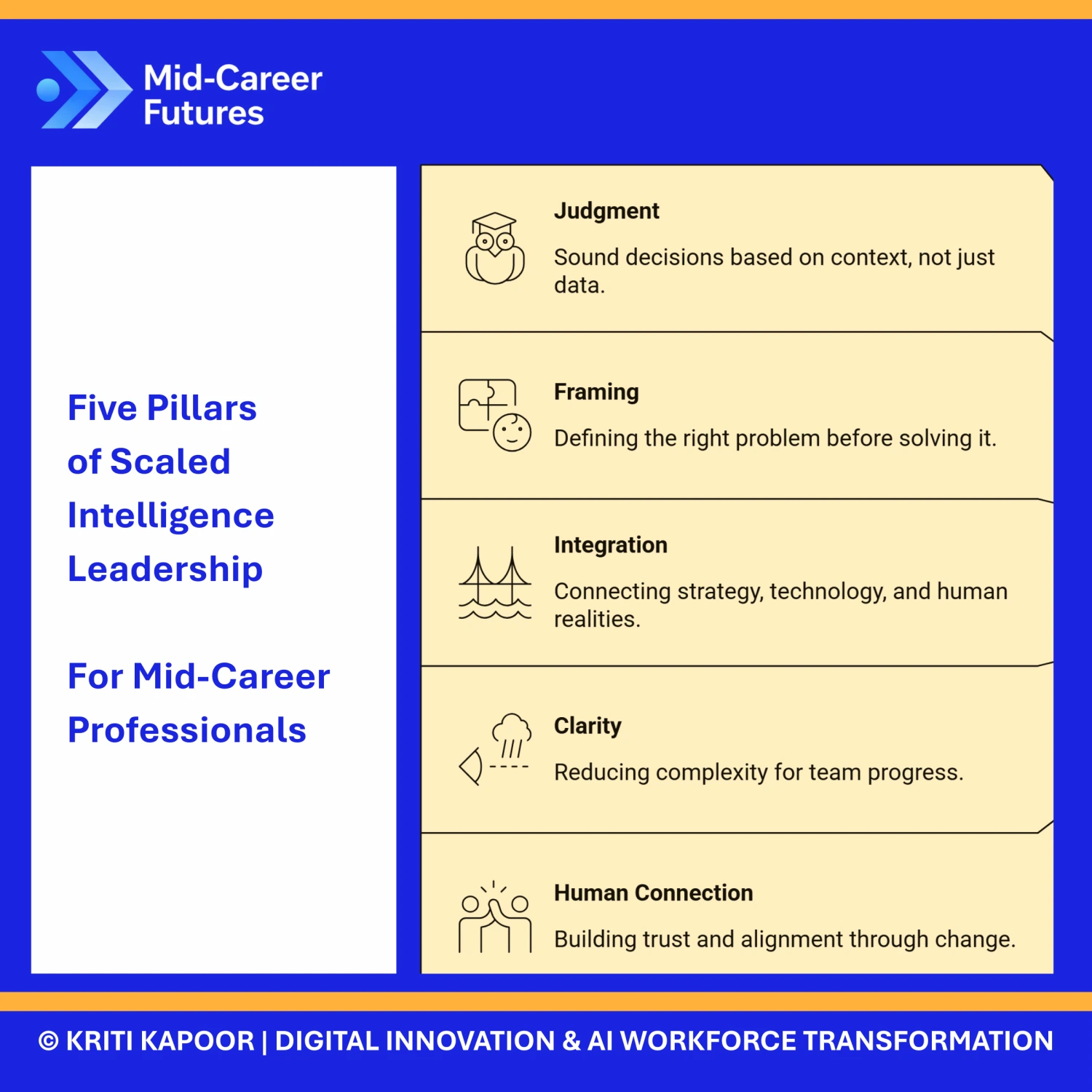
If intelligence is becoming abundant, leadership value concentrates in five areas:
1. Judgment Making sound decisions in context, not just based on data.
2. Framing Defining the right problem before solving it.
3. Integration Connecting strategy, technology, and human realities.
4. Clarity Reducing complexity so teams can move forward.
5. Human Leadership Building trust, alignment, and momentum through change.
These are experience-driven capabilities. And, they compound over time.
What This Means Going Forward
The future of work is not a competition between humans and AI.
It is a redesign of where humans create leverage.
Execution will increasingly be supported by intelligent systems.
Direction, interpretation, and leadership remain deeply human.
Which means mid-career professionals are not becoming less relevant.
They are becoming more strategically important.
Reflection for This Week
Where are you still operating as an executor when your real value may now lie in integration and direction?
I would love to hear what you are noticing as your role evolves.

Kriti Kapoor
Digital Innovation & Workforce Transformation
Author, The Mid-Career Digital Shift