 The Mid-Career Digital Shift
Mid-Career Futures
Mid-Career: When Experience Meets Resistance and Gets Stress Tested.
Read original on LinkedIn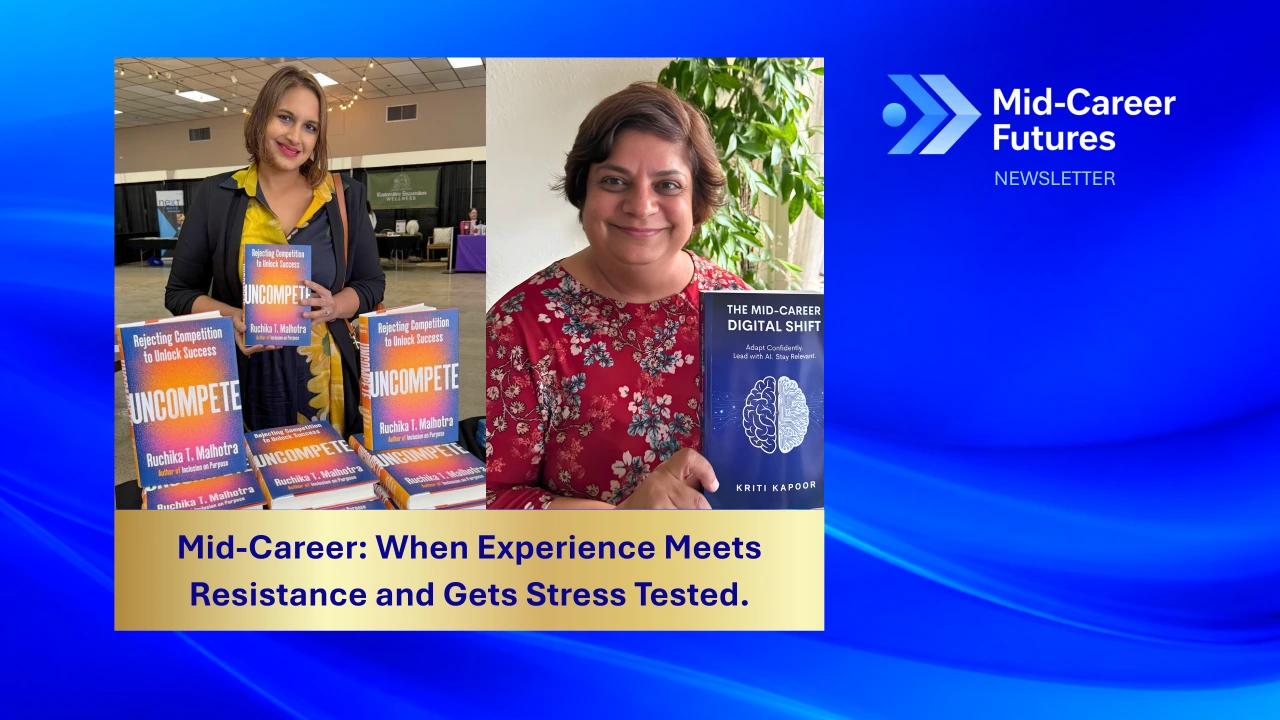
50 rejections in a year.
That's what a dear friend of mine, national bestselling-author, Ruchika T. Malhotra shared via LinkedIn this week. Advisory roles gone. Speaking engagements unravelled. Writing submissions declined, despite two decades on the page.
"Behind the 'glamour' is so much rejection," she wrote. "So very much."
During COVID, I had 250+ conversations and faced repeated rejection before landing one meaningful role at HP, after a year-long arduous job search during extenuating circumstances. Over two decades of cross-functional, global experience. A strong track record. Teams strengthened. Real results delivered. Still, something wasn't landing.
At the time, I didn't have the language or the courage to talk about it openly. I was focused on securing a great role, not on processing what I was experiencing internally. So I stayed quiet.
That itself is a form of rejection. The kind we do to ourselves.
We self-edit before anyone else gets the chance. We hold back ideas we should share. We don't reach out to people we know we should. We don't ask for help. We don't request support. We edit ourselves out of our own story.
And then there's the rejection that comes from outside. The interview loop that goes quiet. The job application or proposal that disappears into silence. The layoff. The demotion. The stalled promotions. The idea that was rigorous, data-driven, well thought through, and still didn't get adopted. Sometimes, we're just early, and the market is not ready.
When Experience Meets Barriers
This is what makes mid-career uniquely hard.
The ambition and aspirations don't disappear. They sharpen. After decades of building, you know exactly what you're capable of. You know what great looks like. You've seen what leading transformation entails. And then the barriers arrive, because the system hasn't caught up to where you are.
That deflation is specific. Doing everything right and still watching doors close. Being credentialed, experienced, and still invisible to the systems designed to evaluate you.
The 2025 Lovelace Report by Oliver Wyman names it plainly: 75% of women with 11 to 20 years of experience reported waiting more than three years for advancement. The primary barriers aren't family responsibilities. They are career progression that stalls and systems that reward visibility over capability. The "sticky middle," they call it. Structural misalignment dressed up as individual failure.
What I've come to understand from living through it: so much of what we experience is not a reflection of our capability or our value. It's the environment many of us are navigating. Budget cuts. Investments shifting toward AI. Workforce restructuring. The right career opportunities often come together after a stretch that feels far harder than it should.
The Layer Beneath
For women, there is a layer beneath this that rarely gets named.
Much of what we carry at this stage is invisible. Mentoring junior colleagues. Holding team culture together. Smoothing conflict. Onboarding new hires. Bridging gaps. Essential work that almost never gets counted when promotion decisions are made.
Then comes the guilt. Feeling knocked back while knowing others have it harder. As if your struggle needs to earn its place before you're allowed to feel it.
Add the pace of AI transformation, the expectation to reskill while still delivering, and you arrive at a very specific kind of exhaustion: having to overperform just to stand still. I call this the Triple Effort Reality™. Not a concept. A lived condition that millions of mid-career professionals are navigating right now, often in silence.
What Ruchika Understood
What stayed with me about her post wasn't the number. It was her response to it.
She didn't rush past it. She allowed space to sit with it. And she reminded us: we can only navigate these times by defining success on our own terms.
That reframe is not passive. It's a strategic move. Because here's what deflection costs you at this stage: if you're measuring your progress against someone else's timeline, someone else's title, someone else's version of arrival, you will always come up short. Comparison will cost you more than the rejection ever did.
The Rejection That Became the On-Ramp
Had that HP role not happened, The Mid-Career Digital Shift would not have happened.
HP became a genuine playground. Driving digital practices adoption. Designing learning experiences to enable thousands of new citizen developers to build automation solutions at scale. Testing ideas in the real world, with real constraints, real teams, and real results. The concepts at the heart of the book were built there, not in theory.
The rejection that preceded that role was not the end of the road. It was the on-ramp.
What This Moment Actually Needs
AI adoption is accelerating. Workforce expectations are being rewritten in real time. Organisational complexity is increasing as we speak.
Every experienced professional who exits or is being asked to leave mid-career takes domain expertise, customer insight, and institutional knowledge with them, at a cost organisations rarely calculate until it's too late.
The professionals who can bridge strategy to execution, technology to human outcomes, ambition to action, are exactly who this moment needs. That's not a consolation. It's a market reality.
Give Yourself Permission
Give yourself permission to be rejected and to be disappointed. Give yourself permission to face setbacks and to name what's happening. Give yourself permission to grieve and then to move forward.
And then ask the harder question: where has self-rejection been costing you more than the external rejections?
The external ones are visible. The internal ones compound quietly. We edit ourselves out before anyone else gets the chance. That's the pattern worth breaking.
As AI acceleration and digital disruption reshape careers across every industry, staying quiet about challenges makes the problem invisible. Talking about it, without judgment and without shame, is how we start to change the stigma associated with failure and rejection.
A hat tip to Ruchika for the courage to share openly. This conversation started with her honesty. It continues with ours.
You are building what the next chapter depends on. Keep going.
If this article resonated, and can be helpful to someone in your network, do share it forward. Also, I'd love to hear from you, here in the comments or via DM.
- Ruchika's latest book #Uncompete is out in stores now
- The Mid-Career Digital Shift is out on Amazon (Kindle & Print)
- Why mid‑career women are still leaving tech and what HR can do about it
"Alone we can do so little; together we can do so much" - Hellen Keller

Kriti Kapoor
Digital Innovation & Workforce Transformation
Author, The Mid-Career Digital Shift