 The Mid-Career Digital Shift
Mid-Career Futures
When the Signal and the System Arrive Together
Read original on LinkedIn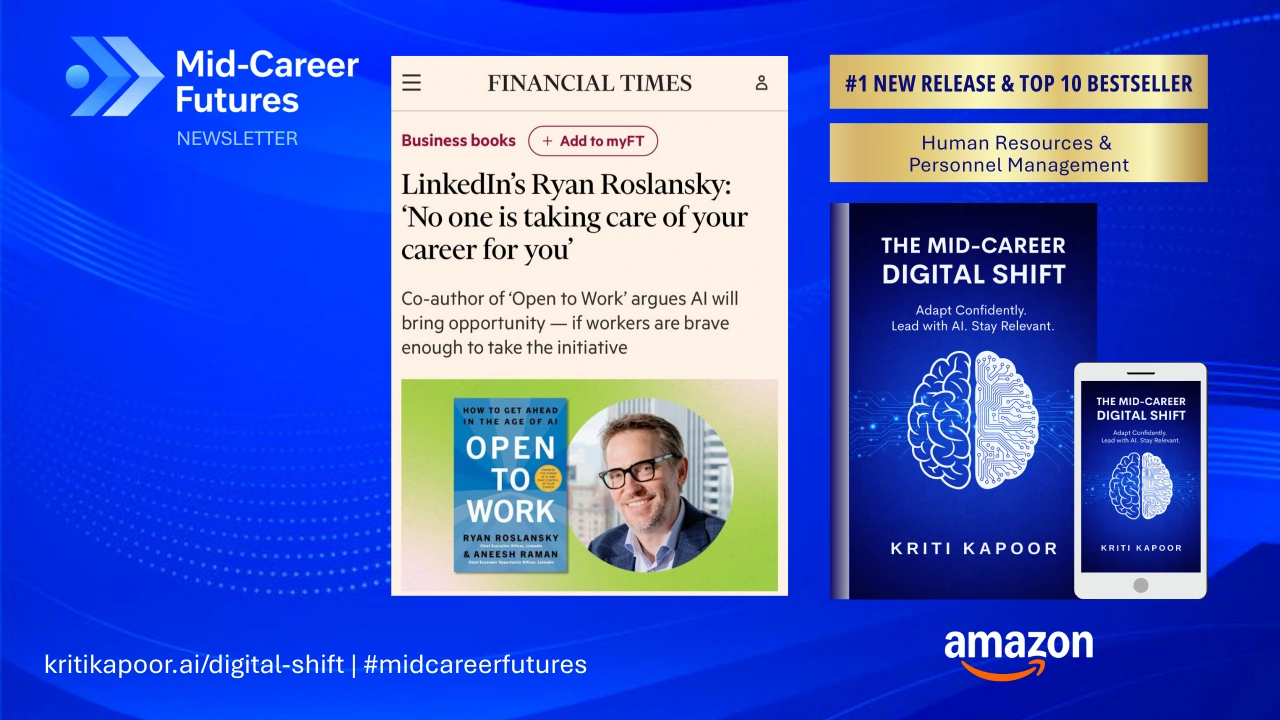
#OpenToWork and #MidCareerShift
Updated 28 April 2026
The future of work conversation for mid-career professionals just got more complete.
"Take control of your career in the AI age."
That is the tagline on the cover of Open to Work, the instant New York Times bestseller by Ryan Roslansky and Aneesh Raman, LinkedIn's former CEO and Chief Economic Opportunity Officer.
It is also the message at the heart of The Mid-Career Digital Shift.
Same conclusion. Different vantage points. One from the largest professional dataset in the world. The other from 25 years of leading enterprise transformation from the inside.
This week, both books landed in the same Amazon category at the same time. Open to Work as a global bestseller backed by LinkedIn's 1.3 billion member platform, Microsoft's marketing engine, and endorsements from Adam Grant, Brené Brown, and Jay Shetty. The Mid-Career Digital Shift as an independently published book with no platform and no PR machinery. Just readers who needed what was in it.
When that happens, something is being confirmed.
Global AI investment will exceed $500 billion in 2026. IDC projects the cumulative economic impact at $22.3 trillion by 2030. And yet 56% of CEOs report no significant financial benefit from AI. 95% of enterprise AI pilots deliver no measurable P&L impact. BCG's research is consistent: 70% of AI transformation value comes from people and processes, not the technology itself.
The scale of the moment is not in question. What is in question is whether people have what it takes to actually capture it.
What the Macro Is Telling Us
Open to Work is built around three themes that are now urgent for every professional: building in-demand skills, staying relevant, and taking control of your career. Roslansky and Raman make the case from 1.3 billion professional profiles, hiring patterns, and skills transitions. That vantage point is rare.
The core model is genuinely useful. Work now splits into three layers: what AI can do alone, what AI can do with you, and what only you can do. Careers are no longer ladders but climbing walls. Jobs are breaking into tasks. The 5 Cs, curiosity, courage, creativity, compassion, and communication, are what the authors call "survival skills." Not soft skills. Survival skills. The 30-60-90 day plan gives structure. The three-bucket diagnostic forces a question most professionals have been avoiding: which parts of your job belong to AI, and which belong to you?
The intent throughout is clear. Humans with AI, not AI replacing humans. Raman's framing of the challenge: "It is completely understandable to be fearful. It is also completely unhelpful."
Open to Work names the shift with the authority of the world's largest professional data set. It forces the question. What it cannot answer is what comes next for the experienced professional who already understands the question but has no structured path through it.
What the Micro Confirms
I have spent 25 years inside that gap. At Microsoft, HP, Dell, and UiPath. Leading large-scale transformation programmes, upskilling 250,000 people, navigating the distance between what executives decide and what frontline teams can actually execute.
The Mid-Career Digital Shift was not written in response to a trend. It was built from the inside of that work, because the gap I kept seeing was always the same: professionals who understood the shift but had no structured way to act on it.
The book covers the same three themes as Open to Work: building in-demand skills, staying relevant, taking control of your career. But through the full lens of digital transformation, not just AI. The digital shift is broader and deeper than AI adoption alone. It includes how work is organised, how decisions are made, how capability is built at scale, and how value is created across an organisation. AI is a critical part of that shift. It is not the whole shift.
The WEF's Future of Jobs Report 2025 projects that 39% of workers' core skills will change or become outdated by 2030. More than 120 million workers face medium-term risk if they don't reskill. Deloitte's research across 3,000+ leaders consistently names insufficient worker skills as the biggest barrier to integrating AI into workflows. The bottleneck is not capital or intent. It is the capability to translate.
The Digital Practices Framework™ maps the specific capabilities that matter across Navigate, Operate, and Lead. The ADAPT Method™ provides a repeatable cycle for continuous transformation. Mid-career professionals aren't navigating one transition. They're navigating continuous transformation. A method that repeats is more useful than a plan that concludes.
Why the Convergence Matters
Raman's sharpest line: "Nobody is coming to save any individual but themselves."
When LinkedIn's CEO writes a book called "Take control of your career in the AI age" and a practitioner with 25 years of enterprise transformation experience arrives at the same message from the inside, that is not coincidence. It is confirmation that the shift is real, the stakes are high, and individual agency is now the only reliable variable.
Open to Work sees the pattern from the macro. It names the problem with the authority of 1.3 billion data points.
The Mid-Career Digital Shift was built from the micro: from living inside organisations during transformation, from developing frameworks with professionals across public health, nonprofit leadership, enterprise sales, process management, and technology implementation. From understanding what actually breaks, and what actually works.
Scale sees the pattern. Experience knows the path.
My Recommendation
Read Open to Work. Use it to name what you are already feeling and to start moving. The three-bucket diagnostic, the 90-day structure, the 5 Cs. Raman's reminder: "No one beats you at being you. Not even AI."
Work through The Mid-Career Digital Shift as a guide for the essentials of digital transformation and an operating system for the execution layer. Understand the full scope of the digital shift. Map the capabilities essential to your role and organisation. Build a repeatable practice for continuous transformation. The equation: Your Experience + Digital Practices + AI Partnership = Exponential Value.
Goldman Sachs projects $1.15 trillion in AI infrastructure investment between 2025 and 2027. The bottleneck is not capital. It is the human capability to turn that investment into outcomes.
Now on Amazon.com
#MidCareerFutures Newsletter
Kriti Kapoor
Digital Innovation & Workforce Transformation
Author, The Mid-Career Digital Shift