 The Mid-Career Digital Shift
Mid-Career Futures
Singapore at 60: The Discipline of Turning Change into Capability
Read original on LinkedIn
(c) Kriti Kapoor #midcareerfutures
One of the central themes in my book, The Mid-Career Digital Shift, is how we ADAPT with confidence in the AI era.
Singapore offers a powerful lens for that idea because its national story has been one of deliberate, disciplined reinvention. Over the last six decades, this island nation has moved from a resource-constrained young nation into a high-income, globally connected economy. Its deeper story is one of turning constraint into capability.
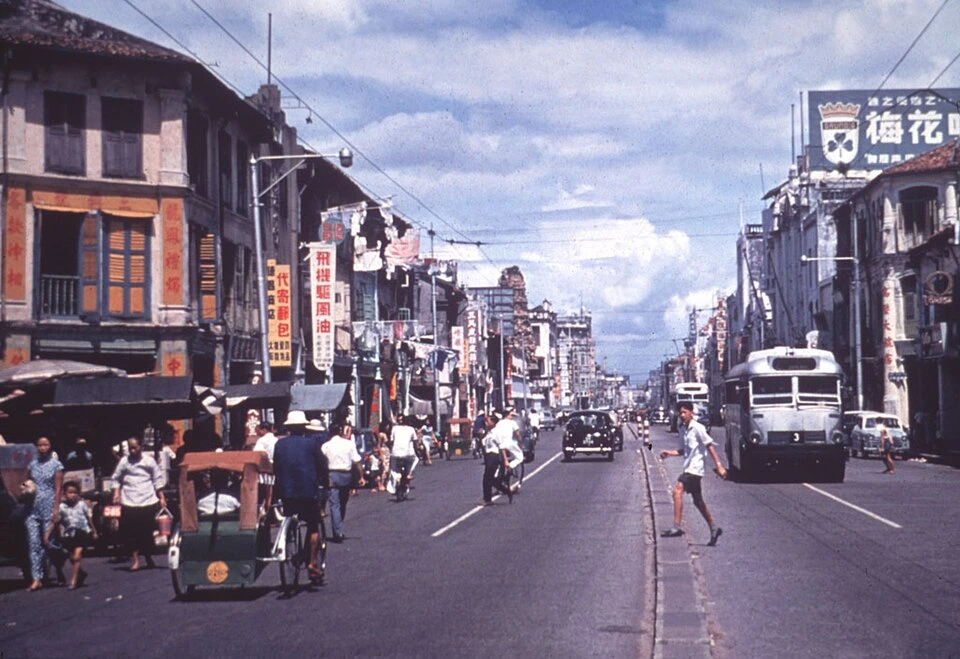
Image: South Bridge Road, Singapore, 1965. Source: Wikimedia Commons.
1. From survival to industrialisation
In its early years, Singapore focused on the fundamentals: jobs, housing, education, infrastructure, and foreign investment. With no natural resources, the country built its advantage around people, trust, connectivity, and execution. Reinvention became a practical necessity. The priority was clear: create stability, build capability, and lay the foundation for future growth.
2. From manufacturing to global services
As wages rose and global competition intensified, Singapore shifted into higher-value sectors such as finance, logistics, electronics, petrochemicals, biomedical sciences, and professional services. The country moved up the value chain with discipline. That ability to pivot while strengthening the basics became one of Singapore’s defining strengths.
3. From efficiency to innovation
From the 2000s onward, Singapore’s focus expanded from productivity and infrastructure to innovation, entrepreneurship, digital government, and knowledge work. Efficiency remained important. The next source of advantage came from building new capabilities, new ecosystems, and new forms of value.
4. From digital adoption to AI-readiness
Today, Singapore’s adaptation challenge is increasingly about workforce transformation.
In 2024, Singapore’s digital economy reached S$128.1 billion, approximately US$99 billion, accounting for 18.6% of GDP. This was up from 14.9% in 2019, with growth driven by digitalisation and AI adoption across sectors. IMDA also reported that 3 in 4 workers surveyed use AI tools regularly, and 85% of AI-using workers said AI helps them work faster and better.
This marks an important shift. Digital adoption is now moving into a deeper question of capability: how people and organisations use AI responsibly, productively, and confidently to improve how work gets done.
5. From lifelong employment to lifelong employability
Singapore’s future strategy is increasingly centred on skills, adaptability, and resilience.
SkillsFuture frames this as a national movement to help Singaporeans build future-ready skills and resilient careers, supported by government, employers, unions, individuals, and industry partners. This matters because past qualifications have a shorter shelf life in a fast-changing economy.
Employability now depends on the ability to keep learning, keep applying, and keep translating experience into new forms of value.
The future-forward lesson
Singapore’s competitive advantage has been its ability to take change seriously, translate it into capability, and scale that capability across the economy.
That is the deeper lesson from Singapore’s 60-year journey of reinvention. The next decade will require this city and its people to extend its strengths into an AI-enabled economy.
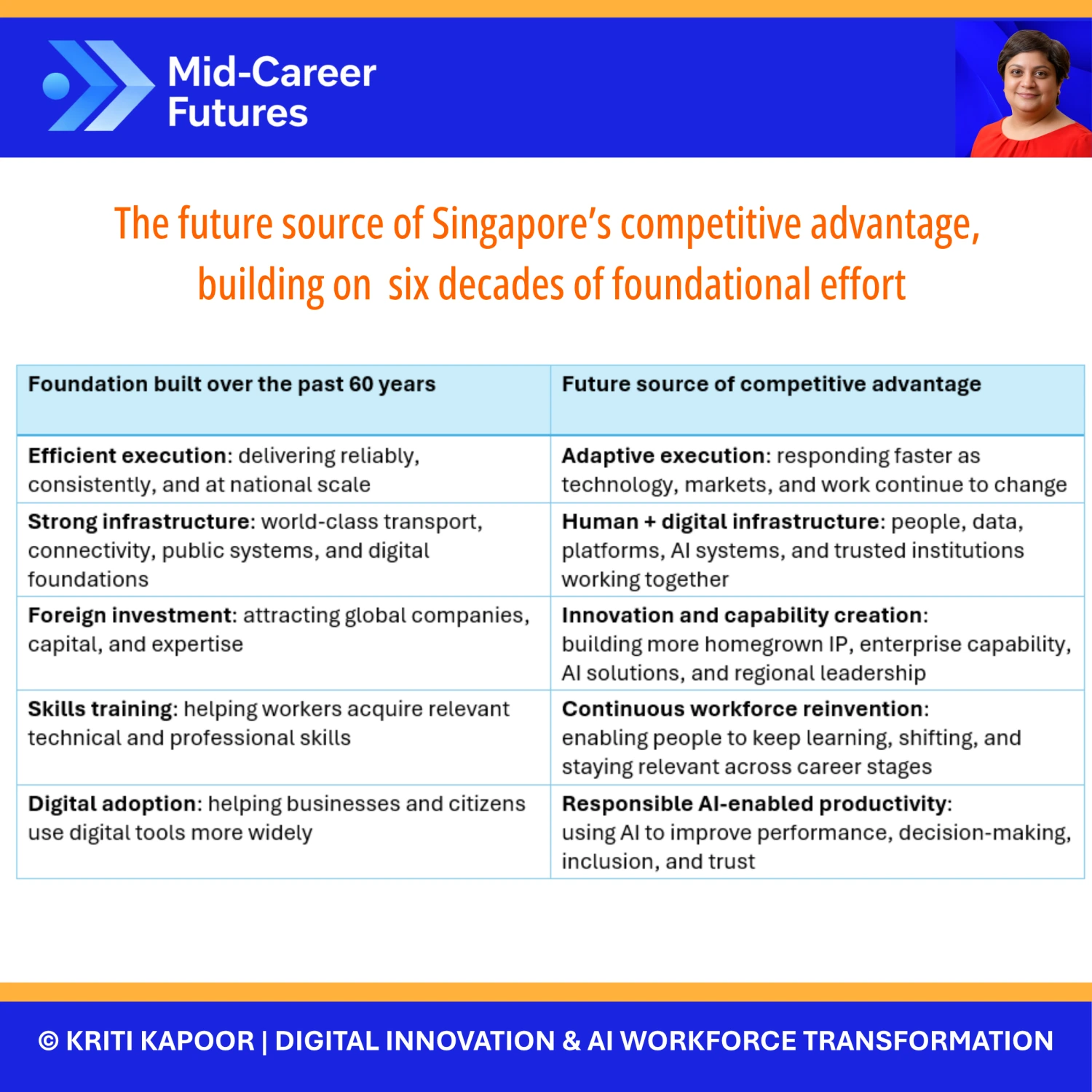
Efficient execution must evolve into adaptive execution. Strong physical infrastructure must expand into human and digital infrastructure. Foreign investment must be matched by innovation and capability creation. Skills training must become continuous workforce reinvention. Digital adoption must mature into responsible AI-enabled productivity.
The principle remains the same:
Keep learning. Keep adapting. Keep turning change into capability.
That is the real lesson for mid-career professionals too. Career relevance is renewed, translated, and strengthened through every tectonic wave of change.
Also worth reading:
- Harvard Business Review by Prof. Lynda Gratton on mid-career shifts. https://hbr.org/2026/05/research-as-careers-get-longer-midcareer-work-needs-to-change
- Singapore just placed AI at the centre of its economic strategy for the next decade. https://www.linkedin.com/pulse/singapore-just-placed-ai-centre-its-economic-strategy-kriti-kapoor-b2b9c
Sources:

Kriti Kapoor
Digital Innovation & Workforce Transformation
Author, The Mid-Career Digital Shift