 The Mid-Career Digital Shift
Mid-Career Futures
How do we build a workforce that is genuinely ready for the AI era?
Read original on LinkedIn
Over the past few months, I’ve been speaking with CHROs and leaders across people, culture and talent development about a shared challenge:
How do we build a workforce that is genuinely ready for the AI era?
Our conversations have moved beyond the future of work as an abstract idea. We are exploring the capabilities people need, how learning and development must evolve, and what leaders can do now to help their workforce adapt, contribute and grow alongside AI.
For decades, organizations have planned their workforce around roles.
Roles defined specific responsibilities, structured career paths, hiring criteria and organizational structure. That model worked when jobs changed gradually and people could rely on established expertise for much of their careers.
AI is changing work at a different speed.
Tasks are being automated, augmented and redistributed across people, platforms and AI agents. Job titles may remain the same while the work inside them changes significantly.
This creates a new leadership question:
Roles are becoming containers for changing work
A role such as marketer, financial analyst, HR business partner or customer service manager is no longer a fixed collection of responsibilities.
Consider a marketing manager. Their evolving work may require:
- Interpreting customer and behavioral data
- Collaborating with AI to generate and test content
- Designing automated customer journeys
- Evaluating AI-generated recommendations
- Applying human judgment to brand, ethics and customer trust
- Learning new platforms as the technology changes
The title may stay the same. The skills, tools and decisions within the role continue to evolve.
The World Economic Forum estimates that 39% of workers’ existing skill sets will be transformed or become outdated between 2025 and 2030. It also projects that 59 out of every 100 workers will require training during that period.
The shift from role readiness to capability readiness
Organizations need a more dynamic understanding of readiness.
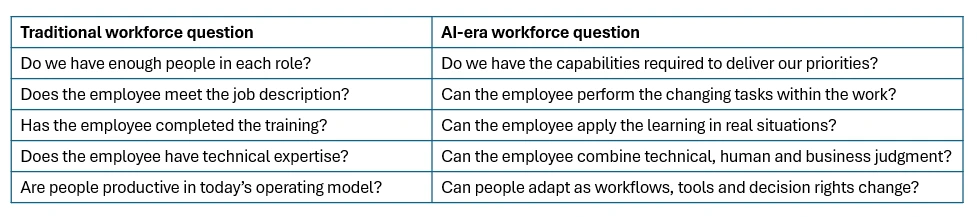
This does not make roles irrelevant. Roles still provide accountability, identity and organizational clarity. Skills provide the more granular view needed to understand how work is changing and where capability gaps are emerging.
AI readiness requires a combination of capabilities
AI-ready employees need more than prompt-writing skills or access to a new tool. Their readiness depends on several connected capabilities.
1. Domain expertise
People need to understand the customer, process, profession or business problem well enough to evaluate AI-generated outputs.
AI can produce an answer. Domain knowledge helps determine whether that answer is useful, accurate and appropriate.
2. AI fluency
AI fluency means knowing how to select, instruct, question and collaborate with AI. It also includes understanding limitations, risks and the circumstances that require human oversight.
The goal is purposeful application, moving from occasional AI use to redesigned ways of working.
3. Data and critical thinking
Employees need to assess evidence, recognise weak assumptions and distinguish plausible output from reliable insight.
As generating content becomes easier, evaluating quality becomes more valuable.
4. Human and relational capabilities
Communication, empathy, creativity, collaboration and ethical judgment remain central. The World Economic Forum identifies analytical thinking, resilience, leadership and collaboration alongside AI and technology skills as critical to growing jobs.
5. Learning agility
Readiness increasingly depends on whether people can learn, unlearn, experiment and transfer what they learn into new contexts.
Expertise still matters. Its value grows when it is paired with adaptability.
Learning must move closer to the work
Many organizations are responding to AI disruption by adding more training. Training is important, but access to content does not guarantee capability.
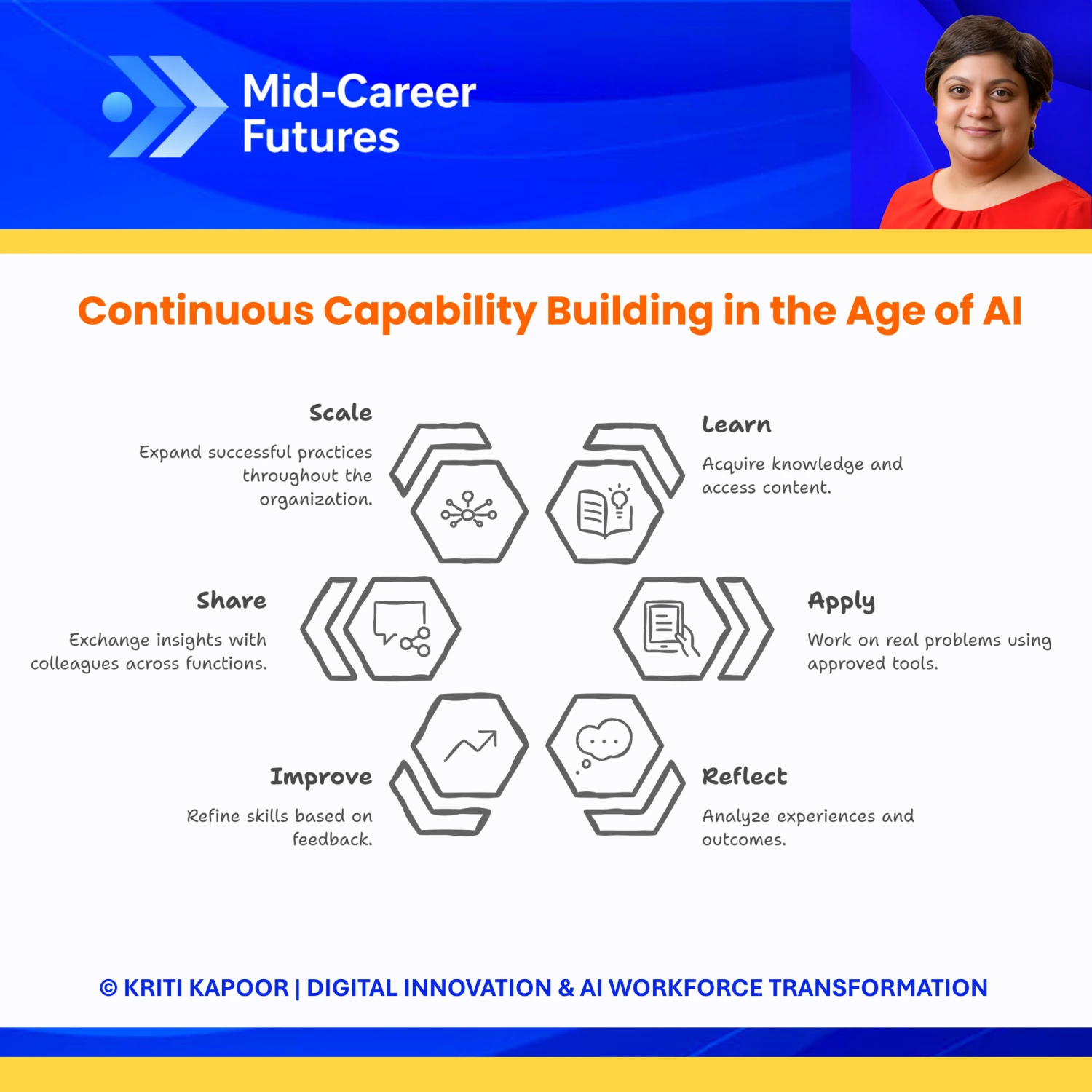
People develop fluency through a repeated growth cycle:
Learn → Apply → Reflect → Improve → Share → Scale
This requires opportunities to work on real problems, use approved tools, receive feedback and learn from colleagues across functions.
The OECD’s workplace AI research found that training and worker consultation were associated with better outcomes for employees. This reinforces the importance of involving people in the redesign of their work, rather than treating AI adoption solely as a technology deployment.
What leaders need to do differently
A skills-based approach is more than creating a skills taxonomy. Leaders need to connect skills directly to strategy, work design and opportunity.
Five practical actions can help:
- Identify the work that is changing. Examine priority workflows and determine which tasks will be automated, augmented, created or retained as distinctly human responsibilities.
- Define the capabilities required. Translate strategic priorities into observable skills and behaviours across business, digital, AI and human domains.
- Assess capability through evidence. Use work samples, demonstrations, simulations and business outcomes alongside self-assessments and course records.
- Create learning pathways through real work. Give employees access to projects, mentors, communities of practice, experimentation environments and cross-functional assignments.
- Make skills visible and portable. Help people understand what they can already do, what adjacent opportunities are available and what they need to learn next. The OECD specifically highlights skills-first hiring, effective career guidance and portable credentials as important elements of modern skills systems.
Workforce readiness is becoming organizational adaptability
The defining capability of an AI-ready workforce is the ability to keep adapting while continuing to deliver value.
- Roles tell us where someone sits.
- Skills tell us what someone can do.
- Readiness tells us whether people, teams and institutions can apply those skills as the work changes.
The organizations that thrive in the AI era will build more than AI-literate employees. They will create the systems, leadership practices and learning conditions that allow people to become confident users, thoughtful collaborators and capable builders of new ways of working.
The future of work will be shaped by technology. The quality of that future will depend on how intentionally we develop human capability.
Additional insights:

Kriti Kapoor
Digital Innovation & Workforce Transformation
Author, The Mid-Career Digital Shift