 The Mid-Career Digital Shift
Mid-Career Futures
The Future of Work Asks More of Us
Read original on LinkedIn
(c) Kriti Kapoor | #futureofwork #midcareerfutures
For many mid-career professionals, the rapid rise of generative AI has sparked a persistent, underlying anxiety. We often find ourselves asking: "When does this end? What does the finish line for AI transformation actually look like?"
The answer is a strategic pivot: there is no finish line. We must dismantle the myth of the "End State" to protect our long-term career equity. AI transformation is not a project with a set completion date; it is a fundamental reconfiguration of professional value.
To navigate this landscape, we must move beyond the exhausting race toward a non-existent destination and instead focus on how we evolve alongside the technology. As Katy George, Microsoft’s Corporate Vice President of Workforce Transformation, recently observed, this shift requires leaders and managers to provide clarity, reassurance and psychological safety so that employees can keep learning as AI evolves. Yet many organisations have not redesigned their structures, incentives and management practices to provide that support consistently.
Over the past month, I have advised CHROs and People & Culture leaders, contributed to conversations on the future of work and workforce capability transformation through book talks and podcasts, and immersed myself in two different Agentic AI accelerators.Across these very different rooms, a consistent set of themes has begun to emerge.
Net net, the future of work is asking more of us.
1. There is No "Finish Line" in AI Transformation
The concept of a definitive end state for AI integration is a dangerous misconception. This realization was the primary driver behind my book, The Mid-Career Digital Shift, which grew from three years of research and lived experience. The transition from initial concept to publication took nearly a year—a timeline that mirrors the very process of digital transformation: it is a continuous journey of adaptation rather than a one-time leap.
Embracing the "journey" mindset is not just a philosophical choice; it is a prerequisite for building durable capabilities. When we stop looking for an exit ramp, we shift our focus to career longevity. This perspective allows us to view our roles as evolving narratives where staying relevant is an ongoing practice of refinement. In this new ecosystem, a "finish line" mindset leads directly to obsolescence.
2. The "Triple-Effort Reality™" is the New Baseline
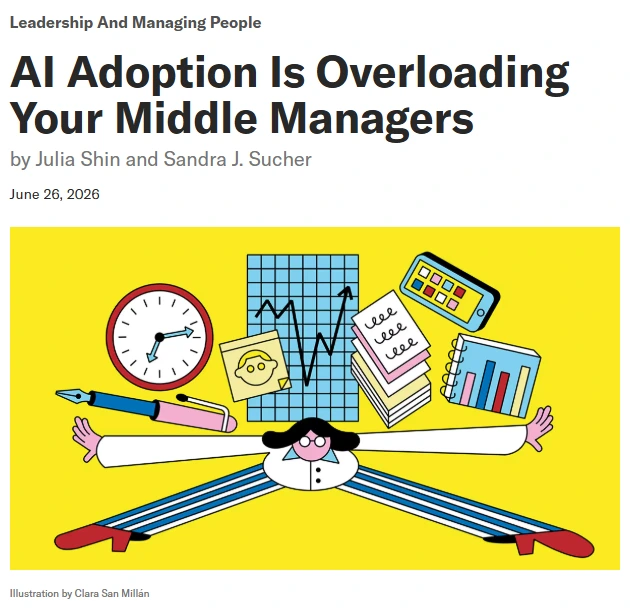
In the current landscape, the expectations placed on experienced professionals have tripled. Organizations often demand high-level output while failing to account for the hidden labor required to integrate new technology. This is the Triple-Effort Reality™, a demanding framework that requires professionals to manage three simultaneous streams of work:
- Delivering day-to-day results: Maintaining standard performance and meeting current business objectives.
- Translating between systems: Acting as the essential bridge between business needs, emerging technology, legacy systems, and new ways of working.
- Continuous learning and experimentation: Dedicating time to test how AI changes specific work functions in real-time.
https://hbr.org/2026/06/ai-adoption-is-overloading-your-middle-managers
Currently, many organizations fail to measure or plan for this massive increase in workload, leading to burnout. As we have been observing, AI skills are not built through an occasional course or a one-off workshop.
Building these capabilities takes significant time and judgment—precious resources that are often already stretched thin by the demands of the "day job."
3. AI Fluency Means Managing Systems, Not Just Using Tools
There is a profound difference between knowing how to use an AI tool and possessing true AI fluency. The old expectation was simply to operate software; the new requirement is to redesign workflows, build solutions, and coordinate the complex interaction between human talent and machine output.
Leaders do not need to be coders, but they must possess enough fluency to manage the people and systems that produce the work. This includes the strategic ability to:
- Ask useful, probing questions that challenge the model.
- Spot weak, biased, or inaccurate outputs that others might miss.
- Make sound investment decisions regarding which technologies deserve a seat at the table.
Ultimately, human judgment is the ultimate override in this new ecosystem. Technology can generate, but the professional must decide when the system’s output meets the necessary standard and when it must be rejected.
4. Learning Must Move from the "Edges" to the "Core"
For decades, professional development was treated as an "extra" activity—something handled in the gaps between meetings or on a weekend. In an AI-driven environment, this model is dead. Learning must move from the "edges" of the job to its "core."
Enterprise AI readiness is not built through theoretical study; it is forged through repeated practice, feedback, and course correction. To succeed, organizations must empower managers who treat learning as a critical part of delivery. This requires a fundamental shift in how we view "work time," ensuring teams have:
- Protected time specifically for iteration and solving live problems.
- Permission to experiment without the threat of immediate failure.
- Clear guardrails to manage risk while pushing boundaries.
The real constraint to AI adoption is rarely a lack of willingness; it is a lack of human capacity.
5. Psychological Health is a Professional Capability
The pressure to constantly reinvent oneself and absorb high levels of uncertainty takes a significant emotional toll. We are seeing a phenomenon that began in the tech sector now becoming pervasive across every industry and profession. The speed and scale of AI-driven disruption are unprecedented. As Yuval Noah Harari observes, “The AI revolution is not a one-time event.”
Because of this, resilience is no longer a "soft skill"—it is a critical professional capability.
Maintaining technical fluency is only half the battle. The other half is managing the human cost of continuous disruption. As the research suggests, psychological health will be as critical as professional capability.
To thrive, we need more than technical agility; we need self-awareness and supportive communities. Workplaces must recognize that the psychological capacity to keep evolving is a finite resource that requires active protection.
The Future of Work Asks More of Us
Navigating the future of work is not about reacting to fear; it is about operating with clarity, confidence, and agency. As AI continues to reshape roles and business models, the demand on our ability to adapt will only increase. We must move forward with intention, ensuring we are building durable capabilities that remain valuable even as the tools change.
Reflection for the week: Is your organization making room for the Triple-Effort Reality, or just adding to the load?
Additional insights:
- HBR: The AI Revolution Won’t Happen Overnight (June 2025)
- HBR: AI Adoption Is Overloading Your Middle Managers (June 2026)
- The end of lifetime careers - Yuval Noah Harari
- Nine Out Of 10 Leaders Say Life Skills More Important Than AI/Technical Skills
- HBR: the Predictable Executive Career Arc is over by Lynda Gratton

Kriti Kapoor
Digital Innovation & Workforce Transformation
Author, The Mid-Career Digital Shift