 The Mid-Career Digital Shift
Mid-Career Futures
Rebuilding Self-Belief in Mid-Career
Read original on LinkedIn
A particular kind of confidence wobble is showing up in mid-career.
You may have spent 15, 20, perhaps 25 years building expertise, credibility, relationships and a professional identity you trust. You know how to navigate complexity, solve difficult problems and get things done. Your judgment was earned the hard way.
And now the ground is moving.
I know this feeling firsthand. After nearly three decades in enterprise technology, I have had to keep learning as the work, the tools and the expectations have changed around me.
In April 2026, Quartz reported a 31-month contraction in US white-collar payrolls, drawing on employment trends across professional and business services, financial activities and information. According to former Glassdoor chief economist Aaron Terrazas, a contraction of this length outside a recession is highly unusual (Quartz Staff, 2026).
In January 2026, Amazon announced organizational changes affecting approximately 16,000 roles, following 14,000 reductions three months earlier. The company said it was reducing layers, increasing ownership and removing bureaucracy. Separately, CEO Andy Jassy had said that efficiency gains from AI were expected to reduce Amazon's total corporate workforce over the next few years (Galetti, 2026; Jassy, 2025).
AI is one part of the story. Pandemic-era overhiring, cost pressures and economic uncertainty are also reshaping the market. Together, these forces are changing what organizations need, how work gets done and what employers expect from the people they hire.
For people with established careers, the effect can feel deeply personal. Roles are changing even when you have done nothing wrong. Skills that once distinguished you are becoming standard. New capabilities are emerging faster than many organizations can teach them.
We are being asked to learn, adapt and reconsider how we create value, on a timeline none of us chose. It is no surprise that even accomplished professionals wonder: Am I still relevant? Can I keep up? Is what I know still valuable? How do I separate hype from reality?
The career challenge is bigger than acquiring new skills. It also involves keeping trust in yourself while the rules of the game are changing.
That is why self-belief is becoming an essential capability for navigating a career in the AI era.
The harder part of learning again
The sensible response to a changing world of work is to keep learning. The harder part is accepting that learning often means becoming a beginner again.
Earlier in your career, asking basic questions and making mistakes were expected. You were there to learn. Now that you are one of the most experienced people in the room, you are expected to already know.
Starting again can feel like more than a learning curve. It can threaten the professional identity you have spent years building.
That is when the inner critic gets loud: You should know this already. You are falling behind. Everyone else seems further ahead. Maybe you have lost your edge.
These fears exist for a reason. In Microsoft's 2026 survey of 20,000 AI users across 10 markets, 65% said they feared falling behind if they did not use AI to adapt quickly. At the same time, 45% said it felt safer to focus on their current goals than to redesign their work with AI.
You know you need to adapt, yet adapting can make you feel less capable before it makes you feel more capable.
The danger comes when that discomfort turns into a verdict about who you are.
- I have not learned this yet becomes I am becoming irrelevant.
- That role did not work out becomes The market does not want me.
- I do not know exactly what is next becomes I have lost my way.
Those statements might sound similar when you are discouraged. They mean very different things. One describes a situation that can change. The other turns that situation into an identity.
For this discussion, I use the distinction this way:
- Self-confidence says, I know I can do this.
- Self-belief says, I do not know how to do this yet, and I trust in my ability to learn, grow and adapt.
Confidence comes more easily when you know the territory. Self-belief carries you when you do not. That trust matters most when the work, tools and expectations around you keep changing.
Self-belief is the quiet confidence that you can meet uncertainty with curiosity, learn what is needed and successfully navigate your way forward. Rebuilding it begins with separating what is actually changing in the world of work from what fear is telling you about yourself.
Stop treating every gap as a verdict
Affirmations can steady us. An honest diagnosis gives us something concrete to act on.
Some of what you are experiencing may be a reasonable response to a market that has become more demanding. Revelio Labs found that the typical external hire in 2026 brought roughly two more years of experience than in 2019. This pattern appeared across seniority levels, suggesting that employers are raising the experience threshold and prioritizing people who can contribute quickly (Munyikwa, 2026).
If your job search is taking longer than it used to, that context matters. The market may have changed. Employers may have become more selective. Your positioning may need to evolve. None of this automatically means something is wrong with you. The goal is to replace a vague sense of inadequacy with a specific problem you can address.
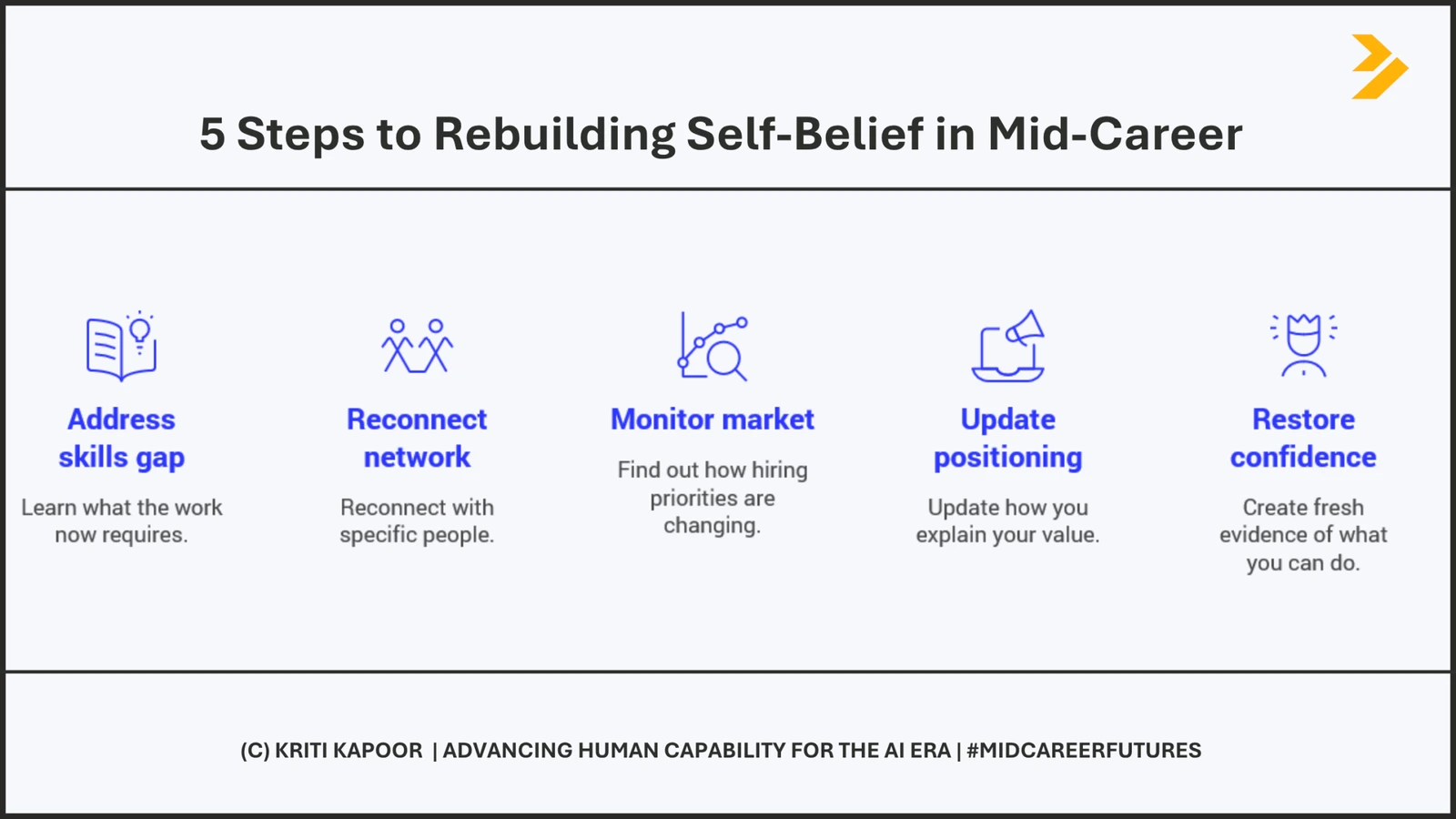
- Is there a skills gap? Learn what the work now requires.
- Has your network gone quiet? Reconnect with specific people.
- Is the market moving? Find out how hiring priorities are changing.
- Has your positioning become dated? Update how you explain your value.
- Has your confidence dropped? Create fresh evidence of what you can do.
These questions move you from judgment to diagnosis, and from diagnosis to a next step.
You can use the same approach when the inner critic speaks.
- What is wrong with me? becomes What problem am I trying to solve?
- I am behind on AI becomes Which AI capability matters for the work I want next?
- My experience is losing value becomes Which parts of my experience matter most now, and what new capability would strengthen them?
Once the problem becomes specific, action follows more easily.
We often want confidence to arrive before we act. In practice, confidence frequently returns after we do something. Action creates evidence. Evidence strengthens self-trust. Self-trust makes the next action easier.
Uncertainty can create a different loop. It leads to overthinking. Overthinking delays action. Without recent evidence of progress, confidence falls further.
Across my own work in enterprise technology, I have watched senior leaders with decades of experience hesitate around a tool they had barely explored. Their ability had not disappeared. What was missing was fresh evidence that they could learn and use it.
If confidence grows from evidence, the next step is clear: start creating new evidence.
Create new evidence
Begin with the work itself. Treat the job title as a secondary clue.
Job titles are changing, and the same title can now contain very different work. Look at the underlying tasks and you will see more clearly what is becoming automated, what is becoming more valuable and where your experience still makes a difference.
- Which tasks can now be automated?
- Where could AI improve the speed or quality of my work?
- What is becoming more valuable as routine tasks take less time?
- Where do judgment, relationships, context and the ability to navigate ambiguity remain essential?
These questions move you past the vague pressure to "get better at AI." They connect learning to the work you actually want to do.
Then ask yourself: What can I do now that I genuinely could not have done a year ago?
Microsoft found that 58% of the AI users it surveyed were producing work they could not have produced a year earlier. Among Frontier Professionals, the most advanced AI users in the study, that figure rose to 80%.
The useful question is: where are you building your own evidence?
AI can help you research, analyze, prototype, draft, personalize and test ideas faster. For experienced professionals, the opportunity lies in combining that speed with a deep understanding of customers, organizations, people and the consequences of real decisions.
Technology expands what you can produce. Experience helps you decide what is worth producing, how to use it responsibly and whether it will work in the real world.
Your experience still matters. It also needs room to keep developing.
You do not need a perfect picture of your next professional identity before you begin. Professor Herminia Ibarra's research on career reinvention shows that people gain clarity by testing possibilities, taking on new activities and connecting with different professional communities. Action itself produces information (Ibarra, 2023).
Doing helps you discover what fits.
Have the conversation you have been avoiding. Try the tool properly, more than once. Take the course, then apply what you learned to real work. Write the article. Teach something you know well. Build a rough prototype. Apply for the role that stretches you.
Each action gives you information: what interests you, your strengths, what to develop next and how your experience creates value today.
Keep a record of what you create. That might be a workshop you designed, a prototype you built, an article that resonated, a new tool you learned, a process you improved or a problem you approached differently.
Over time, these examples become a portfolio of proof. They show other people what you are capable of now. Just as importantly, they let you see your own progress.
That evidence can strengthen your self-belief, provided you let it count.
When you make progress, let it count
We are remarkably quick to move our own goalposts.
It often sounds like this: Yes, I did it, but I should have done it sooner. Yes, that went well, but it was not a big deal. Yes, I learned something, but everyone else probably knew it already.
Every qualifier weakens the evidence you need to rebuild confidence.
Try leaving it out: I did that. I learned something. I moved forward.
Let the achievement register before rushing to the next thing.
One small action will not solve everything, but still deserves to count. Each time you learn something, try something or complete something difficult, you are gathering evidence that you can meet change without losing yourself.
Over time, those small moments begin to shape a stronger story: I can enter unfamiliar territory. I can learn what I need to learn. I can draw on my experience without being trapped by it. I can keep moving, even before I have every answer.
That is the kind of self-belief this phase of work requires:
I may not know how to do this yet, but I trust myself to learn, adapt, ask for help, draw on everything I have built and work out what comes next.
The next time your inner critic asks, Am I still relevant?, give it two better questions:
- What would I do next if I trusted myself 10% more?
- What would I do next if I acted with 1% more courage?
- What would I do next if I acted with 1% more confidence?
Then go and do that ONE thing.
References
Galetti, B. (2026, January 28). Update on our organization. Amazon. https://www.aboutamazon.com/news/company-news/amazon-layoffs-corporate-jan-2026
Ibarra, H. (2023). Working identity, updated edition, with a new preface: Unconventional strategies for reinventing your career. Harvard Business Review Press. https://store.hbr.org/product/working-identity-updated-edition-with-a-new-preface-unconventional-strategies-for-reinventing-your-career/10659
Jassy, A. (2025, June 17). Update from Amazon CEO Andy Jassy on generative AI. Amazon. https://www.aboutamazon.com/news/company-news/amazon-ceo-andy-jassy-on-generative-ai
Microsoft. (2026, May 5). 2026 Work Trend Index report: Agents, human agency, and the opportunity for every organization. https://www.microsoft.com/en-us/worklab/work-trend-index/agents-human-agency-and-the-opportunity-for-every-organization
Munyikwa, Z. (2026, March 31). Why switching jobs is no longer paying off. Revelio Labs. https://www.reveliolabs.com/news/macro/why-switching-jobs-is-no-longer-paying-off
Quartz Staff. (2026, April 20). White-collar payrolls have now contracted for 31 straight months. Here's what the data shows. Quartz. https://qz.com/white-collar-payrolls-have-contracted-for-29-straight-months-heres-what-that-means

Kriti Kapoor
Digital Innovation & Workforce Transformation
Author, The Mid-Career Digital Shift