 The Mid-Career Digital Shift
Mid-Career Futures
The Accidental Tourists in Tech
Read original on LinkedIn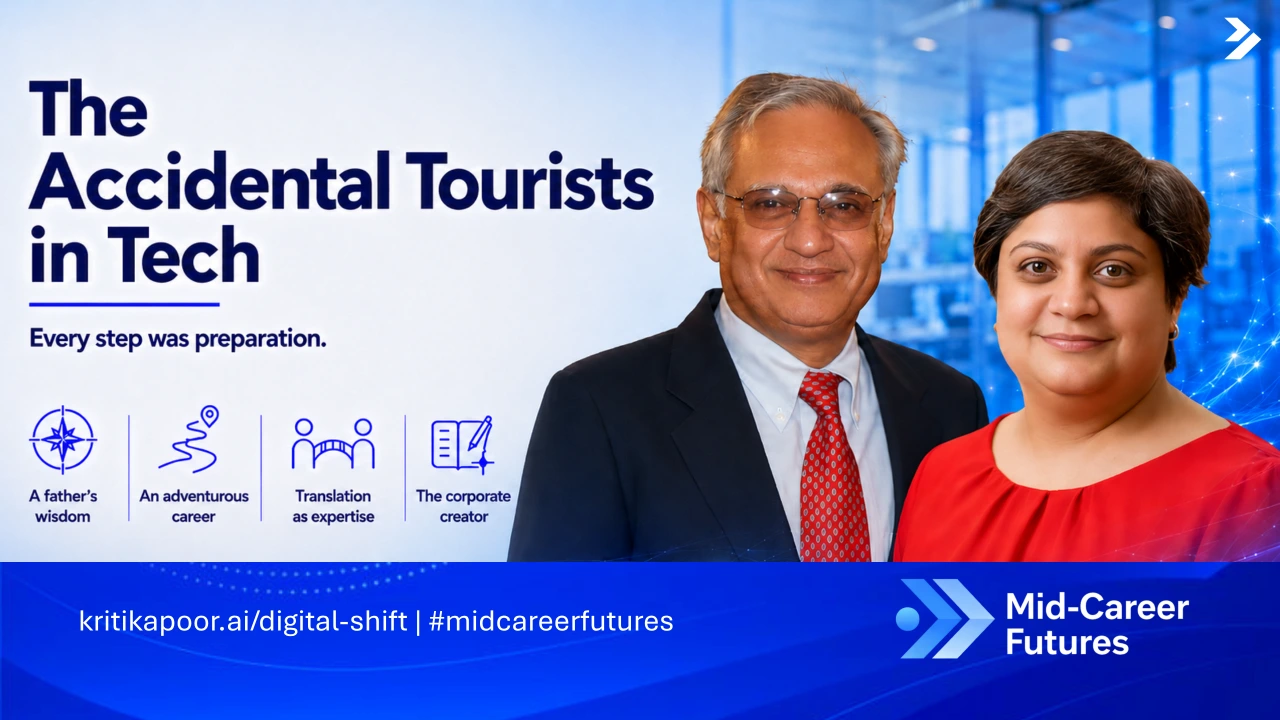
with my father, Inder Kapoor
How Unexpected Careers Prepare Us for the Future of Work
By Kriti Kapoor
I never imagined myself as a technology person.
Thirty-three years ago, choosing my degree at the National University of Singapore, I followed my father's advice: get a tech degree, add an MBA, and life will be "set."
My Dad, Inder Kapoor, joined IBM India in the early 1970s, when computers filled entire floors and cost millions. His own entry into tech had been even more accidental than mine. Someone had mentioned in passing that IBM was a great company. He spotted an ad in the newspaper and applied.
A few months later, my father was on a train at New Delhi Station, bag in hand, about to leave for a different future. Moments before departure, a family member appeared on the platform, breathless, frantically waving a letter. IBM wanted him for an interview. He had to get off the train immediately.
His bag went first, thrown through the window. Then my father followed, pulled out through that same window as the train stood ready to move. Imagine the sight!
There were no mobile phones. No instant messages. No way to track someone in real time. Just a letter that had travelled through the postal system, reached the right house, found the right person, and made it to the platform before the train left. Had it arrived even a little later, our family’s story may have been written in textiles, rather than technology.
Just over two decades later, his daughter was sitting in a lecture hall at the National University of Singapore, enrolled in Computer Science and following a pragmatic path into the future. My journey in tech began through an early-career hire programme with a global multinational company, pioneers in the industry. For a young graduate, it was the opportunity of a lifetime, and the place where the first seeds were planted to explore new horizons.
One career opportunity led to another, the work kept challenging me, the scope kept growing, and before I knew it, "enterprise business technology leader" became part of my professional identity.
Looking back now, every step was preparing me for a moment I couldn't yet see.
The Skills I Was Building Along The Way
At the time, I thought I was simply doing my job. I wasn't. I was developing a set of capabilities that would take decades to fully make sense.
My first role: pre-sales at Digital Equipment Corporation in Singapore. I sat across from enterprise customers and translated what they needed into solutions their teams could use. That was preparation. I just didn't know it yet.
At Dell, I designed marketing programs with my sales teams building strong pipelines, and created Connected Classroom solutions with students and teachers in mind, rethinking how learning could work. I was learning to design for people who weren't in the same room as me. Preparation.
At Microsoft, the team and I reimagined how millions of people got help from each other, turning a support community into a real-time expert marketplace. I was learning to build systems where humans and technology meet. Preparation.
At HP, I designed the operating model that grew 250 citizen developers into 5,000. People who had never written a line of code were building automations. Thousands of them. I was learning to unlock capability in others. Pre-GenAi. Preparation.
Over the last decade, I led communities of practice for technical support, developer ecosystems, and workforce capability. Different labels. Similar work: helping people get better at what they do.
I came for the opportunity. I stayed for the people. And all of it, every role, every pivot, every problem I solved across San Francisco to Shanghai to Sydney, London to Lima, was quietly building a skill set I wouldn't fully understand until the world changed.
The Expertise I Didn't Know How to Name
There's something isolating about spending your career in a field you find yourself in.
You're surrounded by people who genuinely love the technology itself. They light up talking about architecture, product roadmaps, APIs, compute power, bits and bytes. They have debate about programming languages, processes, platforms.
I was excited about the promise of people. And about how organisations adapt. About why most transformation initiatives fail, and why the answer is rarely "better technology."
It took me a long time to understand that this was a positioning advantage. I could speak the language of the Chief Digital Officer and the CHRO in the same meeting. I could see what the technology promised and what the workforce actually needed.
I became what I now call "bilingual": fluent in both tech strategy and human systems. In The Mid-Career Digital Shift, I call the invisible version of this "translation work." Connecting old systems with new ones. Strategy with execution. People with change.
For years, I treated that ability as instinct rather than expertise. Making complex technology meaningful to people seemed like something all leaders simply did. It took me much longer to see that translation itself was the work.
The work I'd been preparing for all along.
Then the Moment Arrived
November 30, 2022. I was leading HP's Digital Practices team, building the case for scaling citizen-led development. A role that sat where digital innovation meets workforce transformation. Most organisations are still trying to figure out how to do it.
That morning, a message from a colleague: "Have you seen ChatGPT?"
Within hours, a shift I'd spent years advocating for, one stakeholder at a time, arrived all at once. A powerful form of automation, immediately accessible to almost any knowledge worker. No coding. No specialist interface. Just plain language.
And suddenly, all those years of preparation had a context.
In 2022–2023, I created a digital business skills curriculum framework in partnership with HP LIFE and co-authored its first two courses alongside colleagues, leveraging ChatGPT’s early capabilities to accelerate the work. Those courses have since reached more than 365,000 enrollments. It was a turning point. The ability to create high-quality, research-backed learning content at scale was no longer limited to large organizations. It was rapidly becoming possible for millions of independent creators around the world.
I am no longer at HP, but I have watched with pride as the HP LIFE team has taken this work from strength to strength, building an entirely new portfolio of future-of-work skills courses that has now surpassed 1.3 million enrollments. To see an idea I helped shape continue to evolve and reach learners around the world is profoundly rewarding.
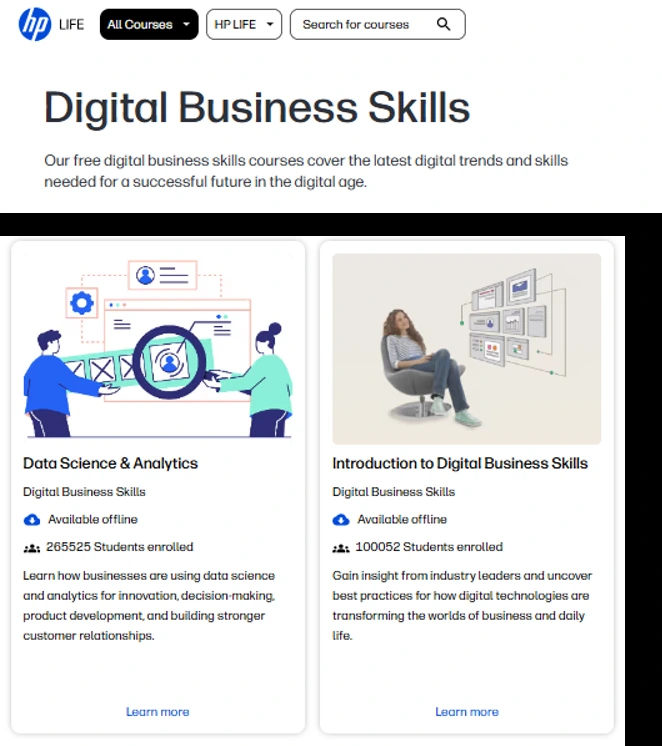
Source: HP LIFE https://www.life-global.org/categorylist/7-digital-business-skills
The real change came when I started using GenAI for my own creative pursuits.
In 2025, I committed to writing a book for mid-career professionals navigating the complexities of digital transformation and the accelerating impact of AI.
The inspiration was deeply personal. Both my father and I have spent decades adapting to successive waves of digital change, doing the best we could with the tools, knowledge, and opportunities available at the time, and learning valuable lessons along the way.
I returned to school for a six-month intensive programme in Digital Transformation and Change Management with Boston Consulting Group (BCG) helped bring those lessons into sharper focus. It validated much of the thinking I had developed during my time at HP, filled important gaps in my frameworks, and clarified the audience I most wanted to serve: mid-career business professionals seeking practical guidance, confidence, and relevance in an AI-enabled world.
Eleven months from idea to print. The Mid-Career Digital Shift is out now on Amazon.com, as a number one new release in HR and personnel development.
I tested ChatGPT, Gemini, You.com, Perplexity, and Claude against my workflow and chose Claude for 80% of development. It offered the greatest writing maturity and the customisation I needed.
GenAI became a thinking partner. It interrogated my arguments, helped me organise research, and pushed me to refine frameworks I'd been developing for years.
For example, I'd written an entire chapter on intelligent automation. Claude helped me identify a blind spot: where's the foundation? I'd skipped the evolution of intelligent automation from Excel macros to RPA to agentic AI. The gap was obvious once pointed out. I went back and filled in the missing blanks in Chapter 2.
The responsibility remained mine: verify the evidence, challenge the output, and decide what deserved to stay on the page.
Then I turned to design and photography. I'd always had a visual sense. GenAI gave me the tools to act on it.
I ideated with ChatGPT on tens of interactions for my book cover and created 30+ visuals in the book to simplify the complex with Napkin.ai. I tested concepts with my target audience, adjusted, tested again, and kept going until the direction felt right.
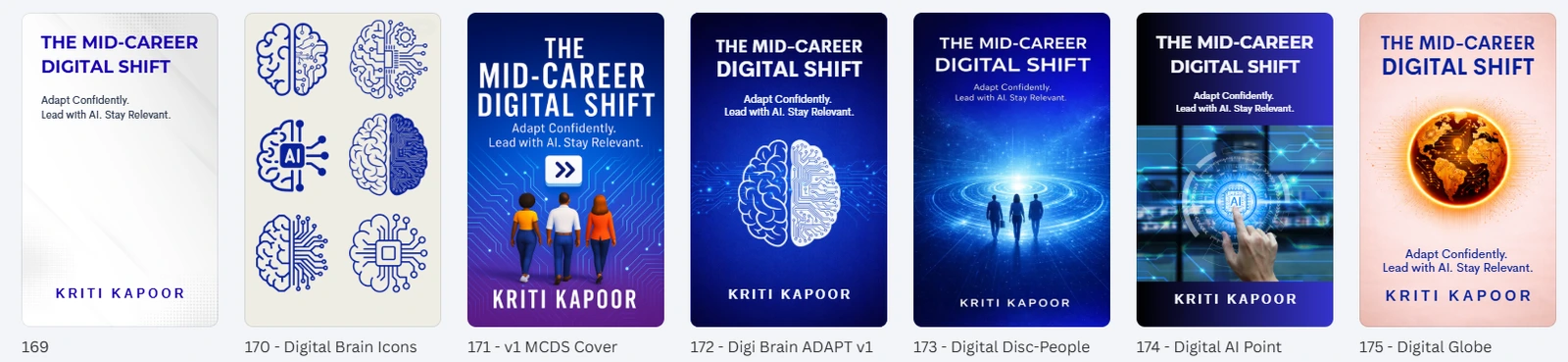
MCDS Book Cover - Behind the Scenes
What looked like learning a new tool was actually unlocking something that had been there all along. The data-driven research synthesis, reframing, pattern recognition, and translation I had used for decades inside organisations could now be applied across a much wider canvas.
Every role. Every stakeholder conversation. Every transformation program. Preparation.
What This Means If Your Career Has Been Preparing You Too
Millions of mid-career professionals fell into their industries the way I landed into mine. You ended up in supply chain, compliance, or healthcare operations. And over 15, 20, 25 years, you got very good at it.
Somewhere along the way, the things you became exceptionally good at probably stopped looking like skills. The judgment people rely on. The way you make complexity understandable. The instinct that helps a team avoid the wrong decision before anyone can explain why.
Familiarity can make expertise invisible, especially to the person carrying it. But that expertise is exactly what AI doesn't arrive with: the ability to make things work when the room is complicated and the stakes are real.
AI might be the tool that reconnects you with the things you actually love. If you're a writer who ended up in corporate strategy, AI can help you write again. If you're a designer who ended up in operations, AI can help you visualize again.
The narrative right now is that AI is a threat to experienced professionals. That story is incomplete.
Many mid-career professionals are not obsolete. They are untranslated. What they need is a way to connect their experience to the tools, language, and opportunities of this new era.
Your career may have been preparing you too. The question is: for what?
New Roles That Are Coming
I used to think my instinct for people over platforms was a weakness. I now think it's the reason I see things differently.
When you love the technology, you see what it can do. When you understand people and organisations, you see what it will take to make that capability stick.
I believe we're at the beginning of a much larger shift. I see three emerging capabilities in the AI era:
The Corporate Creator: turning experience and enterprise knowledge into original ideas, content, tools and intellectual property.
The Corporate Builder: connecting AI capability to business workflows, workforce readiness and measurable value.
The Corporate Orchestrator: bringing people, systems and strategy together to make complex transformation work, and managing a hybrid (Human + AI) workforce.
These roles will be shaped by experienced professionals who know how to navigate ambiguity, translate change into action and use AI to extend human capability.
Over the past year, I have come to see my career differently. What once felt like something accidental now feels like the preparation needed for this moment in time.
Perhaps the career you never planned has been preparing you for the contribution only you can make next.
Kriti Kapoor's career spans Digital Equipment Corporation, Dell, Microsoft, HP, and UiPath across Singapore, London, New York, and Seattle. Her programs have reached 250,000+ professionals globally. She holds an MBA from London Business School, a Computer Science degree from the National University of Singapore, and is BCG RISE certified in Digital Transformation. She is a member of the Emeritus Global Educator Network and partners with organisations to connect AI capability with workforce readiness.
"The Mid-Career Digital Shift" (2026) — Amazon #1 New Release in HR & Personnel Management (US) and Hot New Release (Singapore). A practical guide for experienced professionals navigating AI transformation with confidence.
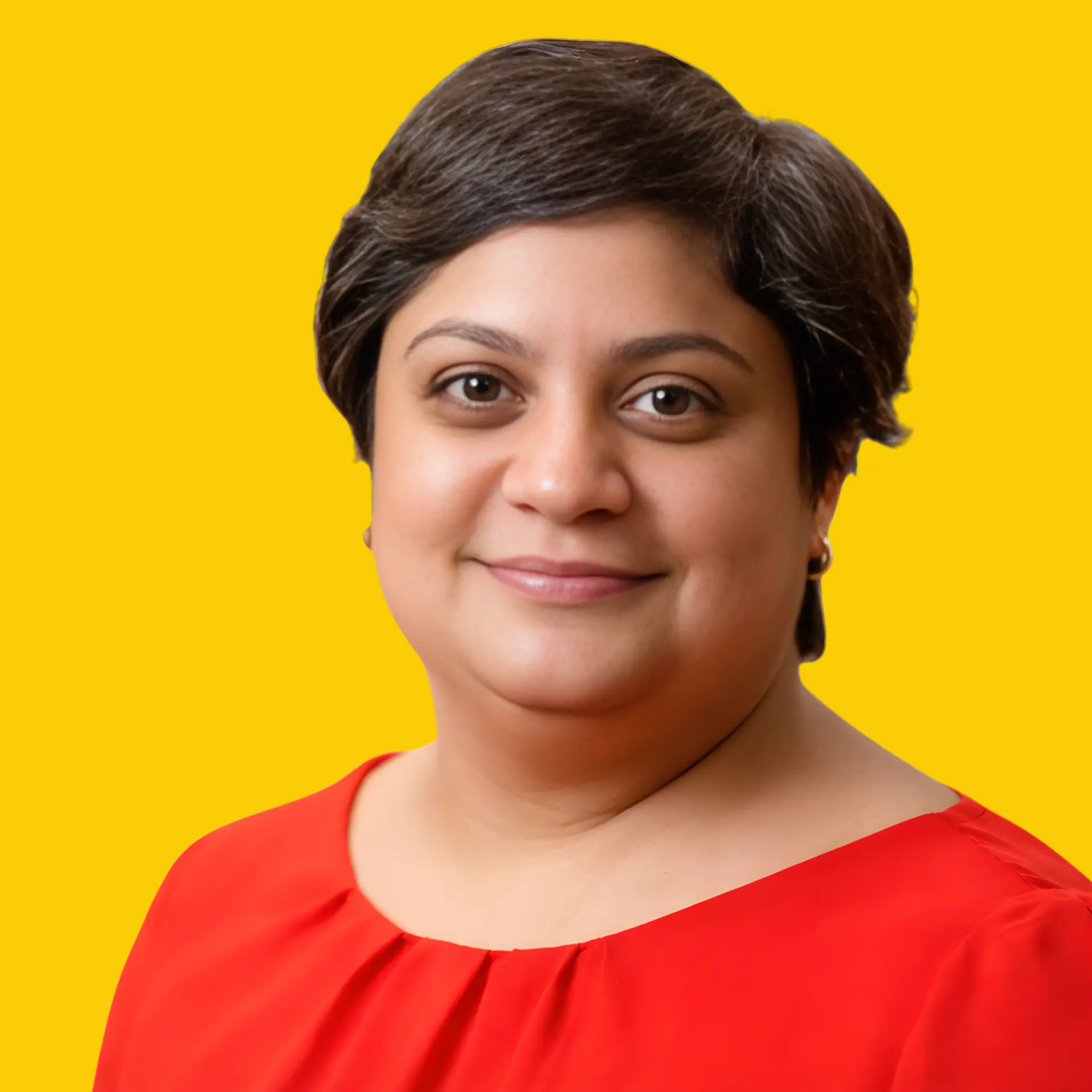
Kriti Kapoor
Digital Innovation & Workforce Transformation
Author, The Mid-Career Digital Shift