 The Mid-Career Digital Shift
Mid-Career Futures
The Rules of Work Are Changing Rapidly in the AI Era
Read original on LinkedIn
https://www.kritikapoor.ai/digital-shift
For decades, mid-career success followed a familiar pattern: build expertise, accumulate experience, manage complexity, lead teams, and translate strategy into execution.
That model is not disappearing. But it is being rewritten.
AI is changing the rules of work faster than most organisations can redesign jobs, skills, operating models, and leadership expectations. For mid-career business professionals, this creates both pressure and possibility. The professionals most at risk are not those with experience. They are those whose experience remains locked in old workflows, old assumptions, and old measures of value.
Rule 1: Your job title matters less than the problems you can solve
The old workplace rewarded role clarity. You had a function, a job description, a reporting line, and a set of deliverables.
The AI-era workplace is shifting toward problem-based work. As AI takes over more routine execution, organisations increasingly need people who can frame the right problem, ask sharper questions, connect business context, and evaluate whether the answer is useful, ethical, and commercially sound.
This shift is already visible in labour-market data. The World Economic Forum expects 39% of workers’ core skills to change by 2030, and employers cite skills gaps as the top barrier to transformation.
For mid-career professionals, this means the question is no longer only, “What role do I hold?” It is also:
What business problem can I help solve better because I know the context, the stakeholders, the risks, and the trade-offs?
That is where experience becomes a differentiator.
Rule 2: AI fluency is becoming a business skill, not a technical specialty
AI fluency does not mean every business professional needs to become a machine learning engineer.
It means understanding how AI changes the flow of work.
A finance leader needs to know how AI can support forecasting, anomaly detection, audit preparation, and scenario planning. A marketing leader needs to know how AI changes segmentation, content operations, customer insight, and campaign testing. An HR leader needs to know how AI affects workforce planning, skills intelligence, learning, internal mobility, and employee trust.
Microsoft’s 2026 Work Trend Index found that 66% of AI users say AI has helped them spend more time on high-value work, while 58% say they are producing work they could not have produced a year earlier.
That is the opportunity. But it also raises the bar.
The future does not belong to professionals who merely “use AI.” It belongs to those who can use AI to improve business outcomes, redesign workflows, and raise the quality of decisions.
Rule 3: Execution is being automated, but accountability is not
AI can draft, summarise, analyse, classify, compare, generate, and recommend. Agents are beginning to complete multi-step workflows. This changes the economics of execution.
But accountability remains human.
Someone still has to decide:
- Is this output accurate?
- Is the recommendation appropriate for our context?
- What are the risks?
- Who is affected?
- What decision should we make?
- How do we explain it to stakeholders?
This is why human skills are not becoming “soft.” They are becoming strategic.
Deloitte’s 2025 human capital research notes that as AI takes over routine tasks, employees increasingly want clarity on their unique value, including creativity, empathy, critical thinking, and problem-solving. It also found that more than 70% of managers and employees are more likely to join and stay with a company that helps them grow and succeed in an AI-shaped world.
For mid-career professionals, this is a powerful signal. The most valuable work will sit at the intersection of human judgment and AI-enabled execution.
Rule 4: Learning can no longer be separate from work
The old model treated learning as an event: attend a course, complete training, earn a certificate, return to work.
That model is too slow for the AI era.
Deloitte’s 2026 Global Human Capital Trends report argues that traditional change management and training may be too slow for the pace of change, and that AI is reshaping how workers learn, adapt, and apply new skills in the flow of work.
This matters deeply for mid-career professionals. Many have built their careers through formal learning, accumulated expertise, and on-the-job experience. Now, the winning pattern is continuous learning in real workflows.
That means learning while:
- redesigning a process
- testing a new AI-enabled workflow
- improving decision quality
- building a prompt library for a team
- creating governance around AI use
- coaching peers through adoption
- translating business needs into AI use cases
The professionals who grow fastest will be those who treat every workflow as a learning system.
Rule 5: The new career advantage is translation
Mid-career professionals often underestimate their strongest asset: translation.
They understand how the business actually works. They know where processes break. They know how decisions are made. They know which metrics matter. They know where resistance will emerge. They know which stakeholders need to be brought along.
AI does not replace that context. It increases the value of people who can connect technology to business reality.
McKinsey estimates that generative AI could unlock up to $4.4 trillion in annual productivity potential across corporate use cases, but that value depends on whether organisations can apply AI effectively inside real work.
This is where many AI initiatives struggle. The tool may be powerful, but value only appears when work changes.
Mid-career professionals can become the bridge between:
- strategy and execution
- technology and adoption
- data and decision-making
- automation and trust
- efficiency and human value
That translation role is becoming one of the most important career advantages in the AI era.
Rule 6: Career security now depends on adaptability, not tenure
Tenure used to signal reliability. Today, it is no longer enough.
The workplace is moving toward skills-based, capability-based, and outcome-based value. The World Economic Forum’s Future of Jobs research shows that job disruption will affect 22% of jobs by 2030, with 170 million roles created and 92 million displaced, resulting in a net increase of 78 million roles.
That does not mean every professional should panic. It means every professional should reorient.
The key question is not, “Will my current role exist?”
The better question is, “How is the value of my work changing, and what capabilities will make me relevant in the next version of my function?”
For mid-career professionals, adaptability is not about starting over. It is about updating the operating system of your career.
What mid-career professionals should do now
The rules are changing, but the path forward is practical.
Start with these five moves:
- Map your work by value, not activity. Identify which parts of your work are repetitive, analytical, relational, judgment-based, or strategic.
- Use AI on real workflows. Do not only experiment with generic prompts. Apply AI to meetings, research, reporting, planning, stakeholder communication, and decision support.
- Build judgment around AI output. Learn to evaluate accuracy, bias, usefulness, risk, tone, and business fit.
- Translate your experience into modern language. Reframe your expertise around outcomes, systems, transformation, adoption, and measurable business impact.
- Become a capability builder. Help your team learn, redesign workflows, and use AI responsibly. In the AI era, the people who lift collective capability become more valuable.
The bottom line
The AI era is not simply changing the tools we use. It is changing what work means, how value is created, and what business professionals are expected to contribute.
For mid-career professionals, this is a defining moment.
Your experience is not obsolete. But it must become more visible, more adaptable, and more connected to the future of work.
The professionals who thrive will not be those who know everything about AI. They will be those who can combine experience, judgment, digital fluency, and human leadership to help organisations turn AI potential into real business outcomes.
A Recommendation
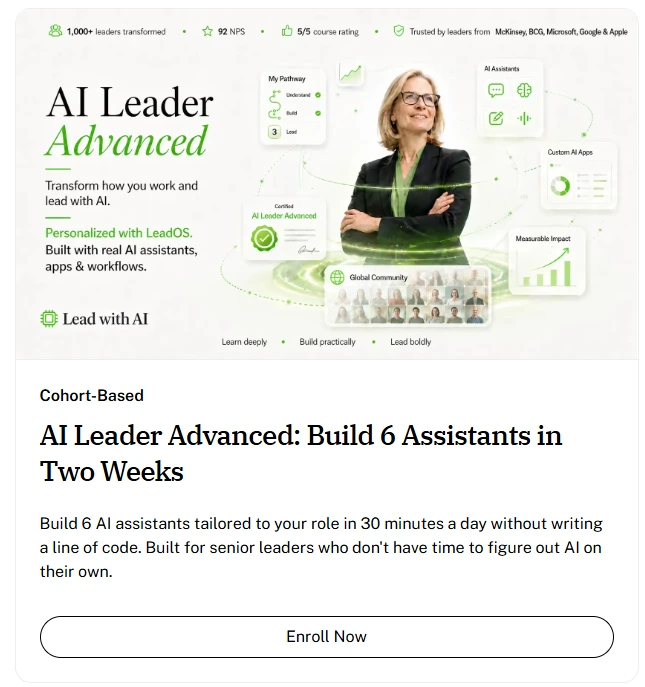
To enhance your skills, check out the Lead with AI - AI Leader Advanced program that helps busy professionals get hours back every week, achieve greater impact per hour, and future-proof their work with AI.
The team keeps the curriculum current with the most important AI platforms: Claude, Gemini, ChatGPT, and Copilot.
https://www.leadwithai.co/course/ai-leader-advanced
Over two weeks (~30 minutes a day for 10 days), you learn by doing: building real AI assistants personalized to your role, your goals, and the workflows that currently drain your time. By the end, you'll have working AI assistants that handle research, writing, analysis, meeting prep, and creative work for you.
https://www.leadwithai.co/course/ai-leader-advanced, apply discount code: aila-midcareerfutures

Kriti Kapoor
Digital Innovation & Workforce Transformation
Author, The Mid-Career Digital Shift