 The Mid-Career Digital Shift
Mid-Career Futures
The Fractional Career Path Reveals an Uncomfortable Truth
Read original on LinkedIn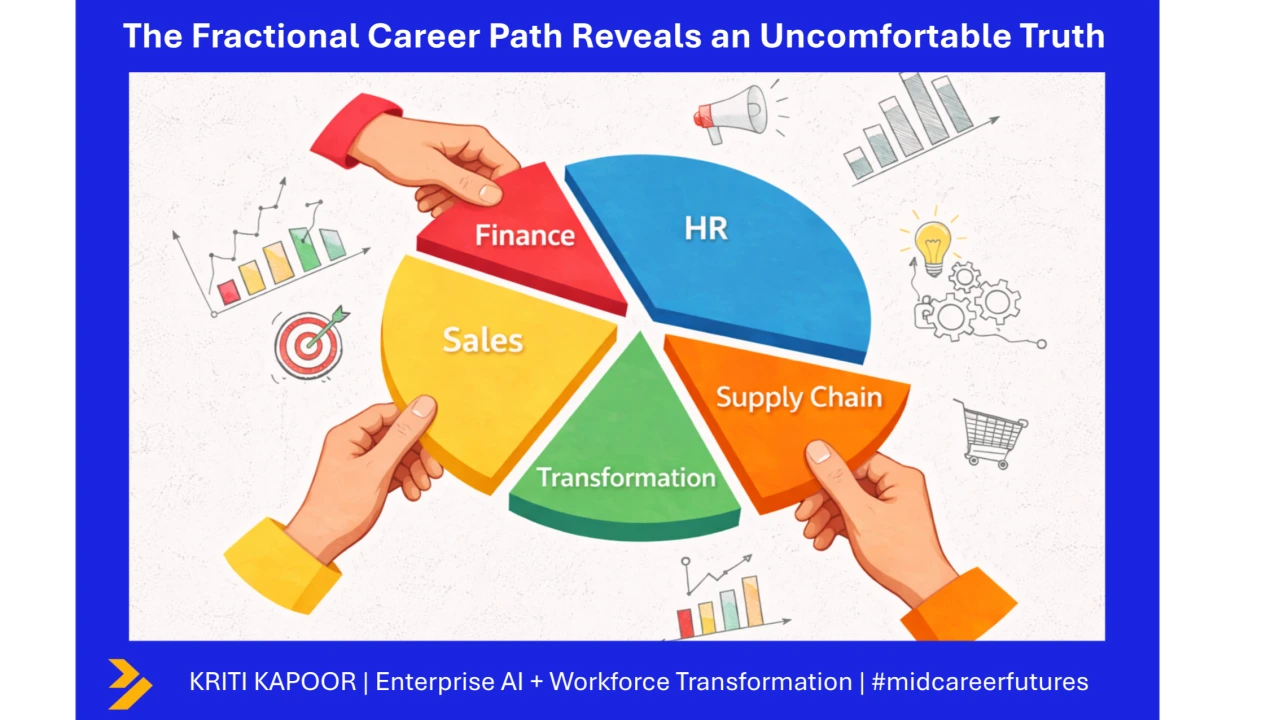
I wanted to understand what it truly takes to build a fractional executive career.
The conversation is gaining momentum, visible across LinkedIn, community ecosystems, and government-supported pilots. Optimism is on the rise. The practical realities of making it work are less often discussed.
So over the past five weeks, I stepped outside my comfort zone and immersed myself in the Portfolio Careers in Asia (PCA) Catalyst accelerator. The experience was both energising and grounding.
Representing an organisation → Representing your own value in the market.
That shift is harder than it sounds.
After decades as “VP at [company]” or “Director of [function],” your identity is institutional. Then comes the simplest question in the room: “What do you do?”.
No brand. No title. Just you. That is where the real transition begins.
It requires a level of discipline most corporate leaders have never had to build:
- Define a precise ideal client - Narrow real options into a focused, high-value segment.
- Articulate a clear value proposition - Specific, defensible, and grounded in outcomes.
- Design services and pricing with intent - Aligned to business impact, not effort or time.
- Communicate with clarity and conviction - No organisational context to carry the message.
- Build the full business infrastructure - Delivery, operations, finance, and growth.
- Run your own operating cadence - Daily, weekly, monthly rhythms without corporate scaffolding.
- Generate demand consistently - Through partnerships, positioning, and network strength.
This shift is less about reinvention. It is about learning to stand independently in the market, and operate with precision.
I listened intently to nine distinct peer pitches, each shaped by decades of real leadership experience, spanning change management, finance, marketing, digital transformation, AI governance, and general management. I watched practical feedback from a diverse panel reshape positioning in real time. I saw how quickly clarity improves when ideas are tested in community.

PCA Fractional Business Accelerator - An Incredibly Talented Cohort 2 at Pitch Day
The journey reminded me of "odyssey plans" from Designing Your Life by Bill Burnett and Dave Evans. Explore multiple possible futures simultaneously. Test them. See which ones generate energy and traction.
Three things stood out as the difference between those gaining traction and those still searching:
- Structure — Clear positioning, target client, and offer design.
- Experimentation — Testing ideas quickly in real market conditions.
- Community — Sharper thinking through feedback and alternative perspectives.
That was what I experienced inside the room. The forces pushing people into that room tell an equally important story.
The forces creating this moment
The trend toward portfolio careers and fractional consulting is accelerating faster than most workforce leaders realise.
Jobs and work are uncoupling. Companies are reorganising around outcomes. The traditional management layer is under tremendous pressure.
The recent layoff pattern confirms it. Oracle cut 20,000–30,000 in March 2026 while committing $156B to AI. Block/Square cut nearly half its workforce. Amazon, Microsoft, Meta, Salesforce: same pattern. Record revenues, record AI investment, thousands of jobs eliminated.
Singapore is not insulated from these shifts. Approximately 20,000 employment reductions were recorded across multiple sectors in 2025, with around 55% of retrenched PMETs re-employed within six months. A path to recovery exists. However transition pathways remain uneven.
The market is responding. Korn Ferry reports 6x more requests from Singapore firms for fractional leaders in 2025 versus 2024. The Ministry of Manpower contracted The Fractional Directory to deliver what is believed to be the world's first government-funded fractional staffing pilot throughout 2026. PCA has scaled rapidly over the last two years, from a founding cohort of 30 professionals to a 2,000+ strong regional community.
The momentum is real. What it takes to sustain it is where the complexity lives.
The uncomfortable truth
Supply is outrunning demand. The number of fractional professionals has grown rapidly in recent years. Demand remains uneven. Only a small proportion of founders in Asia indicate plans to hire fractional executives. The result is a two-tier market:
- A segment building strong, sustainable income
- A larger group navigating inconsistent demand
Income distribution reflects this split. A meaningful share earns above $100,000 annually, while a significant portion remains below $50,000. Satisfaction levels are mixed. The same two challenges surface repeatedly: income volatility and the ongoing effort required for client acquisition.
I saw this dynamic play out clearly inside the accelerator.
Those gaining traction had made different choices:
- Narrowed their focus with discipline
- Defined their ideal client in one sentence
- Said no to broad, unfocused opportunities
- Tested and refined their positioning repeatedly
Their clarity showed.
Experience alone does not determine success in a fractional model. Specificity does.
What Now
For mid-career professionals considering this path:
Fractional work has proven its legitimacy. Government pilots, growing employer demand, and a maturing ecosystem confirm that. The harder question is personal: can you build a practice that lands in the top tier?
The accelerator made the answer clearer. The professionals gaining traction had done three things the others hadn't. They had narrowed to a specific client. They had pressure-tested their pitch in community. And they had treated the transition as a business to build, with the same rigour they once applied inside organisations.
Structure, community, and experimentation are the accelerants. Isolated effort is the bottleneck. The path is viable. Viability is earned through specificity.
For CHROs and workforce leaders:
The professionals exploring fractional work are often your most experienced people. That exploration is a signal worth reading carefully. It means they are assessing their market value, sharpening their positioning, and building optionality.
Professionals who have credible options make more intentional choices about where they stay and how they contribute. They engage differently. They bring sharper thinking. They stay because the work is worth staying for.
To wrap up, growth of fractional work will continue. Not because it is easy. But because the structure of work itself is changing. Integrating fractional talent into your workforce architecture will be essential to closing critical capability gaps without slowing momentum.
Grateful to Moritz Kaffsack, the Portfolio Careers in Asia team, and Workforce Singapore, along with peers across both PCA cohort peers for their generosity of insight and experience..
More sources:
- Inc.com: What Is Fractional Leadership, and Why Is It Booming Now?
- https://www.fractionaljobs.io/ by Taylor Crane
- Guide to Fractional Leadership by Franchise Strategy Co.
- Why Fractional Work Will Explode in 2025—and How Executives Can Pivot Now
- GTMnow: How to Become a Fractional Professional and Land Fractional Work

Kriti Kapoor
Digital Innovation & Workforce Transformation
Author, The Mid-Career Digital Shift