 The Mid-Career Digital Shift
Mid-Career Futures
The Mid-Career Wake-Up Call: Reskilling & Upskilling for the AI Era
Read original on LinkedIn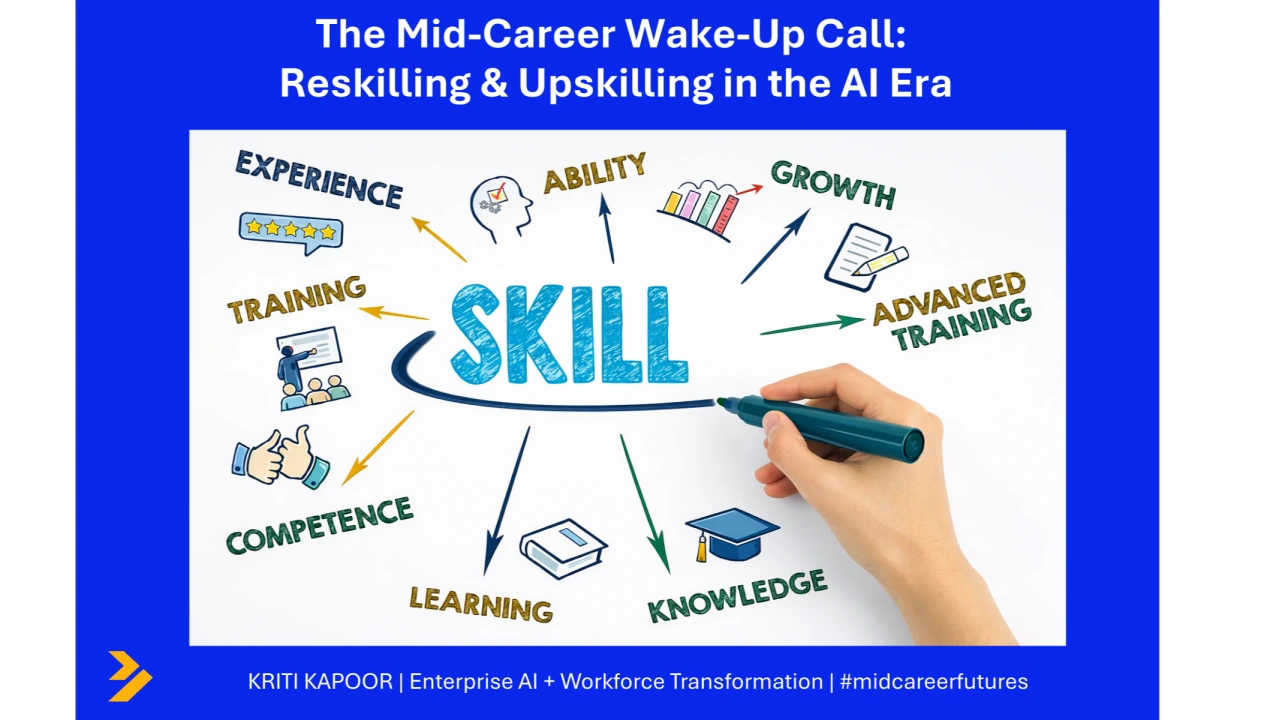
"The question is no longer whether AI will change your job. It already has. The question is — are you changing with it?"
You've spent 10, 15, maybe 20 years building your career. You've earned your expertise. And now, almost overnight, the rules of the game have changed.
Here's the hard truth nobody wants to say out loud: your experience is still your superpower — but only if you upgrade the engine.
The Numbers Guide Us Forward
The data from the world's leading institutions is unambiguous:
- 39% of workers' core skills will be transformed or become outdated by 2030 — World Economic Forum, Future of Jobs 2025
- 46% of business leaders cite skill gaps as the #1 barrier to AI adoption — McKinsey, 2025
- 61% of workers are already considering upskilling or reskilling because of AI anxiety — edX Survey
- Skills for AI-exposed jobs are changing 66% faster than for other jobs — PwC AI Jobs Barometer
- Workers with AI skills earn, on average, a 56% wage premium over peers in the same roles — PwC Global AI Jobs Barometer, 2025
The opportunity is massive. But only for those who act.
Why Mid-Career Professionals Are Best Positioned to Win
It's tempting to feel threatened. But here's what the data and the research consistently shows: mid-career professionals are uniquely positioned to win in the AI era — if they act strategically.
You have what AI can never fully replace:
- Deep domain expertise — AI needs someone who understands which outputs matter
- Institutional knowledge — years of context, relationships, pattern recognition
- Judgment under pressure — knowing when to trust the algorithm, and when to override
- Stakeholder trust — built through years of delivery, not a prompt
The AI era doesn't need you to become a machine. It needs you to lead alongside one.
The Reskill vs. Upskill Map — Know Which Path You're On
Take a few moments to self reflect: Is your role being augmented by AI, or replaced by it? That single question determines your path forward.
Upskilling
- Adding AI tools and capabilities to your existing career track.
- For most mid-career professionals — deepen and evolve your current role
Reskilling
- Pivoting to an entirely new function or field using AI as the bridge.
- For those whose industry or role is facing structural disruption
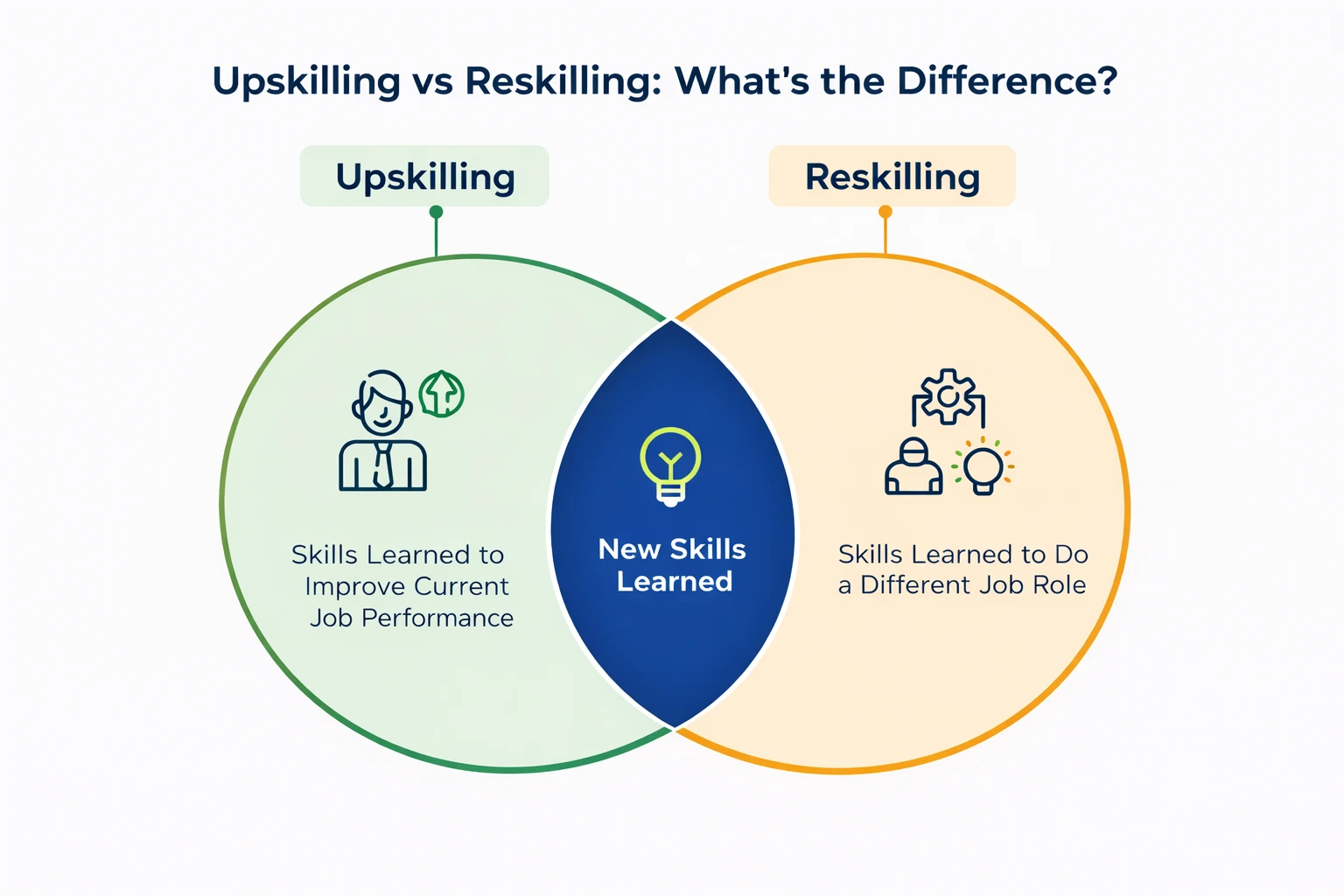
Image adapted from edstellar.com
The 5 Skills Mid-Career Professionals Must Develop NOW
Based on the latest intelligence from WEF, McKinsey, and PwC, here are the five non-negotiables:
AI Fluency (Not Coding — Collaboration)
You don't need to build models. You need to know how to prompt, evaluate, and direct AI tools in your domain. Think: AI as a brilliant junior analyst who needs expert supervision.
Data Literacy
AI runs on data. Understanding what data means, what it misses, and how to interpret it critically is now a baseline professional skill — not a "tech person" skill.
Adaptive Thinking
The IMF found that regions with high AI skills demand see employment in AI-vulnerable roles drop 3.6% over five years — but adaptive workers actually gain labor market value. Rigidity is the real career blocker.
Human-Centered Leadership
As AI automates execution, the premium on communication, empathy, negotiation, and ethical judgment skyrockets. These are your competitive moat.
Cross-Functional Problem Solving
AI can optimize within silos. It struggles at the messy boundaries between them. Your ability to connect dots across domains is your edge.
Where to Start — Real Paths, Not Hype
The good news: high-quality AI learning has never been more accessible or affordable.
- Beginner | Non-technical professionals, any industry | AI For Everyone – Coursera/DeepLearning.AI
- Intermediate | Professionals wanting role-specific AI tools | LinkedIn Learning AI Courses
- Advanced | Senior professionals seeking credential recognition | MIT / Stanford AI Professional Certificates
- Executive | Leaders embedding AI into organizational strategy | Harvard Professional AI for Business
Sharing an excellent guide on AI Fluency from the Lead with AI team -- The A-Z Guide for AI Mastery in Companies https://www.leadwithai.co/guides/ai-fluency
⏱️ The ROI is real: Teaching employees to use AI could add up to $6.6 trillion to the U.S. economy alone — HRDive, 2025
The Mindset Shift That Changes The Game
Most mid-career professionals approach AI upskilling with one of two mindsets:
❌ Threat Mindset: "I need to learn this or I'll be replaced." → Leads to anxiety, paralysis, short-term cramming
✅ Leverage Mindset: "I can use this to do 10x more with my existing expertise." → Leads to strategic learning, experimentation, compounding advantage
The BCG 2025 AI at Work report confirms it: appropriate training dramatically reduces AI anxiety and increases engagement. Fear is transformed by action.
Your 90-Day Reskilling Sprint
Don't try to learn everything. Learn the right things in the right order:
- Month 1 — Awareness → Take one AI fundamentals course (free options available) → Experiment with 3 AI tools relevant to your field → Identify where AI is already touching your role
- Month 2 — Application → Use AI to solve one real problem in your current work → Document what it got right, and what needed your expertise to fix → Join one AI-focused community in your industry
- Month 3 — Positioning → Update your LinkedIn with AI skills and projects → Have one conversation with your manager about AI strategy → Mentor a colleague — teaching accelerates mastery
The Bottom Line
The WEF projects that by 2030, 6 in 10 workers will need some form of AI-related training. The workers who thrive won't be the ones who knew the most before AI — they'll be the ones who learned fastest with it.
Your years of hard-won experience aren't a liability in the AI era. They're the raw material. AI is the multiplier.
The only question left is: when do you start?
What's one AI skill you've started learning — or are planning to?
Drop it in the comments 👇 — let's build a resource thread together.
Sources: WEF Future of Jobs 2025 | McKinsey AI at Work 2025 | PwC AI Jobs Barometer | edX Upskilling Survey | BCG AI at Work 2025 | IMF Future of Work | Edstellar.com - Reskilling vs Upskilling: Key Differences Every L&D Leader Should Know

Kriti Kapoor
Digital Innovation & Workforce Transformation
Author, The Mid-Career Digital Shift