 The Mid-Career Digital Shift
Mid-Career Futures
What Happens When the Architects of the Digital Economy Enter the Disruption?
Read original on LinkedIn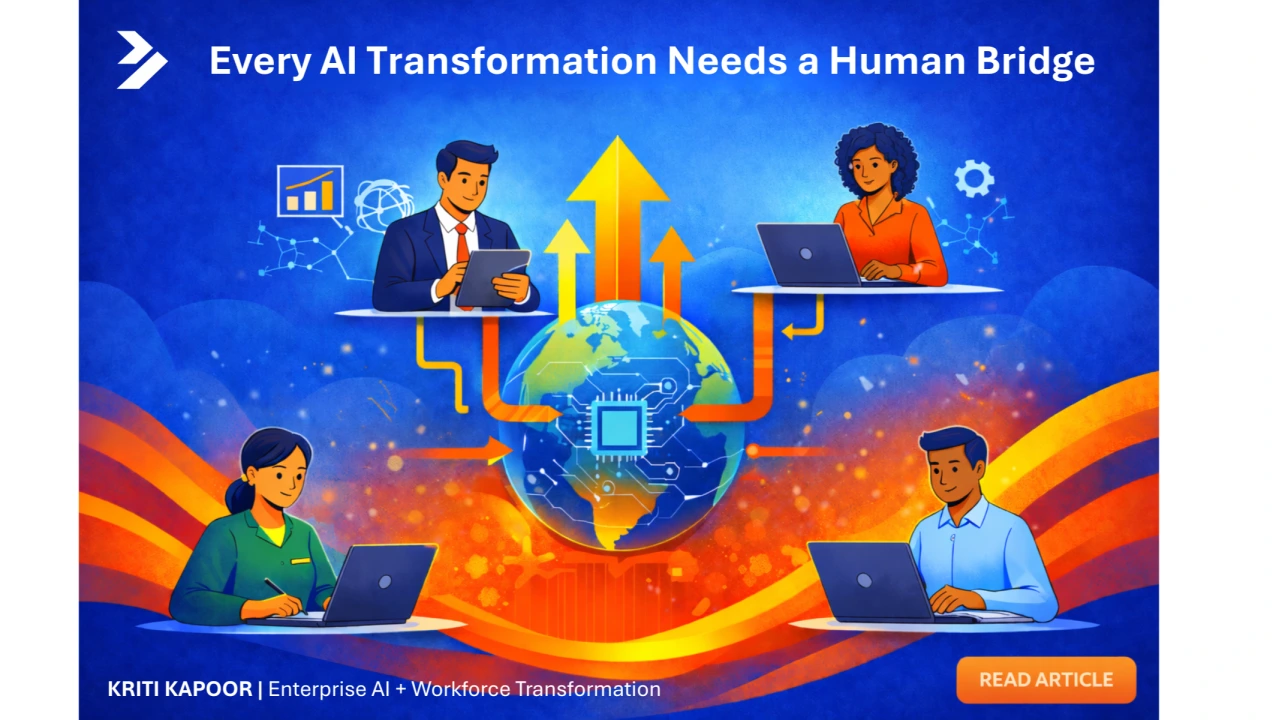
Image collaborator ChatGPT (OpenAI), March 2026.
AI is already writing roughly a third of the world's software.
I saw what that looks like this week.
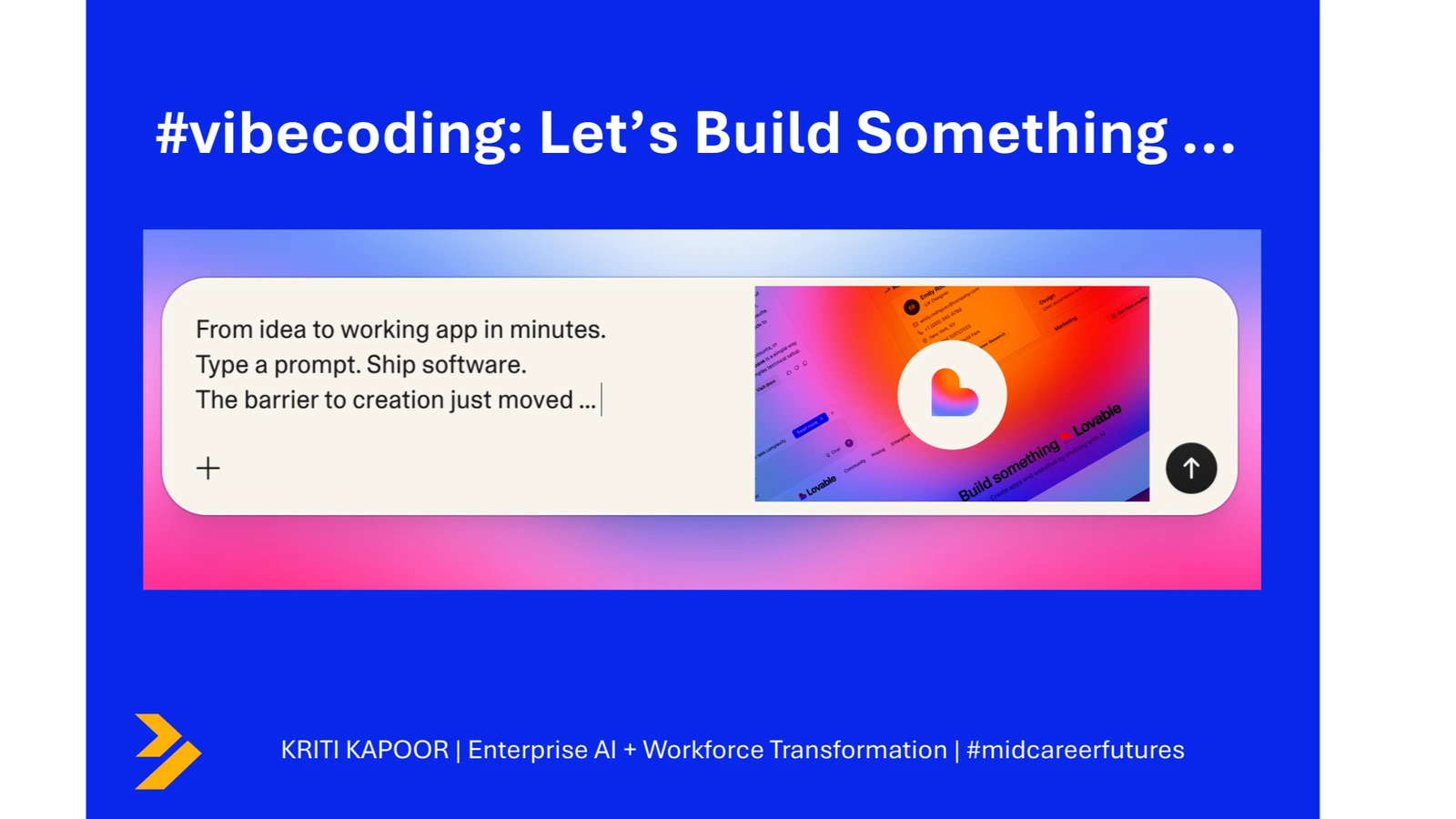
A supply chain manager walked into a vibe coding session. She opened Lovable. Typed a prompt. Built working software. No developer. No code. No waiting.
The person who used to write the requirements document just shipped the product.
When the person closest to the problem can prototype solutions directly, the bottleneck moves. It's no longer about who can code. It's about who can frame the problem clearly, and who can connect what gets built to how real organizations actually work.
I've spent nearly three decades working at the intersection of technology and business transformation, watching automation reshape factories, logistics networks, and customer service operations. What few expected was that AI would begin reshaping the very profession that built the digital economy.
The inversion worth paying attention to
Software developers built the tools that automated everyone else's work.
For two decades, the advice was simple: learn to code. It was the safe harbour. The smart career move. Now the ground beneath that advice is shifting.
- AI coding assistants generate 30–40% of code in professional environments.
- Developers using AI tools complete tasks up to 55% faster.
- McKinsey estimates 40–45% of software engineering tasks could be automated with generative AI.
As AI lowers the barrier to building software, the bottleneck shifts elsewhere.The constraint is no longer writing code. It is framing the right problem and integrating solutions into real organizational workflows.
If software engineering is vulnerable, every knowledge profession is next.
Where enterprise AI transformation breaks
Latest research shows that 95% of generative AI pilots fail to deliver measurable P&L impact (MIT / Fortune, 2025). And 74% of companies report no tangible value from AI investments (BCG, 2024).
Not because the technology fails. Because organizations cannot absorb what gets built.
BCG's 10-20-70 rule explains why:
- 10% of transformation outcomes come from algorithms,
- 20% from technology and data, and
- 70% from people and processes.
Most organizations invest heavily in the first two capabilities. The third gets underfunded every time.
The Human Bridge
As operating environments grow more complex, every successful AI transformation depends on a human bridge between invention, operational reality, and business outcomes.
The Mid-Career Digital Shift
The supply chain manager in that session revealed something important.
The Creator layer is being democratised. More people can build faster, better, cheaper than at any point in history. The real skills scarcity is shifting to the middle layers.
The biggest shift may not be the democratisation of creation. It may be the rising importance of people who can connect inventioTranslation and integration require something AI cannot generate: organizational context.
Understanding where strategy breaks during execution. How informal networks move decisions. How change lands across teams and functions.
That knowledge takes years to build. It cannot be automated. It cannot be learned in a weekend.
I refer to this as Bridge Value, and it compounds with experience. After two decades or more inside real organizations, many mid-career professionals are positioned exactly where the AI-era gap is widest.
The real career question
AI will reshape many professions. It is already transforming the one that built the digital economy.
In the age of AI, Creators imagine, Translators connect invention to reality, and Visionaries lead what comes next.
So the real question becomes:
⏩ Which part of the Human Bridge are you building?
Additional Resources: Boston Consulting Group (BCG) - AI Transformation Is a Workforce Transformation.

Kriti Kapoor
Digital Innovation & Workforce Transformation
Author, The Mid-Career Digital Shift