
Adaptive Intelligence
Why Experience Wins in the Agentic AI Economy
Read original on LinkedIn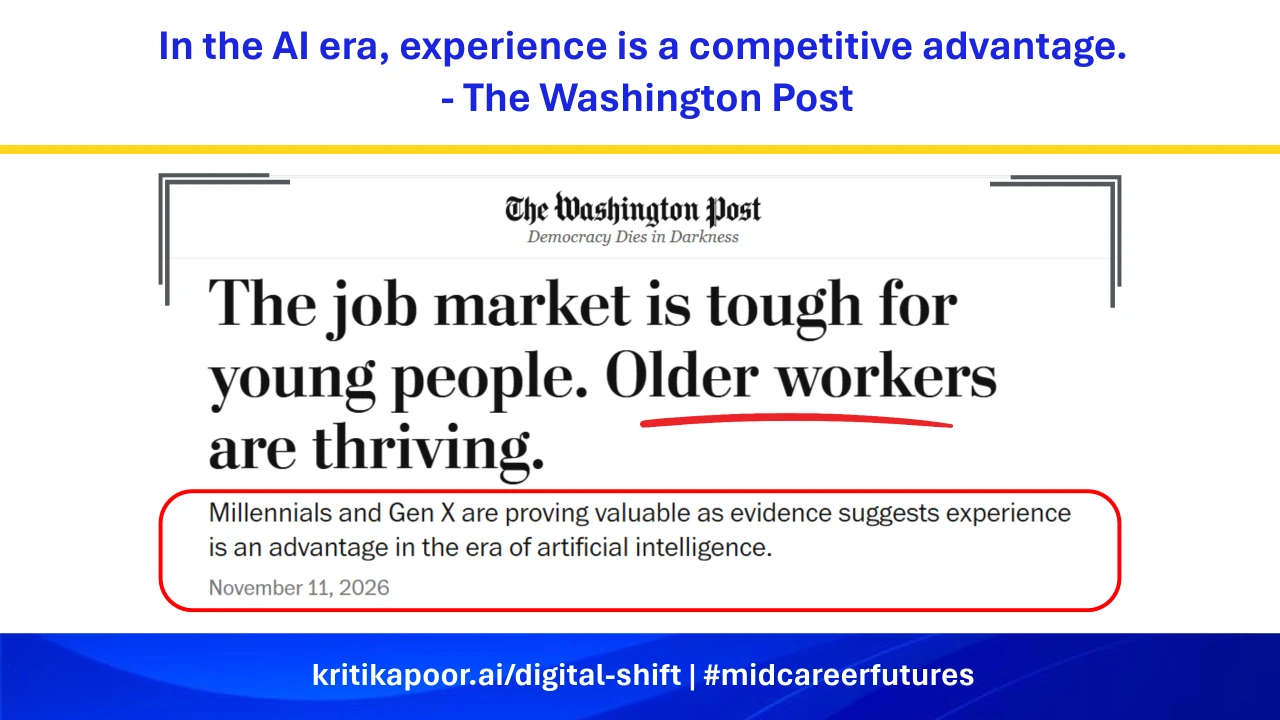
If you have spent 15 years or more building your craft, you may wonder whether AI just made it obsolete. In reality, the data points the other way.
This Washington Post headline caught my attention: "The job market is tough for young people. Older workers are thriving." And, it reinforces the central premise of The Mid-Career Digital Shift: mid-career experience is a competitive advantage in the AI economy.
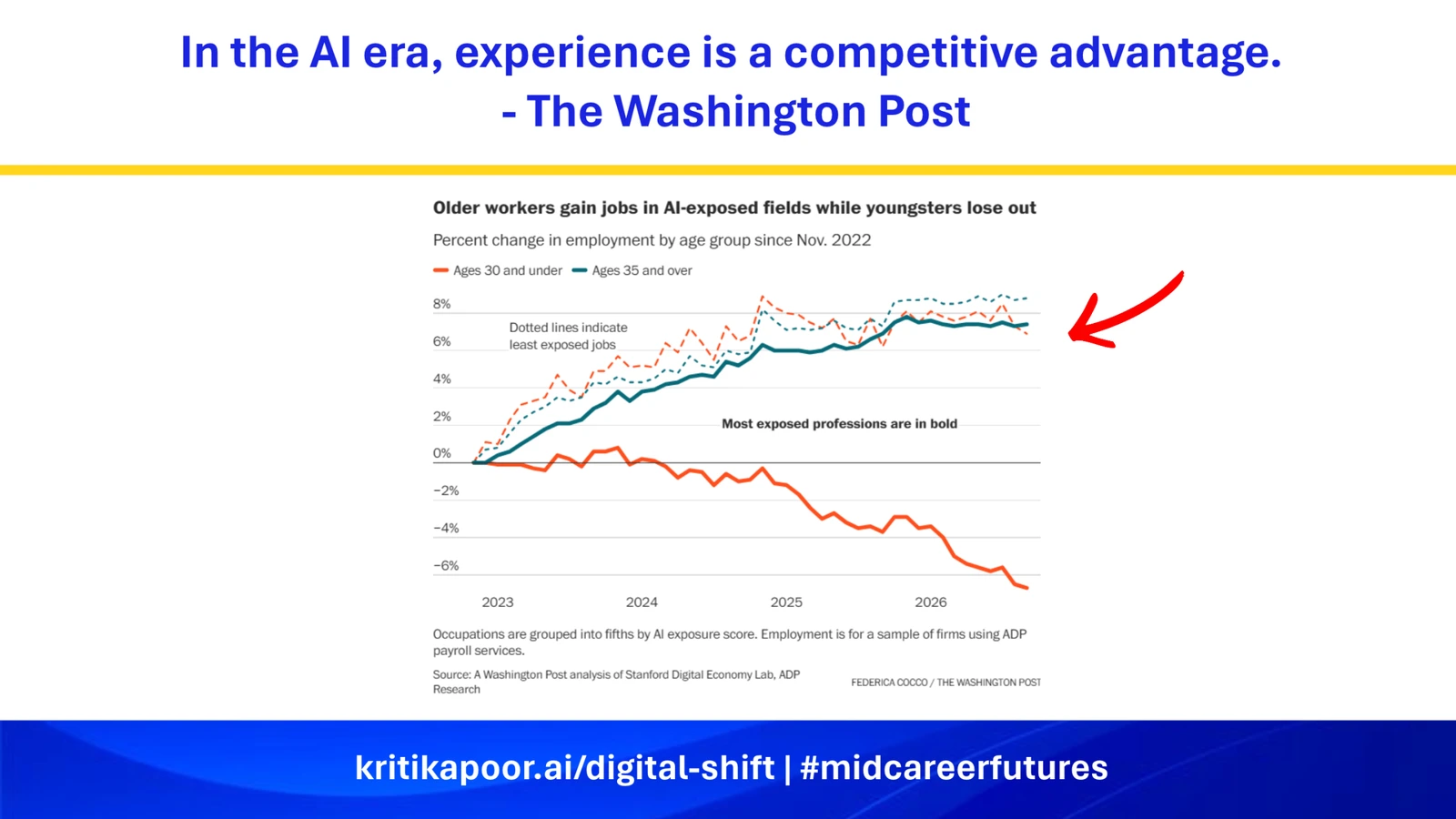
In highly AI-exposed roles such as software development, sales and accounting, employment for Americans aged 35 and older has risen more than 7% since ChatGPT debuted. For those aged 30 and under, it has fallen.
Here is what I see happening. Work is getting harder, and teams are getting smaller. Both raise the value of experience.
Work is getting harder
Every agent action needs a human owner. An agent that flags an invoice discrepancy is easy to pilot. Let it update records or route approvals, and finance, procurement and IT must agree what it can do alone and who takes over when it fails. In the book I write that accountability remains human while execution becomes shared.
Most transformations already miss their goals. Agents raise the stakes. BCG research finds roughly 70% of digital transformations fall short. 78% of companies now use agents in at least one function, yet only 17% have scaled them enterprise-wide. Gartner expects more than 40% of agentic AI projects to be cancelled by the end of 2027.
After a decade of leading global transformation programmes, I watched promising pilots stall as they crossed teams. People were asked to redesign workflows, learn unfamiliar technology and lead others through change, with little chance to build those skills. Every transformation starts with people, and that is where it stalls.
Teams are getting smaller
Fewer people means each judgment call weighs more. Joel Hron, CTO of Thomson Reuters, says smaller, more autonomous teams require more seniority and expertise. Grindr cut its staff from about 223 to 172 while revenue nearly tripled. Judgment shaped by consequences, trade-offs and lived experience is one of the advantages that resist automation.
Agents take the routine work, so the work that remains is harder. Anthropic's junior share of recent technical hires fell to about 9%, from more than 25% in early 2025. The Burning Glass Institute finds job postings in tech, business and legal now favour six or more years of experience over fewer than three. Experienced professionals orchestrate the agents that once did the work. As systems absorb routine work, the remaining work becomes more complex and consequential.
The response: adapt, strengthen, build
Agents rewrite the work every few months. McKinsey research projects that nearly 40% of core job skills will evolve significantly within five years. Waiting for a training plan means waiting while the gap widens. In most organisations, learning for digital transformation is still fragmented, so the plan is yours to build.
Here's what I've learned: the professionals who grow fastest learn faster than the systems around them. Experience plus AI beats AI alone.
Three moves build the adaptive intelligence that keeps experience valuable:
Mindset → Stay curious enough to question a process you know well. Keep sharpening judgment, collaboration and sensemaking.
Methods → Test a change on a real workflow. Agree upfront how you will measure success. Apply new practices within 30 days.
Tools → Choose technology that fits the task and lets people see and correct what the agent does. Build the fluency to frame problems, evaluate outputs and oversee agents.
Think fluency, not mastery.
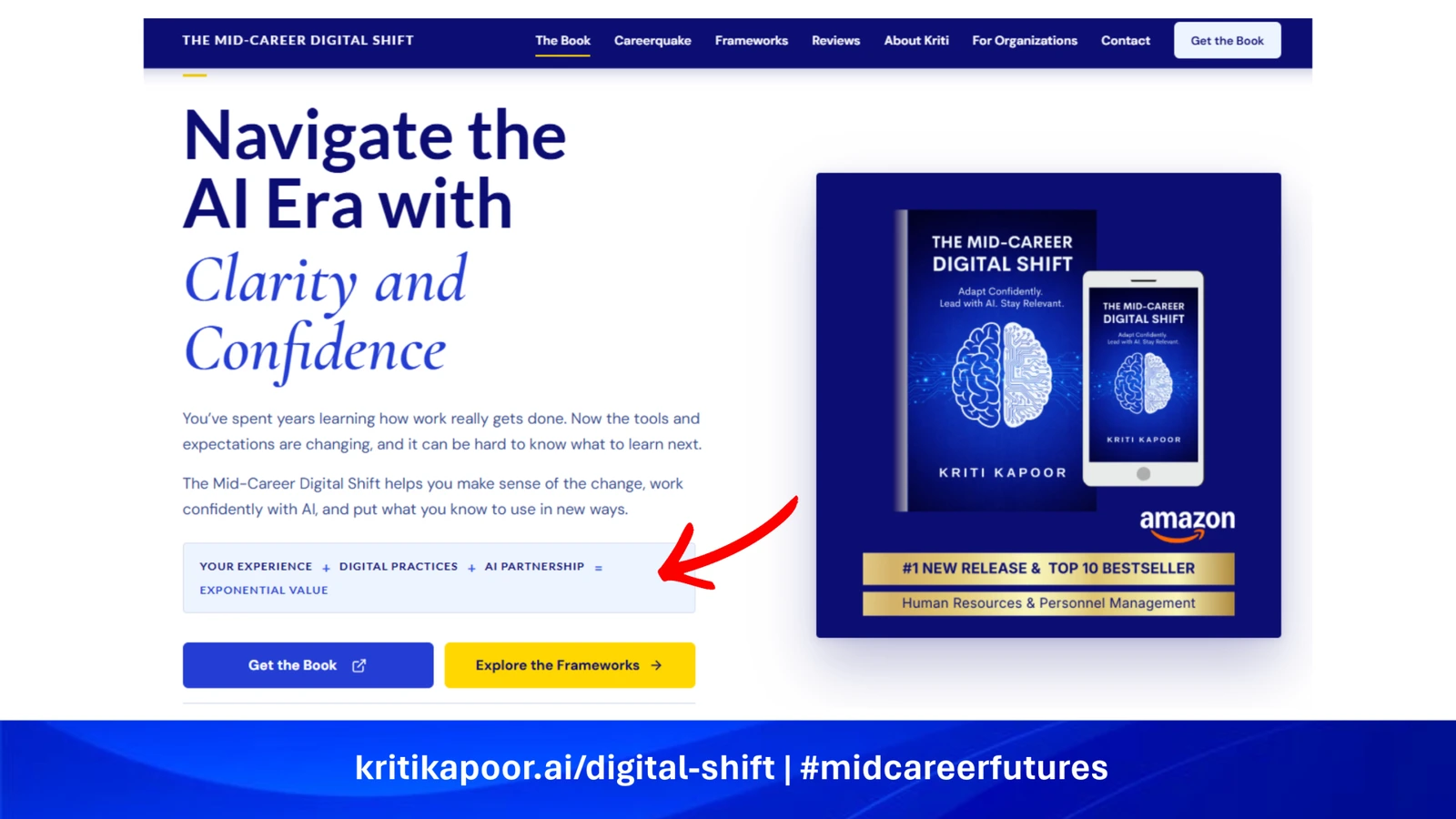
This is bridge value: connecting strategy to execution, legacy systems to new tools, and people to technology. Your Experience + Digital Practices + AI Partnership = Exponential Value.
What to do next
Leaders: Define what each agent can do alone and who owns the exception. Then pair experienced people with newer ones. Fewer entry-level roles today means fewer experienced professionals tomorrow.
Professionals: Pick one workflow you know well and one AI skill to strengthen. Run one 30-day cycle: learn it, apply it, measure it.
You are not behind. The rules changed quietly and quickly.
Until next time, keep building forward. Kriti
♾ Kriti Kapoor is the author of The Mid-Career Digital Shift (Amazon #1 New Release, HR & Personnel Management). As a strategic advisor and principal consultant, she works with business leaders and enterprises navigating AI-driven change globally.
#MidCareerFutures supports professionals building resilient careers in the AI era.
📚 For practical insights and frameworks to navigate digital disruption and the complexities of enterprise AI acceleration, get your copy of The Mid-Career Digital Shift.
Skills & Workforce Development Agency (SWDA) , RISE by BCG U , London Business School , Microsoft , Dell Technologies , HP , The LPI (Learning and Performance Institute) , Chief Learning Officer , Portfolio Careers in Asia , Lead with AI , Tigerhall Executive Council for Leading Change (ECLC)

Kriti Kapoor
Digital Innovation & Workforce Transformation
Author, The Mid-Career Digital Shift