
Adaptive Intelligence
AI and the Future of Public & Government Affairs
Read original on LinkedIn
This week’s Influence Builders roundtable was a valuable opportunity to exchange perspectives with corporate, public and government affairs professionals on how AI is being used in Singapore and across Asia. What I appreciated most was that the conversation went well beyond tools. We talked about legislative tracking, consultation processes, governance, agentic workflows, transparency, organizational culture and what all of this could mean for the role of the public and government affairs professional.
Very quickly, the discussion moved from productivity to a bigger question: how does AI change the work itself? That stayed with me because it shifts the conversation from isolated use cases to how the function itself may need to evolve. It is relatively easy to talk about drafting faster, summarizing more efficiently or automating routine tasks. It is much harder, and ultimately more useful, to ask what becomes possible when teams have access to more information, more analytical capacity and different ways of working.
1. Start with the Work, Not the Technology
Much of current AI use still looks like familiar work done faster: drafting, summarizing, translating, preparing meeting notes or creating first versions of content. That can be useful, but it does not automatically make the process itself any better. One leader described AI being used “like a plaster on top of a bleeding wound.” Both point to the same issue. If the underlying process is unclear, fragmented or poorly designed, adding AI may simply help us move through a weak process more quickly.
A better starting point is to ask where the real constraint sits. Is it time, information, skills, coordination, access or something else? In public and government affairs, that might mean tracking more legislative activity across multiple jurisdictions, connecting developments that would otherwise sit in separate silos, identifying emerging issues earlier or freeing up more time for stakeholder engagement and relationship building. The opportunity is to improve the work itself rather than simply place AI on top of what already exists.
2. Move from Efficiency to Capacity and Capability
A lot of the AI conversation still starts with efficiency: how much faster can we do this, how much time can we save, how much can we automate? Those questions matter, particularly in teams that are already stretched, but they only describe part of the opportunity.
As one participant put it, “It’s not just about efficiencies, but it’s giving professionals information that they’ve never had before.” One example discussed showed AI helping increase participation in a reimbursement process from roughly 10 submissions to 150. What mattered in that example was not simply faster drafting. It was the ability to bring many more people into a process that previously required too much time and effort.
For me, this is where AI becomes much more interesting. It can increase capacity, because teams can handle a larger volume of work, but it can also increase capability, because work that was previously too slow, too expensive or too difficult becomes possible. That distinction matters. If we only measure AI by time saved, we may miss some of the more significant changes it can enable.
3. Human Judgment Still Matters Deeply
Public and government affairs is deeply contextual. Legislative texts, regulatory updates, stakeholder positions, public statements and media coverage all matter, but they only tell part of the story. One comment from the discussion stayed with me: “The real work is happening way above anything that can be monitored online.”
That feels particularly true in this field. AI can help with monitoring, first drafts, translation, profiling, synthesis and pattern recognition, but it cannot automatically understand the history behind a relationship, the mood in the room, the importance of timing or the meaning of an informal conversation. It does not necessarily know which signal matters and which one is noise, or why two similar situations may require very different responses.
There is still a deeply human layer to this work. Trust, judgment, relationships, institutional memory and an understanding of context continue to matter, and in many cases they become more important as the volume of information increases. The more AI can surface, the more important it may become to know what deserves attention.
4. Information Quality Matters More Than Ever
Another simple line from the discussion was: “The quality of your output is only as good as your input.” That sounds obvious, but it becomes much more important once AI starts sitting inside real workflows and influencing decisions at scale.
The input is not just the prompt. It is the quality of the sources, internal knowledge, data access, institutional memory, instructions, business rules and the way information is structured and maintained. As teams experiment with agents and more automated workflows, these foundations start to matter much more because weak information can travel further and faster than before.
This raises some fairly practical questions for organizations. What information can AI access? Which sources should it trust? How current is the underlying knowledge? Who is responsible for keeping it accurate? If the information is weak or poorly governed, moving faster does not solve the underlying problem. In some cases, it simply amplifies it.
5. Accountability Still Has to Sit Somewhere
As AI becomes more autonomous, governance questions become much more practical. One of the clearest comments from the discussion was: “Someone, a human, has to be accountable.” That principle sounds straightforward, but applying it can become complicated very quickly.
Who reviews the output? Which decisions still require human judgment? Where can an agent act independently? Who owns the outcome when something goes wrong? At what point does oversight become too light, and at what point does it become so heavy that the technology adds very little value?
The discussion also surfaced issues around data sovereignty, organizational policy, shadow AI, privacy and control. For many organizations, these questions are still being worked through while the technology itself continues to move. That creates a tension between experimentation and governance. Teams need enough freedom to learn, while organizations also need clear boundaries around risk, accountability and the use of sensitive information.
6. AI Can Lower Barriers
One of the more encouraging themes was AI’s potential to act as an equalizer, particularly where access to resources has traditionally shaped what smaller teams can do.
I shared my own experience of working on my book, a long-form writing project completed in eight months rather than the more typical multi-year process, and vibe coding my portfolio website for a fraction of the cost of a traditional external quote, with much greater flexibility. Neither experience removed the need for judgment, editing or iteration. What changed was the amount I could do independently and the speed at which I could move from idea to something tangible.
For smaller country or regional public affairs teams, that matters. Research, analysis, content creation and specialist support can become more accessible. A small team may be able to monitor more issues, prepare more thoroughly, create higher-quality materials or explore questions that would previously have required additional budget or external support. The opportunity is to use that leverage on work that matters, rather than simply produce more because we can.
7. Adoption and Change Management Are Still the Hard Part
Perhaps the clearest conclusion from the session came in one sentence: “The hardest part is the adoption and the change management.”
That felt very familiar. The technology may be moving quickly, but organizations do not change at the same pace. People are learning at different speeds. Some are experimenting daily, while others are still unsure where to begin. Policies often lag behavior. Leaders are making decisions about tools they may only partially understand, while the capabilities of those tools can change significantly within months.
This is why the practical suggestions from the roundtable resonated. Make AI part of regular team conversations. Give people permission to experiment within clear boundaries. Connect tools to trusted internal information where appropriate. Review public-facing work carefully. Measure impact rather than activity. Revisit use cases as the models improve. None of these ideas is particularly dramatic, but together they create the conditions for adoption to become part of how the organization works rather than a separate technology initiative.
Closing
My biggest reflection from the roundtable is that AI in public and government affairs is becoming less about the tools and more about how the function itself evolves. The technology can increase capacity and capability, lower barriers and give teams access to information and analytical support that were previously harder to reach. At the same time, the work still depends heavily on trust, judgment, relationships, context and accountability.
What struck me is how closely this mirrors the challenge I explore in The Mid-Career Digital Shift. When the way work gets done changes, people and organizations have to change with it. That means developing new capabilities, reconsidering established processes and deciding more deliberately where human judgment adds the most value.
A key question to leave you with in summary, is to shift the conversation from “What can AI do?” towards “What can we now do that we could not do before, and what needs to change as a result?”
Thank you Andras Baneth, The GR Company and the Influence Builders community for bringing together a diverse group of corporate, public and government affairs professionals for an open dialogue and thoughtful conversation. Till next time!
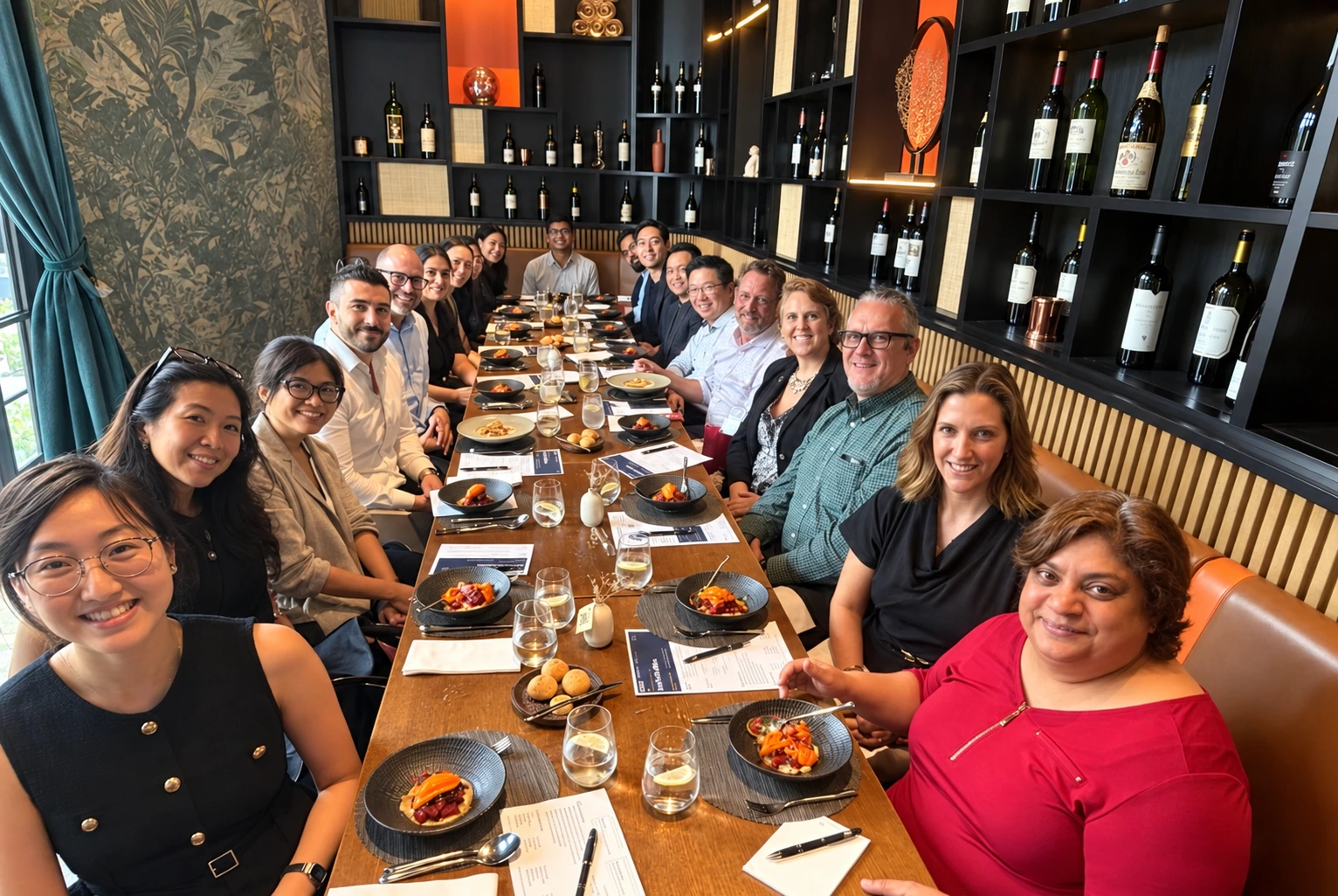
Thank you for an engaging conversation and the contributions Surbhi Jain Winnie Tan (陈炜霓) Ada Wong @Juhairul Marzuk Roy Tan Meg Chang Jason Descamps Amara Buyse Jared Ragland Kate Wang Michelle Zhang Steffan Lian Dianne Baunbaek.

Kriti Kapoor
Digital Innovation & Workforce Transformation
Author, The Mid-Career Digital Shift